
ESTJ (Responsible type)のdecision making methodI will explain this.
Have you ever felt frustrated with the decision-making methods of your colleagues or friends? Were they illogical or disorganized? If not addressed early, these problems can snowball and cause widespread disruption in the workplace. Decision-making methods vary greatly depending on the individual and their personality. There is no right or wrong way to make decisions. However, there is a decision-making method that is right for you and that works best for you.
However, when people with different decision-making styles work together, tension can rise. Understanding each other is key to maintaining communication and ensuring the success of the project.MBTITaking the time to understand your own personality type can help improve and streamline decision-making for you and your team, and build a deeper mutual understanding in the process.


Decision-making methods of ESTJ (Responsible Type)
ESTJ types are quick decision-makers. They are also intuitive and pragmatic, first defining the criteria for their intervention and gathering all the human and capital resources that may be relevant to the decision-making process. While this way of thinking can sometimes be overly quantitative (i.e., quantifiable), they tend to prioritize making an impact in the real world. However, as they grow into leaders and decision-makers, they should make an effort to carefully consider options that may have an impact that cannot be quantified.
When evaluating options and ultimately deciding on a specific course of action, ESTJs tend to be systematic, often creating lists or models.There is a tendency to gravitate towards practical and realistic options that are reasonable and can be implemented within a reasonable timeframe.(=Extraverted Thinking: TeThey may take their time to logically examine each option and create a simple "pros and cons" chart. ESTJs tend to narrow down the options to two or three and then compare and consider each one further.
Once the optimal course of action is decided, they will work on it with enthusiasm and all their might. However, from the perspective of this type of person, "optimal" often means "pragmatism," and once they find a logical result,Consider more creative action plans.(=Extroverted Intuition: NeThey rarely do this. Therefore, ESTJs tend to benefit from the innovations of others, especially if those innovations can translate unconventional approaches into significant real-world impacts.
ESTJs can overcome any obstacle and get things done. They also keep their promises and apply their high standards to their peers and colleagues. This is a strength in some ways, but at the same time,Taking into account individual needs and personalities(=Introverted Feeling: Fi) We sometimes neglect this and expect everyone to approach things in the same way.Productive(=Extraverted Thinking: Te) and yet,Taking into account the individuality, strengths, and values of different people(=Introverted Feeling: FiIf they offer different methods or approaches, we can accept them.
When ESTJs reflect on decisions they've made, they tend to analyze their actions, retrace their steps, and consider how the process could have been improved. However, this reflection often becomes process- and data-driven, neglecting human influences and issues that may have been beyond their control. For ESTJs to continue growing, they need to accept the reality that there are challenges they cannot overcome because of these issues. They also need to make an effort to understand that decision-making must be not only rational but also compassionate. By taking these simple steps, they can become better decision-makers.
reference Suitable occupations (ideal jobs/vocations) for ESTJs and tips for succeeding at work
・Suitable occupations for ESTJs
・How ESTJs set goals and gather information.
Other types of "decision-making methods"If you would like to read more about this,Click here ↓
16 Types of Decision-Making Methods
youESTJ (Executive/Responsible Type)Then
Share it on social media (tweet it) and let your followers know!
↓↓↓Share on social media (tweet)↓↓↓
↑↑↑Share on social media (tweet)↑↑↑
Further characteristics of ESTJ (the responsible type) and compatibility with other types
- What is ESTJ? – Main Page –
- "Taking on one challenge after another" - ESTJ ~ How do gender differences affect the lives of ESTJs? ~
- A Personality Guide for ESTJs
- ESTJ's hobbies
- Things that ESTJs dislike
- Strengths and weaknesses of ESTJs
- Suitable occupations for ESTJs
- ESTJ leadership
- Compatibility between ESTJ and other types
- ESTJ and relationships
- ESTJ and romance
- How ESTJs set goals and gather information.
- ESTJ parent-child relationships
- For ESTJs to succeed
↓Learn more↓
Compatibility chart and advice for ESTJ (the leader type) and other personality types.
Ideal compatibility type pair
ESTJs are compatible with people who value practical application in external settings, the knowledge of predecessors, and information that is actually useful.
From an ESTJ's perspective...
- ESTP (Adventurer type):Se – Ti, put knowledge into practice and quickly implement what can be done in reality.
- ISTJ (Hardworking Type):Si – Te, maintain and preserve order
- ESFJ (Sociable Type):Fe – SiTo show respect and reverence to society
Type pairs that are prone to conflict
ESTJs tend to clash with idea-driven individuals who don't share a realistic worldview and don't place much value on tradition.
From an ESTJ's perspective...
- INFP (Psychologist type):Fi – NeThey pursue ideals, value personal values, and crave alone time.
- INTP (Researcher Type):Ti – NeHe has a unique personality, is always thinking about something, and is difficult to deal with.
Romantic compatibility type pair
ESTJs are compatible with people who are open and willing to discuss their thoughts intimately, without regard for personal gain.
From an ESTJ's perspective...
- ESFJ (Sociable Type):Fe – SiRespecting society and being able to discuss ideas
- ISFJ (Parental Type):Si – Fe, respecting the organization and traditions
- ISTJ (Hardworking Type):Si – TeThey value the organization and possess practical insight.
- INFP (Psychologist type):Fi – NeYou can enjoy your hobbies intimately and relieve stress.
*The pairs that tend to clash and the pairs that have good romantic compatibility may overlap. This is because while people may dislike those who are the complete opposite of themselves due to disagreements, they may also be attracted to those who appear mysterious because they are different. However, it seems that these relationships often end up breaking down.
(Advice for those dating an ESTJ)
reference ESTJ and romance
ESTJs are trustworthy and keep their promises seriously. While they can be inflexible, once they build a relationship, they will likely maintain it for life. However, they often avoid touching on emotions and feelings, prioritize their own opinions, and don't listen to others', which can be difficult for their partners. Remember that while they may not always express their feelings in words, they often communicate through actions.
For example, ESTJs put a great deal of effort into fulfilling their obligations to loved ones. Social events are also important to them, and ESTJs remember important events such as birthdays and anniversaries.
ESTJ (Responsible Type) Roadmap (Click to open)
Reading the following roadmap from top to bottom will help you understand the ESTJ mindset in a logical order ↓
- Roadmap – ESTJ (Executive/Responsible Type) –
- Introduction – What is MBTI?
- Summary of my personality
- “The meaning of the four letters "ESTJ"
- What are the personality traits of the four pairs?
- First character:Introvert (type I) or extrovert (type E)
- Second character:Intuitive type (N type) or Sensing type (S type)
- Third character:Feeling type (F type) or thinking type (T type)
- 4th character:Perceiving type (P type) or Judging type (J type)
- The quirks (tendencies) and conflicts of the four pairs of personality traits
- Cognitive mechanisms
- What are the personality traits of the four pairs?
- About psychological functions (cognitive functions)
- What are psychological functions (cognitive functions)?
- The eight psychological functions (cognitive functions)
- Decision-making (judgment) function
- Information gathering (perceptual) function
- Understanding your own psychological functions (cognitive functions)
- The developmental process of psychological functions (cognitive functions)
- Psychological functions (cognitive functions) of ESTJs
- First function:Extraverted Thinking (Te)
- Second function:Introverted Sensing (Si)
- Third function:Extroverted Intuition (Ne)
- Fourth function:Introverted Feeling (Fi)
- Making good use of psychological functions (cognitive functions)
- Strengths and weaknesses of ESTJs
- Make the most of your strengths
- Reasons for focusing too much on the advantages
- How to improve your weaknesses
- If you are alone
- In a team setting: Have others compensate for your weaknesses (fourth function).
To truly understand the ESTJ (Responsible Type),Psychological functions (cognitive functions)This is important ↓
- Extraverted Thinking/Te
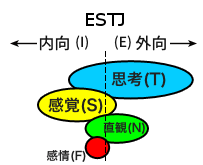
Very good at it /First functionThey are skilled at objectively grasping specific facts using inductive reasoning (practical observation that leads to immediate conclusions). - Introverted Sensing/Si
I'm a little good at it /second function: To bear the responsibility and obligations to society, discipline, loyalty, and honor. - Extroverted Intuition/Ne
I'm not very good at it.Third functionThey aim for their actions and procedures to be effective in the future, but they can become neurotic if things don't go their way. - Introverted Feeling/Fi
I'm really bad at it /Fourth functionI feel anxious or afraid that I am not moral. I don't know how to confront (or don't want to confront) my own moral values.
<The cognitive axis of ESTJ>
List of articles related to ESTJ (Responsible Type)
↑Learn more↑

comment