
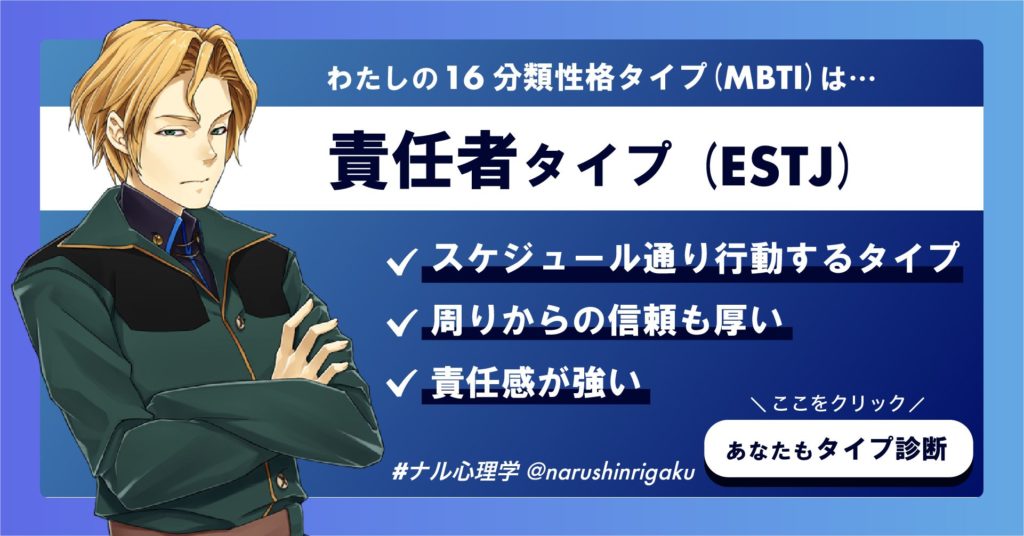
On this page, you can choose from 16 types.ESTJ (Responsible type)personalityI will explain this.
youESTJ (Executive/Responsible Type)Then
Share it on social media (tweet it) and let your followers know!
↓↓↓Share on social media (tweet)↓↓↓
↑↑↑Share on social media (tweet)↑↑↑
Classifying personalities into 16 types16-Type Personality TestCheck which type you are using the following↓↓

↑16-Type Personality Test↑
↑Diagnose↑


ESTJ (Responsible Type) Personality
The following is a quote (with some modifications) from "Let's Look at the World from the Perspective of MBTI Personality Type Theory" (website no longer exists).
They are pragmatic, drawing on proven methods, reliable data, or knowledge gained from personal experience to objectively reason and systematically plan and execute tasks.
I will state my opinions and judgments clearly and without hesitation.
I think and judge rationally, without being swayed by subjectivity, self-indulgence, or wishful thinking, by looking at cause and effect relationships and numerical data. I have a good memory and know what needs to be done on a daily basis. I make solid plans and dedicate myself to executing them meticulously.
Standard strategies, formulas, principles, and common sense can be meticulously memorized once encountered, and retrieved as needed. Furthermore, even while dealing with many different situations, quick judgment and efficient responses become possible.
We emphasize adhering to objective standards that everyone can agree on. We listen carefully to and respect the opinions of parents, teachers, mentors, and experts.
From a young age, children take their responsibilities seriously and complete their homework and household chores. First and foremost, they learn to think for themselves about what they need to do, deal with it, and take responsibility for the results.
They don't handle everything cleverly from the start, but they learn a lot from their failures and successes, and eventually they become attentive to even the smallest details. They diligently complete the small, repetitive tasks that are done on a daily basis.
That being said, I don't try to do everything myself. When possible, I rely on the wisdom and labor of others. Seeking opinions and judgments from trustworthy people is often more helpful than trying to figure things out on my own.
You will be able to skillfully perform tasks in games, sports, and academics by memorizing established strategies and, when necessary, adapting and applying them flexibly.
I make an effort to keep my tools and documents organized and easy to find. This way, I can retrieve what I need without any difficulty. It's satisfying to see things neat and tidy. This habit remains strong even into adulthood, but as I get older, perhaps because my workload increases, I may start to think that a little messiness is unavoidable.
They are perceptive of societal values and common sense, and they quickly adapt to the unwritten rules of the community or organization they belong to. They strive to fulfill their roles and responsibilities within society, organizations, and groups. They perceive being preoccupied with their own interests and questions without taking any action as lazy and self-centered.
However, they rarely think deeply about or skeptically examine the significance of values, common sense, and rules imposed from the outside. Rather, they fear deviating from the established path, and prioritize maintaining appearances and reputation, thus prioritizing riding the wave of success.
However, even if an unforeseen event were to disrupt their sense of security and lead to hardship, they would likely believe that complaining is useless and instead bravely pursue new possibilities.
I appreciate and enjoy the idea that the order of events should be determined by fair rules. In competitions, as long as the rules are clear and fairness is maintained, I can accept the winner and loser fairly. Conversely, I will make strict judgments against rule violations. In organizations and groups, I expect everyone to follow the rules.
They prefer achieving goals through a top-down command structure and collective discipline. They respect and obey their superiors. They may find the level of discipline found in the military to be just right. They have a strong sense of belonging to an organization and seek fairness, order, and security.
I always strive to create a safer and better environment. I cannot ignore situations that are chaotic and potentially dangerous. If necessary, I will communicate my opinions to others and seek out capable individuals for assistance.
In this way, by proactively following the rules themselves and encouraging others to do the same, and by working efficiently and systematically with a plan, their strong sense of responsibility is quickly recognized, and they are often entrusted with management positions within their department.
I'm good at highlighting my achievements and efforts, but I also value ensuring that the whole system runs smoothly by staying true to my own strengths. So, my primary motivation isn't simply to climb the corporate ladder and become a leader.
I expect others to think realistically and rationally, to be punctual and meet deadlines, and to fulfill their responsibilities. I cannot tolerate sentimental atmospheres or excuses. I see them as the behavior of weaklings and self-indulgent, and I will firmly reject them.
I prioritize diligently completing my daily routines, but sometimes I come up with new possibilities regarding technical matters or collaborative relationships. However, these ideas often lack specificity, so I need to think them through carefully afterward.
When forming new relationships or asking acquaintances for a favor, I believe that nothing will progress unless I talk to them. So, even if I feel anxious or afraid, I put those feelings aside and try to proactively make contact first.
While their interests are often focused on work, they are sociable and build a wide range of relationships beyond that.
They also take their married life, family, and roles in their community and clubs very seriously. They participate in local activities and the PTA, vote in elections, and strive to contribute to the safety of society.
We will cherish traditional ceremonies, weddings and funerals, and relationships with relatives, striving to be exemplary and good citizens. We will return to our roots and respect the traditions that have been passed down through generations from our respected ancestors.
They are friendly and easy to talk to, they make people laugh with their playful remarks, and they laugh a lot themselves. They prefer cheerful topics and lighthearted small talk. However, because they are blunt, sensitive people may perceive them as insensitive. They are frank and willing to confirm what needs to be done and offer encouragement, but they are not very good at warmly empathizing with and accepting those in distress. They rarely delve into personal emotional issues or private problems. Even less likely are they to willingly take on the role of a counselor.
Despite being an ESTJ, their fourth psychological function, introverted feeling, is at work, so they sometimes acknowledge individuality and let others do as they please. Unlike their usual selves, they may empathize with plants and animals, or treat children with kindness and joy.
They are mindful of their lifestyle and have strong convictions about it. They take care of their bodies through healthy eating habits and traditional health practices. They are not extravagant with money and save for the future.
They are interested in practical things, and their interests lie in engineering, mechanics, chemistry, and business administration. In recent years, many have also chosen computer programming as a career. They will likely struggle if they choose fields that deal with hard theories and abstract concepts, such as mathematics and physics. Creating original ideas is rarely their strength. Also, as they reach the age to choose a specialty or profession, the workings of their extroverted intuition and introverted feeling begin to become more apparent, and contrary to the positive aspects of being an ESTJ, they may occasionally choose a profession that is more suited to an NF.
Even in challenging environments, they will diligently learn, involve those around them, and achieve their goals. They will make rational decisions with a sense of urgency, contributing to the creation of a safe and secure society.
End of quote from "Let's Look at the World from the Perspective of MBTI Personality Type Theory" (website no longer exists) (partially modified)
reference
・What is ESTJ? – Main Page –
・"Taking on one challenge after another" - ESTJ ~ How do gender differences affect the lives of ESTJs? ~
youESTJ (Executive/Responsible Type)Then
Share it on social media (tweet it) and let your followers know!
↓↓↓Share on social media (tweet)↓↓↓
↑↑↑Share on social media (tweet)↑↑↑
Further characteristics of ESTJ (the responsible type) and compatibility with other types
- What is ESTJ? – Main Page –
- "Taking on one challenge after another" - ESTJ ~ How do gender differences affect the lives of ESTJs? ~
- A Personality Guide for ESTJs
- ESTJ's hobbies
- Things that ESTJs dislike
- Strengths and weaknesses of ESTJs
- Suitable occupations for ESTJs
- ESTJ leadership
- Compatibility between ESTJ and other types
- ESTJ and relationships
- ESTJ and romance
- How ESTJs set goals and gather information.
- ESTJ parent-child relationships
- For ESTJs to succeed
↓Learn more↓
Compatibility chart and advice for ESTJ (the leader type) and other personality types.
Ideal compatibility type pair
ESTJs are compatible with people who value practical application in external settings, the knowledge of predecessors, and information that is actually useful.
From an ESTJ's perspective...
- ESTP (Adventurer type):Se – Ti, put knowledge into practice and quickly implement what can be done in reality.
- ISTJ (Hardworking Type):Si – Te, maintain and preserve order
- ESFJ (Sociable Type):Fe – SiTo show respect and reverence to society
Type pairs that are prone to conflict
ESTJs tend to clash with idea-driven individuals who don't share a realistic worldview and don't place much value on tradition.
From an ESTJ's perspective...
- INFP (Psychologist type):Fi – NeThey pursue ideals, value personal values, and crave alone time.
- INTP (Researcher Type):Ti – NeHe has a unique personality, is always thinking about something, and is difficult to deal with.
Romantic compatibility type pair
ESTJs are compatible with people who are open and willing to discuss their thoughts intimately, without regard for personal gain.
From an ESTJ's perspective...
- ESFJ (Sociable Type):Fe – SiRespecting society and being able to discuss ideas
- ISFJ (Parental Type):Si – Fe, respecting the organization and traditions
- ISTJ (Hardworking Type):Si – TeThey value the organization and possess practical insight.
- INFP (Psychologist type):Fi – NeYou can enjoy your hobbies intimately and relieve stress.
*The pairs that tend to clash and the pairs that have good romantic compatibility may overlap. This is because while people may dislike those who are the complete opposite of themselves due to disagreements, they may also be attracted to those who appear mysterious because they are different. However, it seems that these relationships often end up breaking down.
(Advice for those dating an ESTJ)
reference ESTJ and romance
ESTJs are trustworthy and keep their promises seriously. While they can be inflexible, once they build a relationship, they will likely maintain it for life. However, they often avoid touching on emotions and feelings, prioritize their own opinions, and don't listen to others', which can be difficult for their partners. Remember that while they may not always express their feelings in words, they often communicate through actions.
For example, ESTJs put a great deal of effort into fulfilling their obligations to loved ones. Social events are also important to them, and ESTJs remember important events such as birthdays and anniversaries.
ESTJ (Responsible Type) Roadmap (Click to open)
Reading the following roadmap from top to bottom will help you understand the ESTJ mindset in a logical order ↓
- Roadmap – ESTJ (Executive/Responsible Type) –
- Introduction – What is MBTI?
- Summary of my personality
- “The meaning of the four letters "ESTJ"
- What are the personality traits of the four pairs?
- First character:Introvert (type I) or extrovert (type E)
- Second character:Intuitive type (N type) or Sensing type (S type)
- Third character:Feeling type (F type) or thinking type (T type)
- 4th character:Perceiving type (P type) or Judging type (J type)
- The quirks (tendencies) and conflicts of the four pairs of personality traits
- Cognitive mechanisms
- What are the personality traits of the four pairs?
- About psychological functions (cognitive functions)
- What are psychological functions (cognitive functions)?
- The eight psychological functions (cognitive functions)
- Decision-making (judgment) function
- Information gathering (perceptual) function
- Understanding your own psychological functions (cognitive functions)
- The developmental process of psychological functions (cognitive functions)
- Psychological functions (cognitive functions) of ESTJs
- First function:Extraverted Thinking (Te)
- Second function:Introverted Sensing (Si)
- Third function:Extroverted Intuition (Ne)
- Fourth function:Introverted Feeling (Fi)
- Making good use of psychological functions (cognitive functions)
- Strengths and weaknesses of ESTJs
- Make the most of your strengths
- Reasons for focusing too much on the advantages
- How to improve your weaknesses
- If you are alone
- In a team setting: Have others compensate for your weaknesses (fourth function).
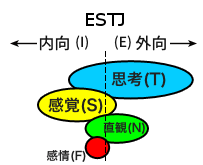
To truly understand the ESTJ (Responsible Type),Psychological functions (cognitive functions)This is important ↓
- Extraverted Thinking/Te
Very good at it /First functionThey are skilled at objectively grasping specific facts using inductive reasoning (practical observation that leads to immediate conclusions). - Introverted Sensing/Si
I'm a little good at it /second function: To bear the responsibility and obligations to society, discipline, loyalty, and honor. - Extroverted Intuition/Ne
I'm not very good at it.Third functionThey aim for their actions and procedures to be effective in the future, but they can become neurotic if things don't go their way. - Introverted Feeling/Fi
I'm really bad at it /Fourth functionI feel anxious or afraid that I am not moral. I don't know how to confront (or don't want to confront) my own moral values.
<The cognitive axis of ESTJ>
List of articles related to ESTJ (Responsible Type)
↑Learn more↑

comment