
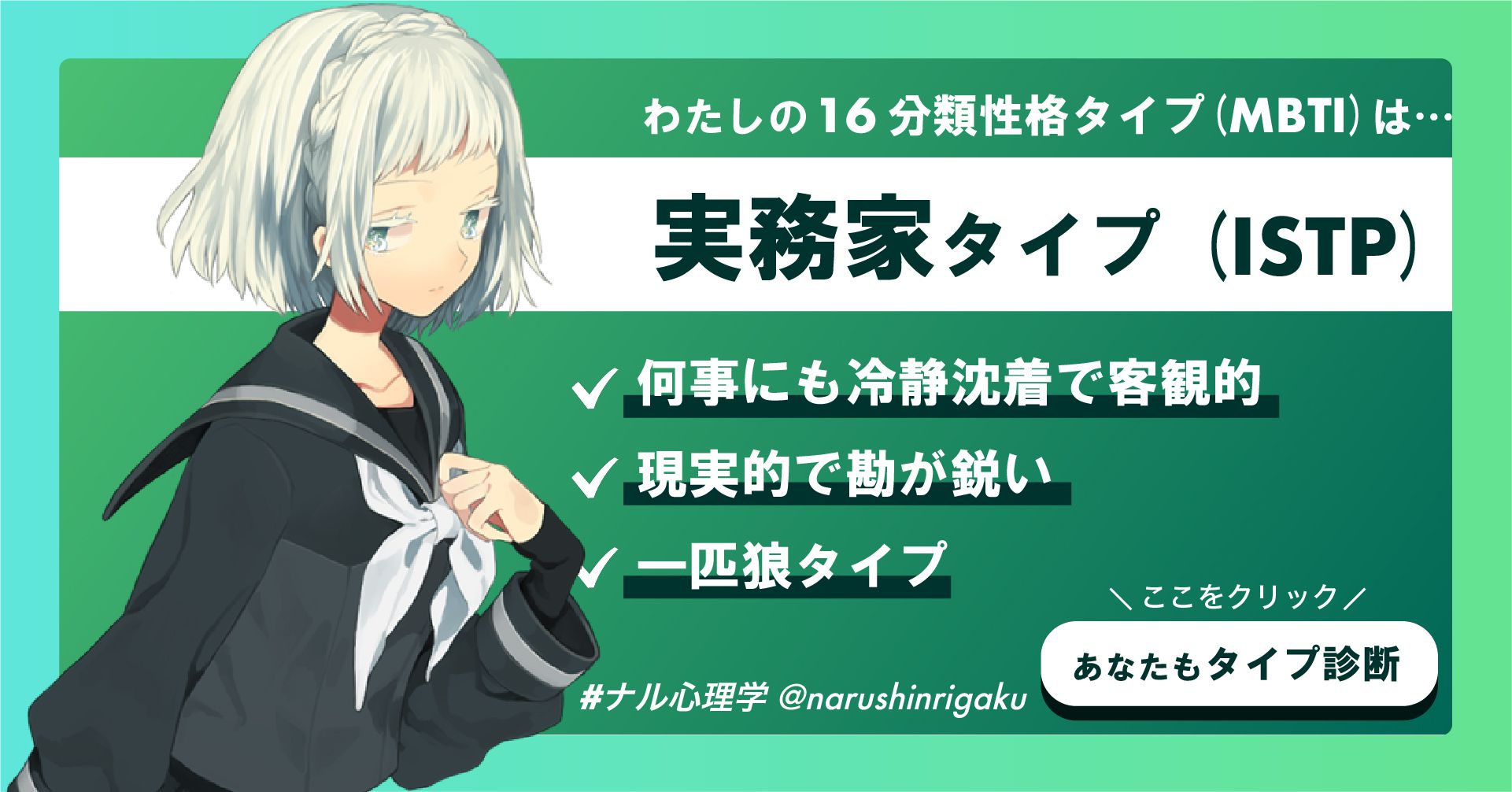
youISTP (Master/Practitioner Type)Then
Share it on social media (tweet it) and let your followers know!

↓↓↓Share on social media (tweet)↓↓↓
↑↑↑Share on social media (tweet)↑↑↑
Classifying personalities into 16 types16-Type Personality TestCheck which type you are using the following↓↓

↑16-Type Personality Test↑
↑Diagnose↑


The ISTP (Practitioner) personality trait: "They try everything at least once."
ISTPThey are reserved, introverted, and cautious in interpersonal relationships, but they are willing to try everything at least once.
The type that looks inward (=Introvert/IThis, combined with a tendency to make objective decisions, allows them to observe how the conversation progresses and what others do before revealing their own hand.
- The way of perceiving and thinking about things is concrete (=Senses/S)、
- To relate everything to things around you (=Perception/P)
Because of this tendency, even though they are inherently introverted, they tend to take on active and proactive roles.
ISTPThis is often the case, especiallyExtrovert type (E type)やJudgment type (J type)These types of people may find their behavior inexplicable. For example, they might suddenly crack a joke that catches the other person off guard, act like they're in character and say "leave it to me," or suddenly feel the urge to fix something that's broken, leaving others bewildered. This unpredictable behavior and apparent indifference to social interactions can irritate extroverts (E types) and judging types (J types), leading to complaints.ISTPNot only does he rebel against such pushiness, but he also deliberately behaves in a way that disappoints others, secretly gloating to himself, so in the end, he's still seen as someone who's hard to understand.
ISTPThey are dexterous and feel a sense of satisfaction when they see tangible results quickly. They have excellent observational skills, so when something catches their attention, they don't think about following procedures or reading manuals; they get started immediately. They enjoy their work, and when things go well, they feel a great sense of accomplishment and satisfaction. If they have to read a manual while working, they only read the directly relevant sections. They avoid wasting time and effort.ISTPThis is an extremely important issue for the type.
The assigned workISTPHowever, if they find a task "boring, dull, and useless in real life," they will often prioritize their own interests over the work. They become so engrossed in what they want to do that they put other responsibilities second (though not necessarily ignoring or forgetting them). However, when they are motivated, they work with such precision and rigor that others are surprised and envious. At such times, they will even take risks for the sake of their work.
Regarding the differences between men and women,ISTPThese men find fulfillment and satisfaction in activities traditionally considered male-dominated, such as one-on-one sports, handling heavy equipment, racing cars, and carpentry.
ISTPWhile women are often good at such things and find great satisfaction in them, when they actually do them, they are often seen as tomboyish due to gender differences.
reference
・ISTP personality
・A guide to the ISTP personality type
Further characteristics of the ISTP (Practitioner type) and compatibility with other types
- ISTP personality
- ISTP personality trait: "Try everything at least once." ~ How do gender differences affect the lives of ENTPs? ~
- A guide to the ISTP personality type
- ISTP's hobbies
- Things that ISTPs dislike
- Strengths and weaknesses of the ISTP personality type
- Suitable occupations for ISTPs
- ISTP leadership
- Compatibility between ISTP and other types
- ISTP and Relationships
- ISTP and love
- How ISTPs set goals and gather information.
- ISTP's Decision-Making Methods
- ISTP parent-child relationships
- For ISTPs to succeed
↓Learn more↓
ISTPPractical type)Compatibility chart and advice for other types
Ideal compatibility type pair
ISTPs are compatible with people who possess common sense, value logic, and can think realistically and practically.
From an ISTP's perspective...
- ISTJ (Hardworking Type):Si – Te, to think about things in a practical and realistic way
- ENTP (Inventor Type):Ne – Ti, the ability to make logical and coherent reasoning to realize an idea.
- ISFP (Artist type):Fi – SeThey think about things realistically, but also respect freedom.
Type pairs that are prone to conflict
ISTPs tend to clash with idealistic, conceptual people who don't have a realistic or common-sense perspective.
From an ISTP's perspective...
- ENFJ (Collaborator Type):Fe – NiThey act based on their own sense of ethics and ideals, but reality doesn't operate on ideals alone, so in reality they accomplish nothing.
Romantic compatibility type pair
ISTPs tend to be romantically compatible with people who are good at navigating social situations (those with a realistic perspective on the world) or those who can provide a sense of security even in difficult circumstances.
From an ISTP's perspective...
- ESTP (Adventurer type):Se – TiHe is a realist who thinks about things from a practical perspective.
- ENTP (Inventor Type):Ne – TiIt's a way of thinking that can actually be used and applied in various ways.
- ENFJ (Collaborator Type):Fe – NiEven in difficult situations, it somehow provides a sense of reassurance.
*The pairs that tend to clash and the pairs that have good romantic compatibility may overlap. This is because while people may dislike those who are the complete opposite of themselves due to disagreements, they may also be attracted to those who appear mysterious because they are different. However, it seems that these relationships often end up breaking down.
(Advice for those dating an ISTP)
reference ISTP (Master/Practical Type) and Romance
Because ISTPs live in the present moment, maintaining long-term relationships can be challenging. To deepen your relationship with an ISTP partner, it's important to cherish each day and respect their strong desire for independence.
ISTP (Practitioner type)A collection of links explaining psychological functions (for those who want to understand how the mind works)
Reading the following roadmap from top to bottom will help you understand the ISTP mindset in a logical order ↓
- Roadmap – ISTP (Practitioner Type) –
- Introduction – What is MBTI?
- Summary of my personality
- Cognition is
- Type-specific cognitive characteristics
- Four personality indicators (psychological tendency axes)
- Conflicts over personality indicators
- “The meaning of the four letters "ISTP"
- First character:Introvert (type I) or extrovert (type E)
- Second character:Intuitive type (N type) or Sensing type (S type)
- Third character:Feeling type (F type) or thinking type (T type)
- 4th character:Perceiving type (P type) or Judging type (J type)
- About psychological functions (cognitive functions)
- What are psychological functions (cognitive functions)?
- The eight psychological functions (cognitive functions)
- Decision-making (judgment) function
- Information gathering (perceptual) function
- Understanding your own psychological functions (cognitive functions)
- The developmental process of psychological functions (cognitive functions)
- Psychological functions (cognitive functions) of ISTPs
- First function:Introverted Thinking (Ti)
- Second function:Extroverted Sensing (Se)
- Third function:Introverted Intuition (Ni)
- Fourth function:Extraverted Feeling (Fe)
- Making good use of psychological functions (cognitive functions)
- Strengths and weaknesses of the ISTP personality type
- Make the most of your strengths
- Reasons for focusing too much on the advantages
- How to improve your weaknesses
- If you are alone
- In a team setting: Have others compensate for your weaknesses (fourth function).
ISTP (Practitioner type)To truly understand this,Psychological functions (cognitive functions)* is important ↓
*Generally in cognitive science,Cognitive functions「The function by which living organisms actively collect external information, perceive and remember it, and then process it by adding reasoning and judgment in order to acquire knowledge about their subject.It is defined as "
List of articles related to ISTP (Practitioner type)
- Psychological functions of ISTP
- “The meaning of the four letters "ISTP"
- Psychological functions (cognitive functions) of ISTPs
- Integration of the ISTP's second and third functions
- The difference between extroverted thinking (Te) and introverted thinking (Ti)
- The difference between introverted thinking (Ti) and extroverted thinking (Te) [Part 2]
↑Learn more↑
youISTP (Master/Practitioner Type)Then
Share it on social media (tweet it) and let your followers know!
↓↓↓Share on social media (tweet)↓↓↓
↑↑↑Share on social media (tweet)↑↑↑

comment