

Jung said,Self-authoredType theoryIn this context, each person has their own strengths (things they use frequently)Psychological functions (cognitive functions)He proposed that there is such a thing.Human cognitive biasesThis is a very useful concept for understanding [something].Psychological typologyof"Psychological functions (cognitive functions)It's no exaggeration to say that this concept underpins the theory of MBTI.
Psychological typologyIt was developed by Carl Jung, a Swiss psychologist and psychiatrist. (*Psychological typologyThis refers to a personality theory that systematically explains the human mind, and also to the books that describe it. It is sometimes also called type theory. This theory not only classifies people into eight types,Characteristics of human cognitionBased on the aboveIt is structured in a very systematic way.This is what was done.
below,A Japanese translation of Jung's theory of psychological types.is.Among Jung's works, this is one of the finest.It is sometimes called this, as of 2020/05/15All reviews on Amazon are 5 stars.That's it. However, the content might be specialized and difficult to understand.


What are psychological functions (cognitive functions)?
(Psychological functions (cognitive functions)In order to understand,"Extroversion/Introversion"と"Senses/Intuition" "Thoughts/Emotions"You need to understand this thoroughly beforehand. (First, tap the orange tab below and read it.)
"Extroversion/Introversion""Senses/Intuition" "Thoughts/Emotions" [Jungian psychology]
Jung's concept of "extroversion and introversion"
It also appears in MBTI.Extroversion/Introversion Personality IndicatorsOriginally,Psychological typologyIt seems that Jung was the first to propose this idea. Jung was also a psychiatrist, and based on his clinical experience...「The libido flows observed in contrast to those of hysterical patients and schizophrenic patients are defined as "extraversion" and "introversion," respectively.」* And it was used to aid in treatment.(Libido originally comes from the Latin word for desire or passion, but Jung defined it as the psychic (spiritual) energy that drives people.)。* Jung's "Theory of Types" and Pragmatism: Types as "Personal Formulas (persönliche Gleichung)" (Quoted from by Yuka Ogiso)
Yoshihiko Tanno, Cognitive Behavioral Science, Graduate School of Arts and Sciences, University of TokyoFive personality factors theory (2nd dimension) Extraversion/Introversion (E dimension)Quoted from the following:
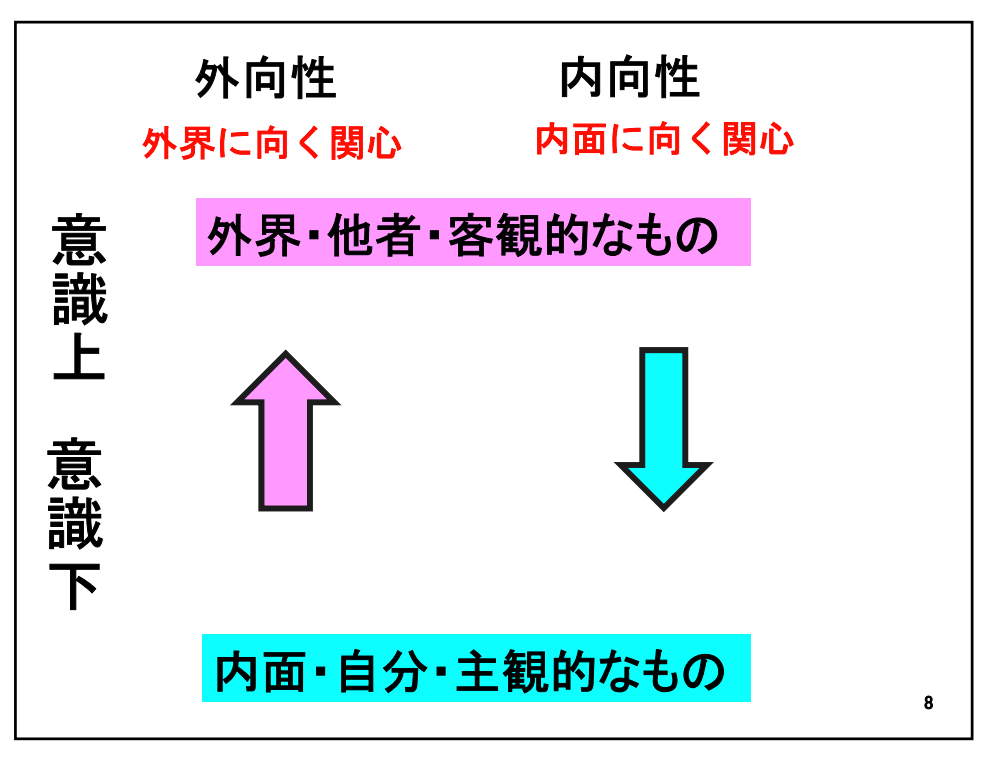
Jung attempted to extend the concepts of extroversion and introversion not only as a "pathological framework" but also to human beings in general.。Psychological typologies are explained within a broader framework of human beings in general, rather than within a framework of pathology.。(This approach could be considered groundbreaking. For example, it's like taking medicine that was originally taken to cure illness and starting to use it to improve the health of healthy people. Many people might think it's strange to take medicine when you're not sick.)
In short, Jung's argument can be summarized as follows:
- Everyone possesses both extroverted and introverted traits.
- They cannot be used simultaneously; only one can be consciously controlled at a time.
- Humans have a natural tendency to try to balance extroversion and introversion to prevent their minds from collapsing.
- When one leans too much towards either extroversion or introversion, there is an unconscious tendency to pull them back to the other side.(←This is "Compensability(It's called "..."
Jung said,An extreme bias towards either introversion or extroversion can be a cause of neurosis.I predicted that,Hysterical patients exhibit conversion symptoms due to their strong extroversion.I thought,A method that balances introversion and extroversion is effective in treatment.That's what I thought. In modern terms, cognitive behavioral therapy might also be considered effective.
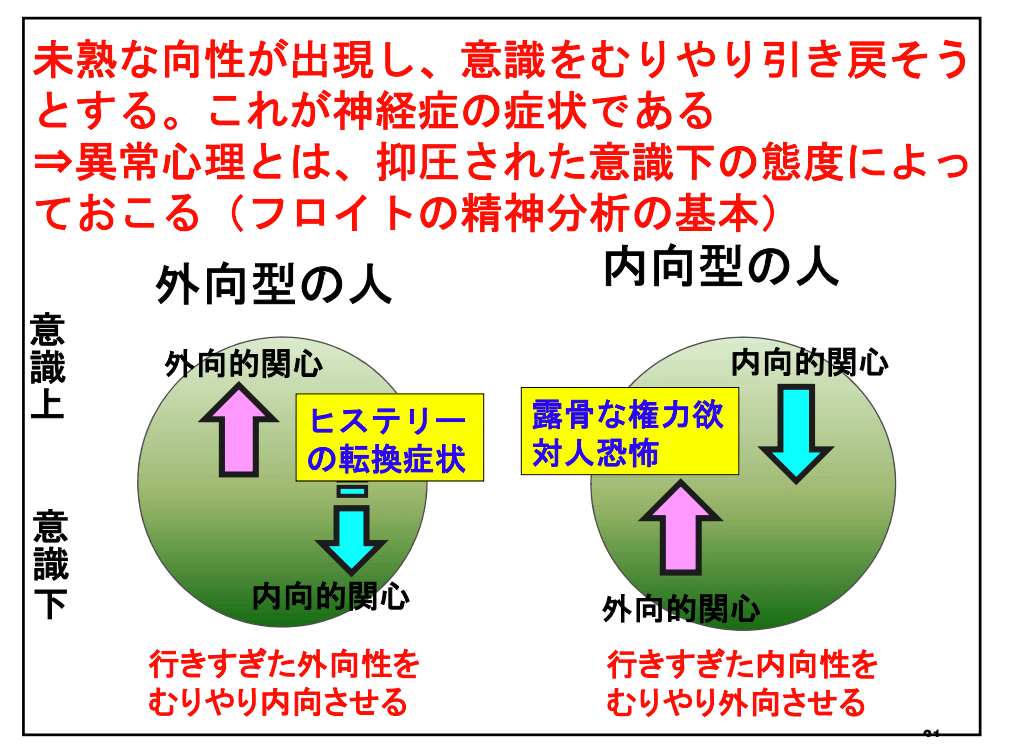
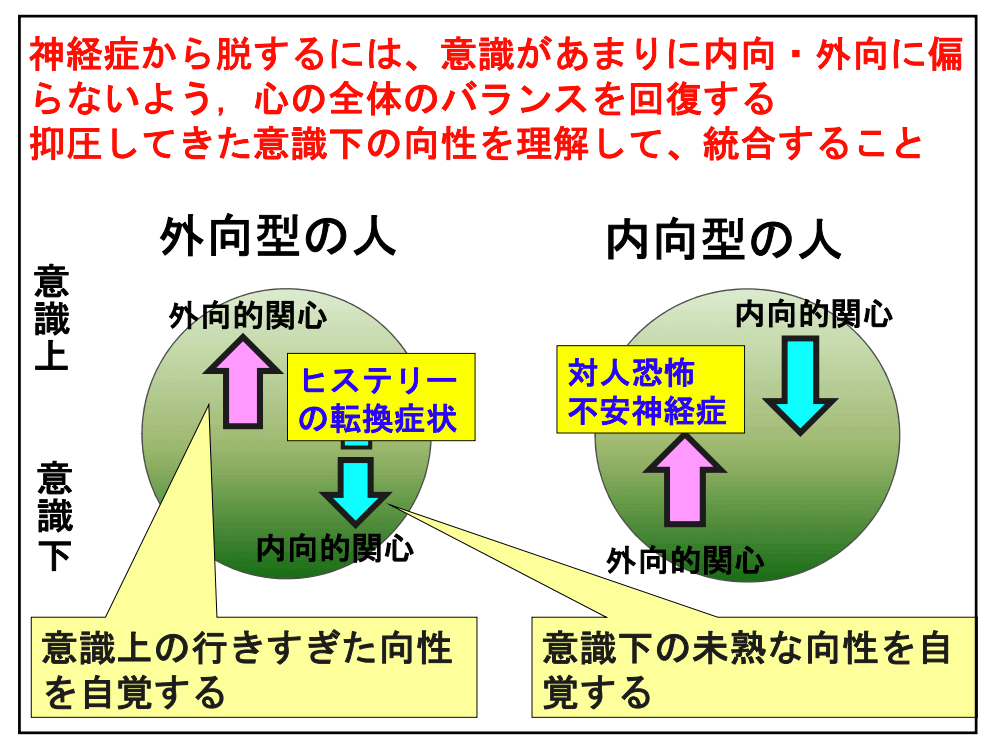
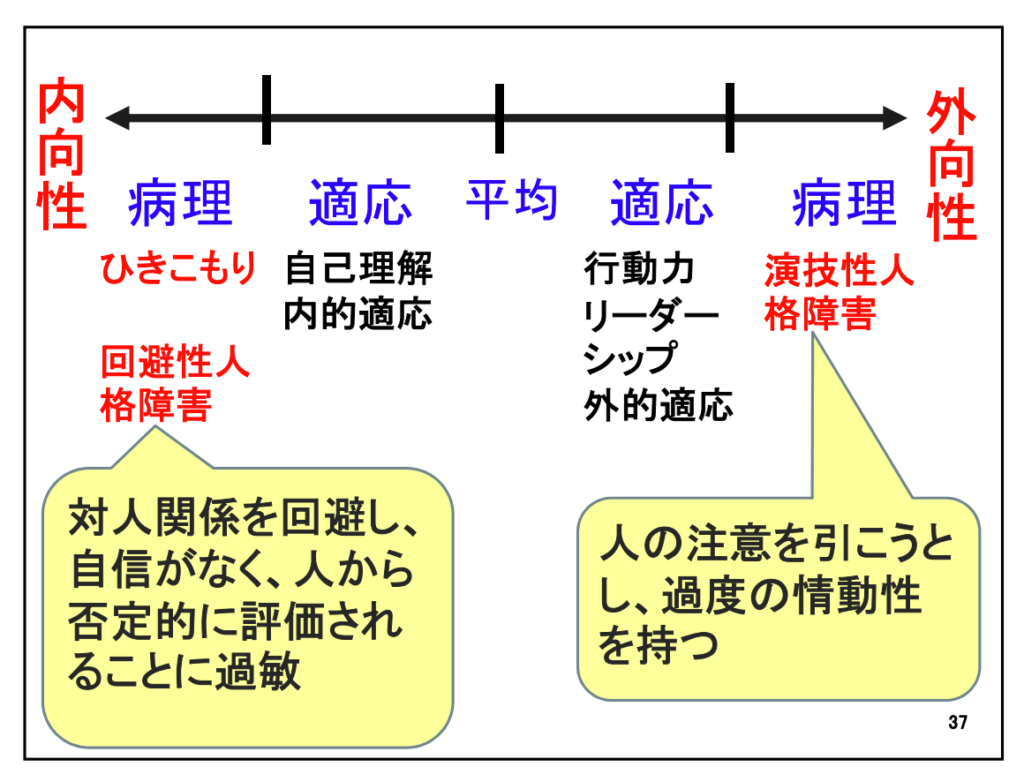
actual,As Jung's theory suggests, hysterical patients exhibit strong extroversion.It seems so ↓
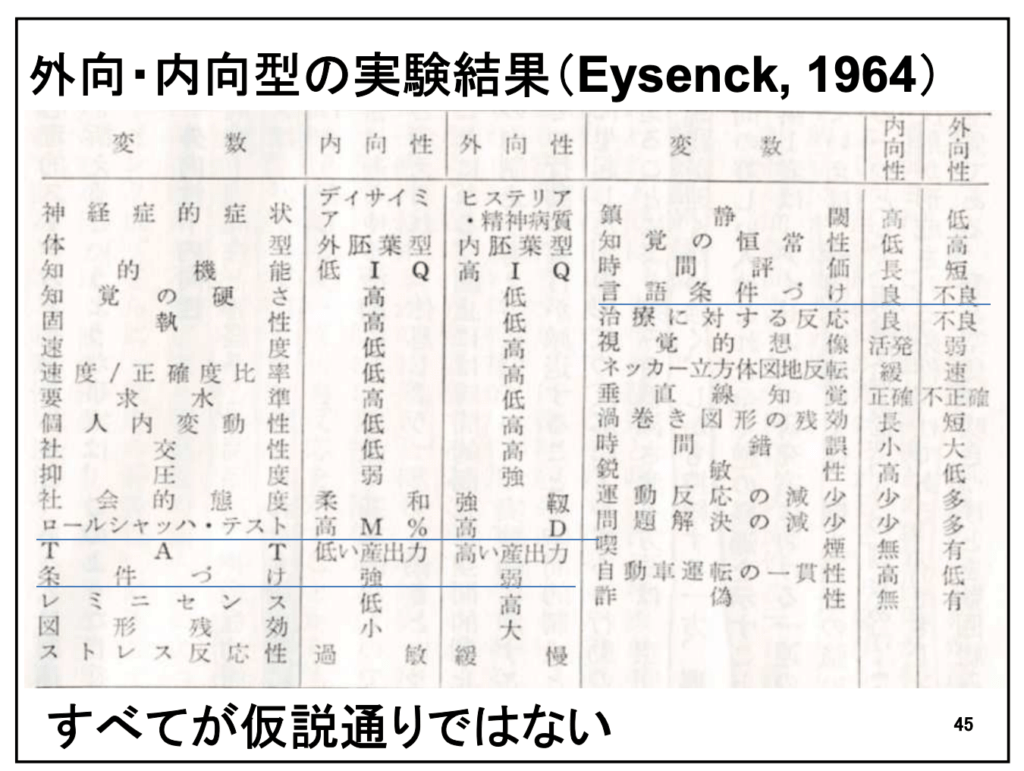
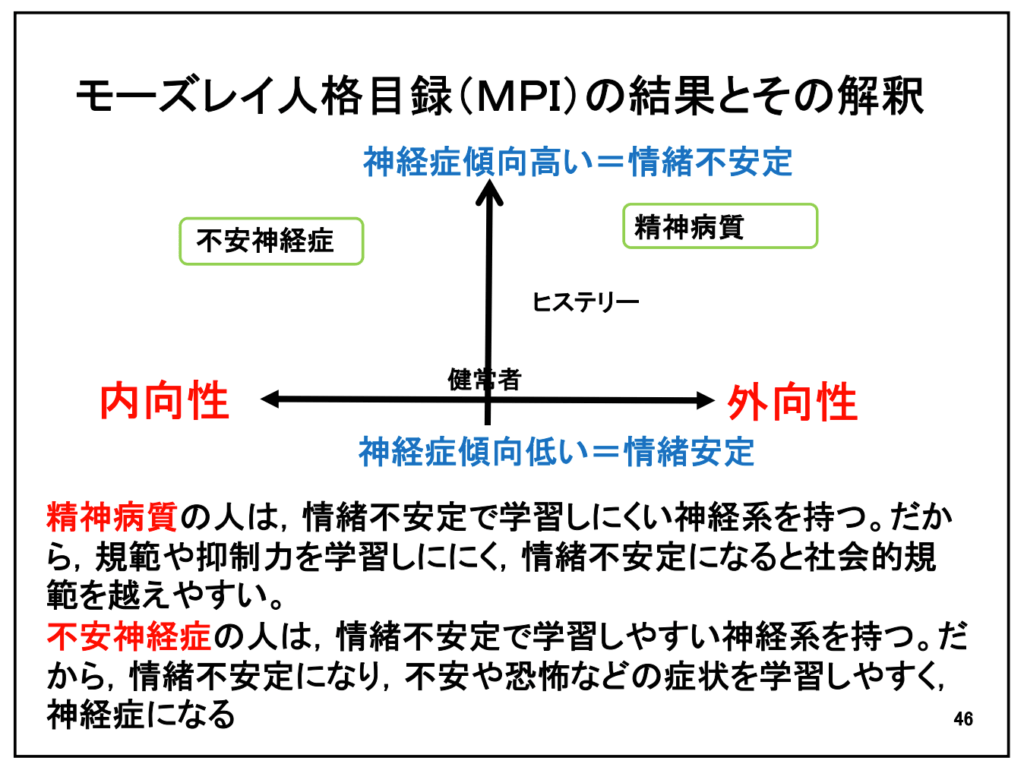
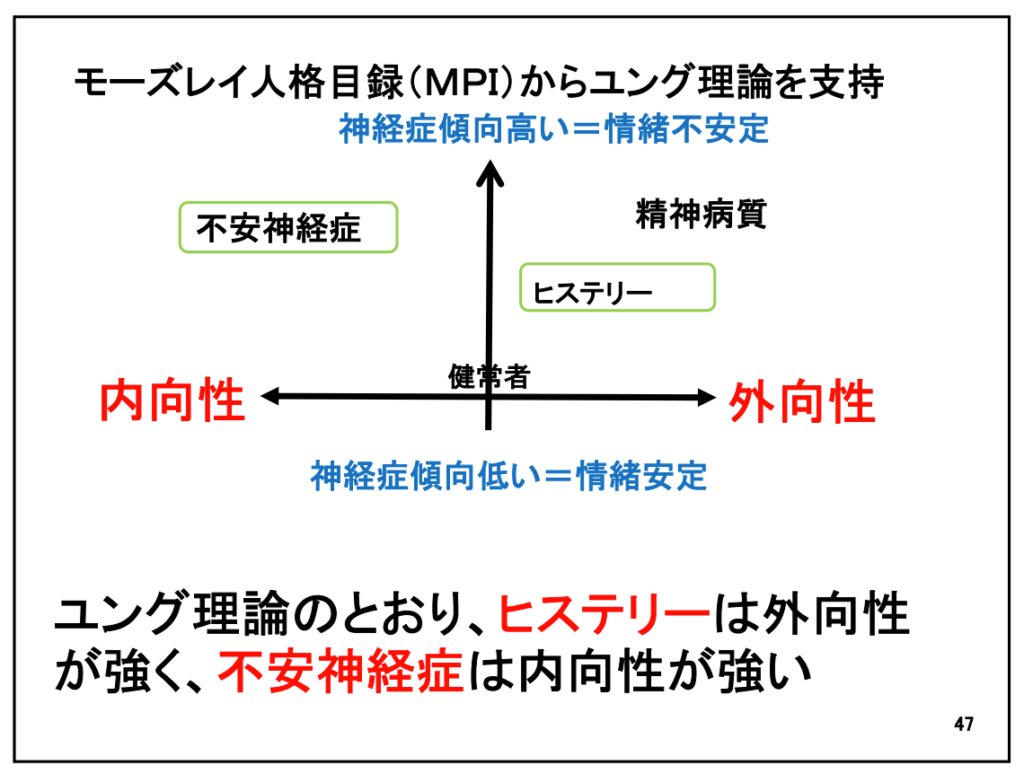
All images in this column are by Yoshihiko Tanno of the Department of Cognitive Behavioral Science, Graduate School of Arts and Sciences, University of Tokyo.Five personality factors theory (2nd dimension) Extraversion/Introversion (E dimension)This is a quote from "[source]".
The four psychological functions (psychological functions)
Jung considered extroversion and introversion to be opposing forces, assuming that one is used consciously while the other resides in the unconscious realm. Furthermore, he also considered other opposing concepts.Psychological typologyIt is explained there. It has already been explained in MBTI.The opposing concepts of [emotions/thoughts] and [sensations/intuition] are psychological functions.is.
Yoshihiko Tanno, Cognitive Behavioral Science, Graduate School of Arts and Sciences, University of TokyoFive personality factors theory (2nd dimension) Extraversion/Introversion (E dimension)Quoted from the following:
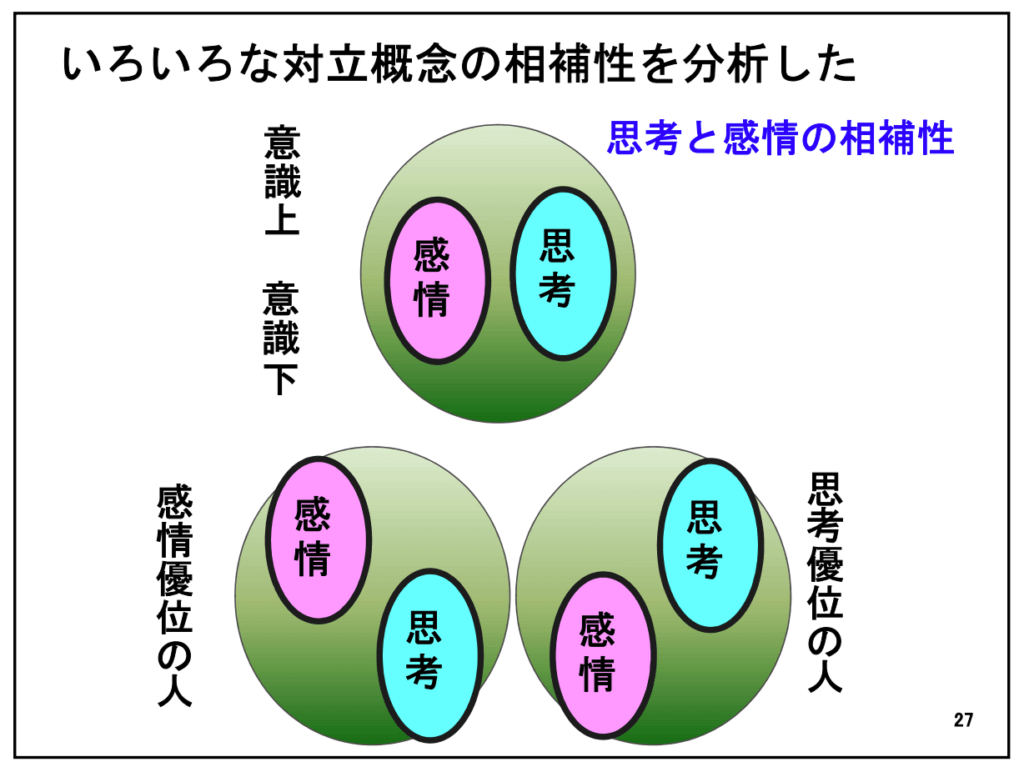
Four psychological functionsTo summarize, it looks like this:
- Psychological functions used when making decisions (judgments)
- emotion←Conflict→thinking
- Functions used when gathering (perceiving) information
- feelings←Conflict→Intuition
「Cognitive mechanismsAs explained in "[ ]", people,Decision-making (judgment) functionとInformation gathering (perceptual) functionI use them alternately.
Use both
Decision-making (judgment) function ⇄ Information gathering (perception) function
※Decision-making (judgment) functionAlternative names:rational function、
Information gathering (perceptual) functionAlternative names:irrational function
『Being rational means "consciously excluding randomness and irrationality" and "imposing a certain pattern on the disordered and accidental events of reality, or at least attempting to do so.""*death,"In contrast, "irrational" does not mean "contrary to reason" (widervernünftig), but rather "outside of reason" (außervernünftig), meaning that things like the Earth having a moon, or chlorine being an element, are simply coincidences or things that cannot be explained by reason.』* I will do it.
*Philosophical Inquiry into English Language Education 2『C.G. Jung, *Type Theory*, translated by Michiyoshi Hayashi (1987), Misuzu Shobo.Quoted from and modified by the author from "[Title of the work]".
psychological functionteeth,Cognitive functionIt means the same thing. In general, in cognitive science,Cognitive functions「The function by which living organisms actively collect external information, perceive and remember it, and then process it by adding reasoning and judgment in order to acquire knowledge about their subject.It is defined as "
| Main cognitive functions | |
|---|---|
| memory | The ability to remember things and retrieve them when needed. |
| Planning ability | The ability to devise, prepare, and execute the optimal plan according to the situation at hand. |
| Attention | The ability to recognize and acquire what is important and necessary, to focus one's attention on it, and to persevere. |
| orientation | The ability to understand basic situations such as the current year, month, time, and location. |
| Spatial awareness | The ability to quickly and accurately grasp and recognize the state and relationships of objects in three-dimensional space, including their position, direction, orientation, size, shape, and spacing. |
*The table above is from the Cognitive Function Visualization ProjectCognitive Function – Overview –』 This is a quote and adaptation by the author.
The famous psychologistJungHis book "Type theory(Psychological Types)*」We assumed four types of psychological functions (cognitive functions).。
*「Type theory(Psychological TypesThe phrase ")" has been translated into Japanese, so if you're interested, why not check out the content via the link below?
theThe four functions of the mindfor,[Feeling type (F type), Thinking type (T type)], [Sensing type (S type), Intuition type (N type)] There is also.[Feeling type (F type), thinking type (T type)]をDecision-making (judgment) function、[Sensing type (S type), Intuitive type (N type)]をInformation gathering (perceptual) functionThese are called [names of the terms]. Each will be explained in detail below.
Dictionary of Clinical Psychology Terms「Psychological functions (thinking, feeling, sensing, intuition)Quote begins from (partially modified by the author)
An example using an ashtray
The example of "how we perceive a ceramic ashtray" is used to explain the four types of ways of perceiving things: thinking, feeling, sensing, and intuition. It goes something like this:
- thinking
—Let's consider that this belongs to the category of ceramics, and its inherent properties such as its fragility. - emotion
—You decide whether the ashtray looks good or bad. - feelings
—Accurately grasp the shape and color of the ashtray. - Intuition
—It brings about possibilities that transcend the attributes of the object itself, such as instantly coming up with a solution to a problem about geometric circles the moment you see it.
End of quote
Humans use this function to perceive the world and to engage with things.(In MBTI, the balance of development in these psychological functions determines strengths and weaknesses, and personality types are classified into 16 categories.)
Furthermore, Jung said,Introvert (I)/Extrovert (E)He is also famous as the psychologist who first proposed this concept.Whether your awareness is directed towards the outside world or your own inner selfThat's the point. The preference for extroversion and introversion is oftenattitude* is called
*As a psychological termattitude」
→A psychological tendency based on emotions and evaluative judgments towards an object that underlie human behavior.
and,The four psychological functions (cognitive functions)teeth,It functions in conjunction with extroversion (E) and introversion (I).Yes, that is.Classified into 8 categoriesIt is possible. For example, the extroverted feeling function, that is,Extraverted Feeling (Fe)This is how it is expressed. The table below illustrates this:
| Thinking type (T type) | Emotional type (F type) | Sensory type (S type) | Intuitive type (Type N) | |
| Extrovert type (E type) | Extraverted Thinking (Te) | External emotions (Fe) | Extroverted Sensing (Se) | Extroverted Intuition (Ne) |
| Introvert type (type I) | Introverted Thinking (Ti) | Introverted Feeling (Fi) | Introverted Sensing (Si) | Introverted Intuition (Ni) |
The eight psychological functions (cognitive functions)
As described above, the four psychological functions ([Feeling type (F type), Thinking type (T type)], [Sensing type (S type), Intuition type (N type)])butExtroversion/IntroversionIn conjunction with this, the psychological functions can be classified into eight types. Jung believed thatThe eight psychological functions (cognitive functions)UsingClassified into 8 personality typesI did.In MBTI, cognitive functions often refer to these eight functions.is.
A simple explanation of the eight psychological functions
- Te (extroverted thinking)
- Emphasis on objectivity and logic in the real world
- Think about the tasks in order.
- Ti (introverted thinking)
- Emphasizing the spiritual world, aiming to build a consistent world of knowledge.
- Excellent at analysis and problem identification, and well-suited for troubleshooting.
- Fe (Extraverted Feeling)
- Prioritizing the feelings of others
- I find joy in helping others.
- Fi (introverted feeling)
- Emphasis on individual feelings, beliefs, and morals
- Judging the surrounding situation based on whether it is "good" or "bad."
- Se (Extroverted Sensing)
- Emphasis on experiencing or perceiving the current world.
- Focus on the present and find meaning in life through exciting experiences.
- Si (Introverted Sensing)
- Emphasis on facts and memories of past events (tradition)
- They are loyal to rules and obligations, and consistently tackle even the most challenging tasks.
- Ne (Extroverted Intuition)
- Emphasis on real-world experience and possibilities
- Dedicated to growth and improvement
- Ni (Introverted Intuition)
- They value their intuition and excel at grasping the whole picture from abstract information.
- They are sensitive to how the world perceives people and have a superior ability to wear masks.
8 psychological functionsYou can read more details in the article below ↓
.jpg)

comment