
↑The right person for the right jobMBTI (16 Personality Types) CompatibilityQuoted from '
Reference: 16 Personality Type Theory (modified)
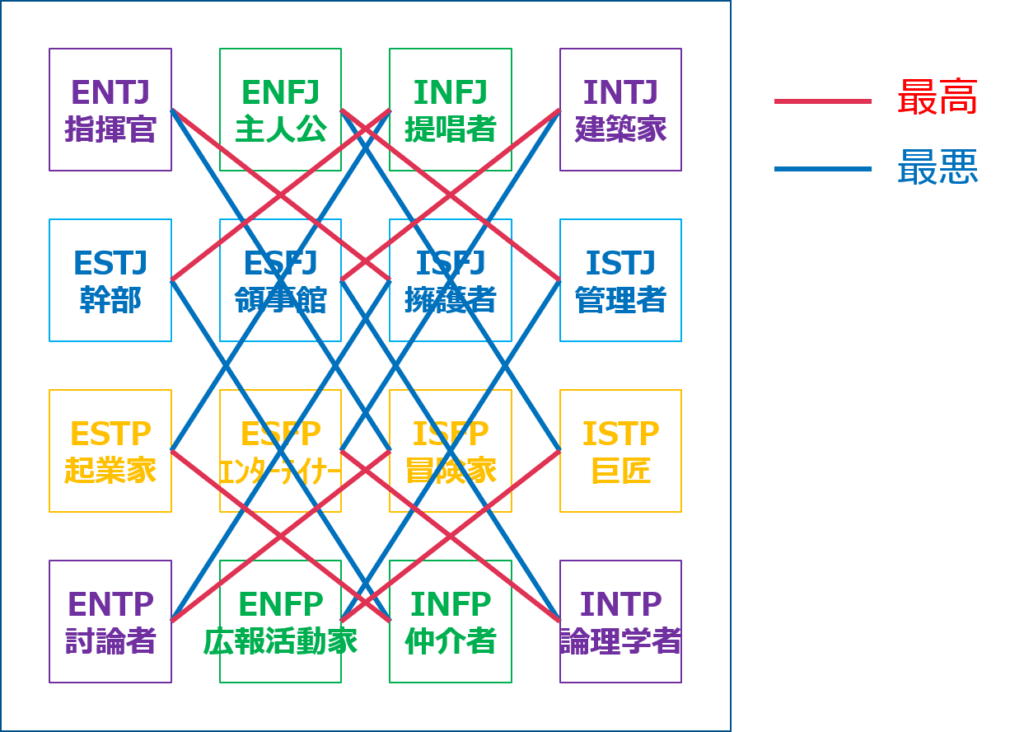
- ESTJ & INFP
- ENFP & ISTJ
- ENTJ & ISFP
- ESFP & INTJ
- ESFJ & INTP
- ENTP & ISFJ
- ENFJ & ISTP
- ESTP & INFJ
Both individuals utilize the same psychological functions, but in completely opposite order. This reversed order leads to frustration when working together, as it prevents understanding the other person's intentions and leads to suspicions of deliberate harassment or simply a lack of intelligence.
Having the order of psychological functions reversed means that even when performing the same task, the psychological process is reversed, and the order of developmental stages in life is also reversed. Therefore, important things often don't align, especially in youth.
When we first meet, we are impressed and drawn to each other's way of thinking, feelings, and abilities. We become interested in each other as people and are attracted to one another. And we believe that we can build a friendly and cooperative relationship.
However, you'll notice that problems keep arising, and eventually you'll start to think something is wrong. Still, you might think these problems aren't a big deal and can be easily resolved. You might think that with a little more effort, you can understand each other. In reality, understanding each other is not easy.
The first and second psychological functions work together within each type, potentially creating strengths. The order in which they function is also important. In conflict-prone relationships, a third psychological function that one person doesn't trust or utilize, and which may be underdeveloped, or a fourth psychological function that they suppress, may play a crucial role for the other. Therefore, their strengths, interests, perspectives, coping mechanisms, and behavioral patterns can be completely different.
The second and third psychological functions both operate to varying degrees within each type, maintaining a degree of balance. Maintaining this balance is crucial for each individual. This shared characteristic may be a factor in their mutual attraction.
They effortlessly do things that I can't imitate, which can evoke a slight sense of envy and make them seem more attractive.
Furthermore, by completely entrusting the functioning of the fourth psychological function, which you are not good at, to the other person, you may be tempted to act as a pragmatist to avoid troublesome situations or common mistakes.
What seems normal and natural to you may not be at all to the other person. The things we take for granted are often done unconsciously, without even needing to put them into words. And we unconsciously expect the same from others. However, in this relationship, those expectations are betrayed, the other person's actions are unpredictable, and friction arises without any explanation.
What we suppress within ourselves are things we unconsciously dislike and fear. And unconsciously, we expect others not to show us these things, imposing our values on them. In relationships prone to conflict, these suppressed aspects are starkly revealed.
They can easily hit each other's weak points, and suffer from a lack of understanding. When they start pointing out each other's flaws, the arguments escalate, and the situation only gets worse. They may even end up judging the other person as selfish. Unfortunately, it often ends in a breakup, leaving behind immense damage.
Even if you try to maintain the relationship several times, you may eventually drift apart, and only then may you feel a sense of liberation and relief. However, if you have lost a great deal, you may end up resenting the other person.
In reality, these types of people who are prone to conflict often encounter each other in society. At first glance, it might seem that they would coexist because their interests and passions are so different, but even so, people with various roles come together to work in one place. Furthermore, there are many people who spend their youth diligently trying to overcome their weaknesses, and who succeed to some extent, even influencing their career choices. However, in reality, this often means that they remain stuck in the dysfunctional ways of their inferior function. As a result, they repeatedly encounter conflicting types of people in the workplace, and the tragedies that accompany them are repeated.
True mutual understanding is only possible after a long period of companionship. It can only truly be achieved when both partners have fully developed and matured as individuals. Mutual understanding is impossible if either party remains immature. In other words, the conditions are quite stringent.
Integrating repressed psychological functions within oneself and achieving perfect balance is a lifelong theme indispensable for personality development and self-realization. Most people pass away without ever achieving this.
Meeting someone with such a completely opposite personality is a good opportunity to understand the opposite extreme. It's crucial to avoid falling into negative emotions and instead maintain a distance to objectively observe yourself and others. To that end, The functions of the eight psychological functionsAnd, Meaning of orderKnowing this is beneficial.
We need to be grateful that someone else is taking on the role that we ourselves have pushed into the shadows. Even if we can't get along with them, it's important to acknowledge their value. In fact, being able to recognize that this quality resides within ourselves can lead to significant personal growth.
End of quote
*This compatibility explanation is,16-Type Personality TestThis was created based on the theory of [the subject].
A Collection of Information on the 16 Personality Types – The Little-Known Truths of Each Type (Summary, Illustrations, and Analysis)
- Summary of 16 Personality Type Test Websites
- List of articles categorized by personality type (16 types)
- Compatibility chart for 16 personality types
- Suitable occupations, ideal jobs, and dream jobs for each of the 16 personality types
- Nicknames (names) for each of the 16 personality types
- What if there were a country with 16 personality types...?
- The relationship between national characteristics around the world and the 16 personality types
- List of 16 Personality Types Based on Famous Characters
- Detective Conan: A Summary of 16 Personality Types for Each Character
- Percentage of 16 personality types
- Reactions of 16 Personality Types – Heaven and Hell
- To describe the 16 personality types in one word:
- 16 Simple Explanations of Personality Types
- 16 Personality Types: Strengths, Weaknesses, and Ways to Improve Weaknesses
- 16 Personality Types: Preferences and Strengths/Weaknesses in Majors and Subjects
- 16 Personality Types: How to Enjoy Life to the Fullest…?
- 16 Personality Types: Inspiring Quotes from Great Figures
- What if each of the 16 personality types were a murderer?
- How to become an attractive husband or wife based on your personality type (16 types)
- What 16 personality types do after a breakup
- Reasons for fighting according to 16 personality types
- Income by 16 Personality Types - Misconceptions and Truths -
- Characteristics of employees based on 16 personality types
- Potential pathological tendencies of 16 personality types
- Psychological Functions of 16 Personality Types Based on Statistics
- Viewing percentage of the detailed personality pages for each of the 16 personality types
- Summary of the characteristics of the 16 personality types
- 8 psychological functions: "What if I did...?"
- Approaches to tasks based on psychological function: Intuitive (N-type) & Sensing (S-type)
- Social interaction explained by psychological functions
- Understanding Your Financial Habits Through Psychological Functions – Are You a Saver or a Spender?
- Humor (sense of humor) as revealed by psychological functions
- How extroverts (Type E) and introverts (Type I) can get along well
- How Sensing types (S type) and Intuitive types (N type) can get along well
- How Thinking (T-type) and Feeling (F-type) People Can Get Along Well
- How to get along well with Judging (J-type) and Perceiving (P-type) types
- Characteristics of parents with 16 personality types
- Parent-child relationships between extroverts (Type E) and introverts (Type I)
- Parent-child relationships between sensing types (S-type) and intuitive types (N-type)
- Parent-child relationships between thinking types (T-type) and feeling types (F-type)
- Parent-child relationships between judging (J-type) and percepting (P-type) types
- How to identify your partner's personality type: [16 Personality Types]

comment