

By comparing a country's culture with those of other cultures around the world, we can understand the factors that deeply drive its unique culture. A country's culture reflects the central trends of its society.
For example, every individual possesses uniqueness, but due to social control, most people do not deviate significantly from norms (standards).
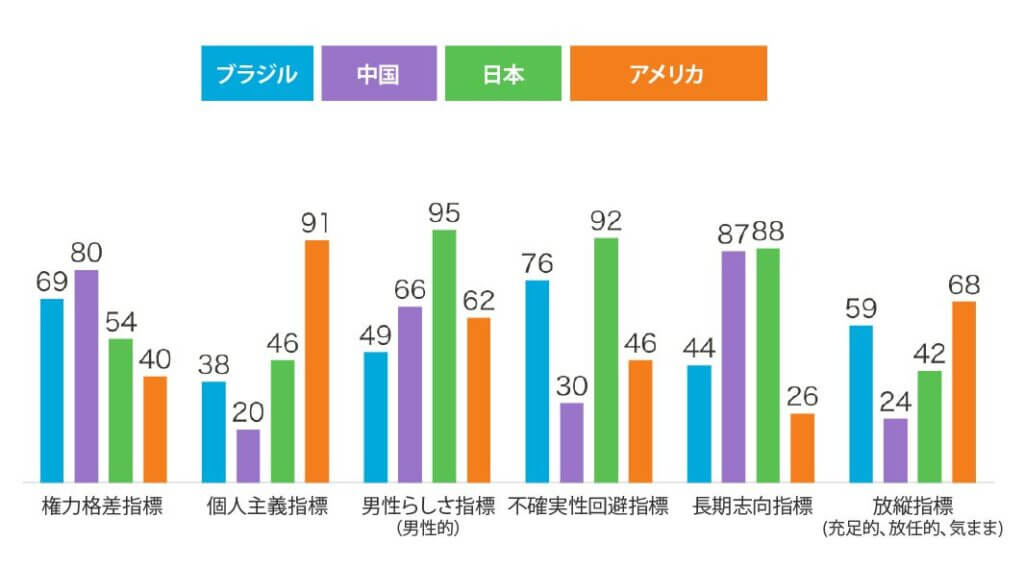


Power Distance Index
The fact that every single person is different means that all people are inherently unequal.One of the most prominent aspects of inequality is the degree to which each person has the power to influence the thoughts and actions of others.is.
This dimension isThis addresses the fact that not all individuals in society are equal, and the cultural attitudes toward such power inequalities among us.This represents...
Power distanceThat is,The degree to which weaker members of a country's institutions or organizations are likely to accept that power is distributed unequally.This is how it is defined.
Individualism indicators (vs. collectivism)
The fundamental issue addressed at this level is the degree of interdependence that society maintains among its members.This is it.This relates to whether people define their self-image using "I" or "we".I am doing it.
In an individualistic society, people only care about themselves and their immediate family (direct family).That's what's planned.In collectivist societies, people belong to a "group" that will take care of them in exchange for their loyalty.。
The Power Distance Index scored a very low 40 points.teeth,The most individualistic culture in the world (high score of 91 points) In combination with the above, it can be expressed as follows:
In America,"Freedom and justice for all"This is based on the premise that,Clearly define equal rights in all aspects of American society and government.This is evident from the emphasis placed on it.
In American organizations, a hierarchical structure is established for convenience.Your boss is someone close to you.Therefore, managers rely on the expertise of individual employees and teams. Both managers and employees anticipate being consulted, and information sharing is frequent. At the same time,Communication is informal, direct, and participatory to some extent.is.
Society is loosely interconnected,People should only take care of themselves and their immediate family (such as blood relatives), and should not rely (excessively) on support from the authorities.It is said that...Geographic mobility is extremely high in the United States.(*Moving is very common in the United States.)
Americans are among the most sociable people in the world, but deep friendships can often be difficult to cultivate, especially among men.
Americans are accustomed to doing business and interacting with people they don't know well. Therefore, they don't hesitate to approach others to gather information.In the business world, employees are expected to be independent and take initiative.。
Furthermore, in the world of exchange-based work,Hiring, promotions, and decision-making are based on merit and evidence of what you have done and what you are capable of.
The score for the "masculinity index" in the United States is a high 62.This is a typical behavioral pattern seen in Americans.
this is,High masculine desiresand,The most individualistic desire in the worldThis can be explained by the combination. In other words, Americans are, so to speakEach of them is individually exhibiting masculine desires.That's right.
However, the British share the same culture in this respect. Therefore, the following question needs to be asked: "Do the same desires usually not surface?"
This difference is,"Uncertainty avoidance"This indicates that the US score is higher than the UK score regarding this. In other words, the same level of motivation is seen in both societies,Americans put it front and center, while the British do it in unexpected ways.That's right.
This American combination (High masculine desiresand,The most individualistic desire in the world) is expressed as follows:
Behavior at school, work, and play influences how people behave."Strive for the best," "The winner takes it all."This is based on a shared set of values. As a result, Americans tend to boast about and freely talk about their "successes" and "achievements" in their lives.
In American society, success itself is not the biggest motivator,It is important to be able to demonstrate success.That's right.
Many American performance evaluation systems are based on precise goal setting, allowing American employees to demonstrate how well they've done. There's a "you can do it" mentality that generates a lot of dynamism in society, as there's always a belief that things can be done better.
The typical American "lives to work," so they can earn a financial reward, and as a result, they can attain a high position depending on their performance. Many white-collar workers move to upscale neighborhoods with each promotion.
Since the goal is to become a "winner," it is believed that a certain degree of competition can bring out the best in people.As a result, polarization and lawsuits become frequent. Such thinking today undermines the fundamental American principle of "liberty and justice for all." Widening inequality endangers democracy because the gap between classes can slowly increase the power distance and undermine individualism.
Uncertainty avoidance indicators
Uncertainty aversion relates to how society deals with the fact that the future can never be known.
Will you try to control the future, or will you simply let things take their course?The uncertainty of the future leads to anxiety, and the way we deal with that anxiety varies from culture to culture.
The degree to which members of a culture have created beliefs and institutions to avoid situations they perceive as ambiguous or unknown.This is reflected in the score of the "uncertainty aversion index."
From the perspective of uncertainty avoidance, the United States scored a low 46 points, below average.This was recorded.
Americans are somewhat receptive to new ideas and innovative products, and they have a willingness to try new and different things, whether it's technology, business practices, or food.
Americans tend to be tolerant of everyone's ideas and opinions and to recognize freedom of expression.There is. At the same time,Americans don't need many rules and express emotions less compared to cultures that prioritize scoring.It has become that.
However, at the same time, 9/11 instilled a great deal of fear in American society and ultimately led to government efforts to monitor everyone through the NSA and other security organizations.
Long-term orientation index (vs. short-term orientation index)
In this dimension,All societies must maintain some connection to their past while addressing present and future challenges.This explains that the priorities for these two existential goals differ depending on the society.
For example, in this dimensionA normative society with a low score maintains old traditions and norms while viewing social change with skepticism.I like to do that.
on the other hand,Cultures with high scores tend to take a more pragmatic approach, encouraging frugality for the future and emphasizing modern education.I will.
The United States scored a low 26 points in this dimension, classifying it as "normative."This can be expressed as follows:
Americans tend to analyze new information to verify whether it is true or not.Thus, due to cultural differences, most AmericansIt's not a practical choice.。
However, this should not be confused with the fact that Americans are very pragmatic, which is reflected in the aforementioned "you can do it" mentality.
The polarization described above is reinforced, so to speak, by the fact that many Americans have very strong ideas about what is "good" and "evil." This may relate to issues such as abortion, drug use, euthanasia, weapons, or the scale and rights between the government, states, and citizens.
The United States is the only country in the world with a large European population where church visits have increased since the early 20th century.It is one of them.
This increase is also evident in some former Soviet countries, such as Russia.
American companies measure their performance on a short-term basis, such as by issuing quarterly income statements. This also leads to individuals striving to produce results quickly in the workplace.
Americans tend to analyze new information to verify whether it is true or not.Thus, due to cultural differences, most Americans are not realistic. However, this should not be confused with the fact that Americans are very realistic, which is reflected in the aforementioned "can-do" mentality. The aforementioned polarization is reinforced, so to speak, by the fact that many Americans have very strong ideas about what is "good" and "evil." This relates to issues such as abortion, drug use, euthanasia, weapons, and the scale and rights between the government and states or citizens. The United States is the only "Caucasoid" country in the world that has seen an increase in church visitors since the early 20th century. This increase is also seen in some post-Soviet republics like Russia. American companies measure their performance in the short term, such as issuing profit and loss statements on a quarterly basis. This also leads to individuals trying to get results quickly at work.
Indulgence (satisfaction, laissez-faire, carefree) indicators (vs. restraint)
One of the challenges that humanity has faced, both in the past and present, isTo what extent are young children socialized?That's the point. Without socialization, we cannot become "human beings."
This dimension isThe degree to which a person tries to control their desires and impulses based on the environment in which they grew up.It is defined as follows.
The tendency to try to control impulses with relatively little force is called "licentiousness (fulfilling, laissez-faire, carefree)." They call it,The tendency to try to control impulses relatively strongly is called "restrained." This is what we call it. In this way, cultures can be classified into "licentious" and "restrained."
In this dimension,The United States is a licentious, laissez-faire society (score 68).This, along with normative scores, is reflected in the following contradictory attitudes and behaviors:
Work hard, play hard.
The United States is engaged in a war on drugs and is still working very hard at it, yet it has more drug addicts than many other wealthy countries. Despite being a cautious society, even celebrities who preach on television can appear immoral.
Share your thoughts on this article on social media using the button below to let your followers know!
- Cultures of various countries around the world
↓Click here if you want to find out your own or someone else's personality type↓

For those who want to learn more about Dr. Hofstede's theory of cultural dimensions, see below ↓

comment