

By comparing a country's culture with that of other cultures around the world, we can learn about the factors that drive its unique culture.The culture of a country reflects the central trends of its society.
(*While every individual possesses unique qualities, social control prevents most people from deviating significantly from norms (standards), thus preserving culture.)
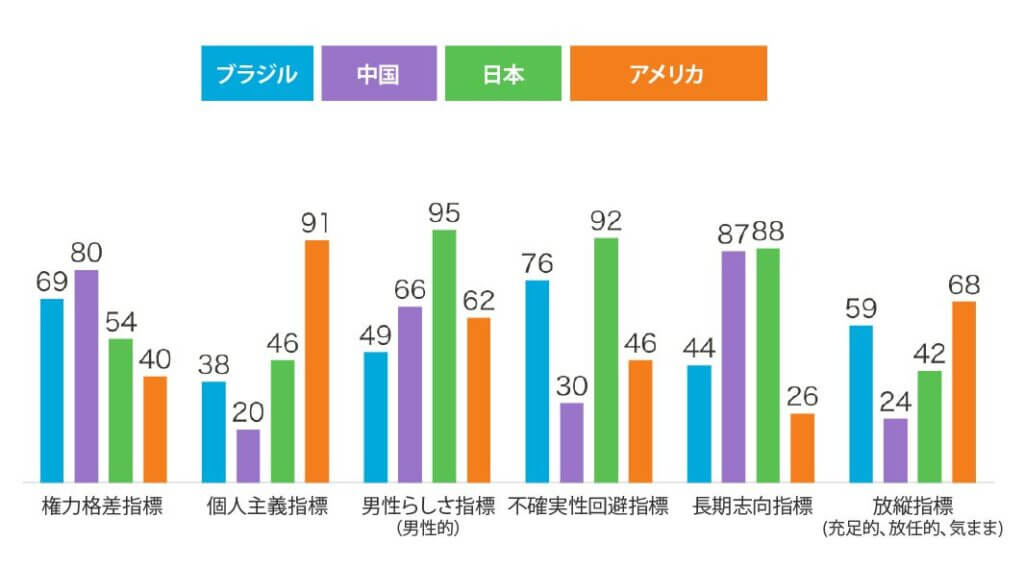


Power Distance Index
The fact that every single person is different means that all people are inherently unequal.One of the most prominent aspects of inequality is the degree to which each person has the power to influence the thoughts and actions of others.is.
This dimension isThis addresses the fact that not all individuals in society are equal, and the cultural attitudes toward such power inequalities among us.This represents...
Power distanceThat is,The degree to which weaker members of a country's institutions or organizations are likely to accept that power is distributed unequally.This is how it is defined.
The score was a midpoint of 54 points, placing Japan on the borderline of a class-based society.is.
surely,Japanese people are always aware of their hierarchical position in any social environment (they are always conscious of superior-subordinate relationships).And they act accordingly. However, compared to many other Asian cultures, it is not as hierarchical (meaning there is a clearly defined hierarchy).
Some foreigners perceive Japan as a highly hierarchical country, based on their business experiences where the decision-making process is extremely slow. This is because they have experienced a laborious decision-making process in business where every decision must be considered at every level and ultimately approved by top management in Tokyo.
Paradoxically,A precise example of the slowness of their decision-making process is that, in Japanese society, there are no top-tier individuals capable of making decisions, as is common in more hierarchical societies.This indicates that...
Another example of a country with a relatively low power distance index is Japan, which has historically been a meritocratic society.That was the case.In the Japanese education system, equality is guaranteed from birth.There is a strong belief that anyone can succeed and become anything they want if they work hard. (Especially among men)
Individualism indicators (vs. collectivism)
The fundamental issue addressed at this level is the degree of interdependence that society maintains among its members.This is it.This relates to whether people define their self-image using "I" or "we".I am doing it.
In an individualistic society, people only care about themselves and their immediate family (direct family).That's what's planned.In collectivist societies, people belong to a "group" that will take care of them in exchange for their loyalty.。
Japan46 points in the individualism index dimensionis.
It is true that Japan exhibits many characteristics of a collectivist society, such as prioritizing group harmony over individual opinions and having a strong sense of shame for losing face. However, it is not as collectivist as other Asian countries.The most well-known reason for this is that Japanese society lacks the extended family system that forms the basis of collectivist societies like those in China and South Korea.is.
Japan was a patrilineal society, where the family name and assets were passed down from the father to the eldest son. Younger siblings had to leave home and live with their own families.。It may seem like a paradoxical example, but while Japanese people are known for their strong loyalty to their companies, Chinese people change jobs easily.It seems so. However, loyalty to a company is individualistic and a choice made by oneself.
Japanese groups change depending on the situation.It can be said that...
In collectivist cultures, people pledge allegiance to natural groups such as extended families or local communities.The Japanese are collectivist by Western standards, but individualistic by Asian standards.It is said that Japanese people are more private and reserved compared to other Asians.
With a score of 95, Japan is one of the most masculine societies in the world..but,Combined with a mild form of collectivism, the assertive and competitive individual behavior often associated with masculine cultures is absent..but,Intense competition can be seen between the groups.From kindergarten age, children learn to compete for their group at sports days (traditionally red team vs white team).
In Japanese companies, employeesI'm most motivated when I'm winning a competition as a team.It is said that another expression of Japanese masculinity is the material production (manufacturing), material services (hotels and restaurants), presentation (gift wrapping and food preparation), etc.A tendency to seek excellence and perfection in all aspects.One example is the notorious Japanese workaholism, which is also one expression of their masculinity.Japan has a masculine norm of demanding long working hours.So, it's still difficult for women to climb the corporate ladder.
Uncertainty avoidance indicators
Uncertainty aversion relates to how society deals with the fact that the future can never be known.
Will you try to control the future, or will you simply let things take their course?The uncertainty of the future leads to anxiety, and the way we deal with that anxiety varies from culture to culture.
The degree to which members of a culture have created beliefs and institutions to avoid situations they perceive as ambiguous or unknown.This is reflected in the score of the "uncertainty aversion index."
With a score of 92, Japan is one of the countries on Earth that avoids uncertainty the most.
this is,This is due to Japan being constantly threatened by natural disasters such as earthquakes, tsunamis, typhoons, and volcanic eruptions.In this situation,The Japanese prepare for all kinds of uncertain situations.I have learned that.
This includes not only emergency measures and preventative measures against sudden natural disasters, but alsoThis applies to every aspect of society. In Japan, everything is regulated in order to maximize predictability.。From cradle to grave, life is highly ritualized, and there are many rituals.For example, school opening and closing ceremonies are held in much the same way everywhere in Japan.
Furthermore, etiquette books detail the proper attire and behavior for socially important events such as weddings and funerals. School teachers and civil servants don't want to do anything unprecedented. In Japanese companies,A lot of time and effort was spent on feasibility studies.Before starting a project, all risk factors must be identified. Before making a decision, managers must...All detailed facts and figures are required.In this way.The high need to avoid uncertainty is one of the reasons why it is difficult to bring about change in Japan.is.
Long-term orientation index (vs. short-term orientation index)
In this dimension,All societies must maintain some connection to their past while addressing present and future challenges.This explains that the priorities for these two existential goals differ depending on the society.
For example, in this dimensionA normative society with a low score maintains old traditions and norms while viewing social change with skepticism.I like to do that.
on the other hand,Cultures with high scores tend to take a more pragmatic approach, encouraging frugality for the future and emphasizing modern education.I will.
With a score of 88, Japan is the most long-term oriented society.It is one of them.Japanese people view their own lives as just a very short moment in the long history of humankind.
From this perspective, a certain kind of fatalism is not surprising to the Japanese. They simply believe they should do the best they can in their own lives. Furthermore, the concept of a single, all-powerful God is also unfamiliar to the Japanese.People live their lives guided by virtues and good examples.
Japanese companies' long-term orientation is characterized by consistently high R&D investment rates, high equity ratios, and a focus on steady market share expansion over quarterly profits, even in challenging economic conditions.These are all examples of this.Corporate durabilityIt's designed to improve [something].
Companies exist not just to generate quarterly profits for shareholders, but for stakeholders and society as a whole.It exists to contribute for generations to come.This idea is based on the premise that (for example, Matsushita Electric) is a good example of such a company.
Indulgence (satisfaction, laissez-faire, carefree) indicators (vs. restraint)
One of the challenges that humanity has faced, both in the past and present, isTo what extent are young children socialized?That's the point. Without socialization, we cannot become "human beings."
This dimension isThe degree to which a person tries to control their desires and impulses based on the environment in which they grew up.It is defined as follows.
The tendency to try to control impulses with relatively little force is called "licentiousness (fulfilling, laissez-faire, carefree)." They call it,The tendency to try to control impulses relatively strongly is called "restrained." This is what we call it. In this way, cultures can be classified into "licentious" and "restrained."
Japan scored a low 42 points, reflecting a culture of "restraint."It can be seen that it has.
A society with a low score in this dimension isCynicism and pessimismThey tend to have this trait.
Furthermore, in contrast to societies with a strong tendency towards "laissez-faire," societies with a strong tendency towards "restraint"They tend to place less importance on leisure time and try to control how they satisfy their desires.
People with this kind of inclinationI recognize that my actions are restricted by social norms, and I feel that there is something wrong with indulging myself.。
Share your thoughts on this article on social media using the button below to let your followers know!
- Cultures of various countries around the world
↓Click here if you want to find out your own or someone else's personality type↓
For those who want to learn more about Dr. Hofstede's theory of cultural dimensions, see below ↓
comment