
How can I learn about other countries?
World cultures are different.That's what they say.Each country has its own culture, and they are all different.friend.
However, most of us don't live in different parts of the world, so it's probably difficult to truly know if cultures are different. Even if someone has lived in 30 countries, it's undeniable that they likely haven't had much time to get to know the culture of each country.
So,For example, is Japan's culture *really* different from that of the West? If so, *how* different is it?Are there no differences within the Western world? South America has a large Latin population, but is it the same as Europe? What about Arabia, Africa, Southeast Asia, Korea, and China?
The solution to this problem wasDr. Gerald Hofstedeis.
The doctor was a professor of organizational anthropology and international management at the Faculty of Economics and Business at the University of Limburg in the Netherlands, and also served as the director of the university's Institute for Intercultural Cooperation.
Remarkably, the multi-talented Dr. Hofstede was also a mechanical engineer and worked for the global corporation IBM. From 1967 to 1973, he worked with IBM's subsidiaries around the world.We conducted a large-scale research study on differences in national values.Therefore, they distributed questionnaires to many people and conducted analyses using what we would now call big data. You could even say they were way ahead of their time.
Furthermore, through his academic and cultural activities in various countries, Dr. Hofstead became one of the leading figures in intercultural studies and research.His theories are still used worldwide in the fields of psychology and business management.
*It has established a leading research tradition in intercultural psychology and is used by researchers and consultants in many fields related to international business and communication. It is particularly well known in intercultural psychology, international management, and intercultural communication studies.
Now, enough with the preliminaries, let's take a look at the differences using the responses to the psychological tests that Dr. Hofstede conducted with a multinational group of people.


Dr. Hofstede's 6-Dimensional Model
I will now explainDr. Hofstede's six-dimensional model is one of the most popular frameworks for measuring cultural dimensions from a global perspective.is.
Identifying the cultural behaviors of each group or category and examining how cultural values influence these behaviors helps deepen our understanding of different cultures. To construct this theory, Dr. Hofstede drew on multiple studies conducted in more than 50 countries during the 1980s.
In this theory, the following"Six Cultural Dimensions"This is what we are presenting.
- Power Distance Index
- individualism index(vs collectivism)
- Masculinity indicators(vs femininity)
- Uncertainty avoidance indicators
- long-term orientation index(vs. short-term orientation index)
- Indulgent (satisfied, laissez-faire, carefree) indicators(vs suppression)
for example,A comparison of four countries—the United States, China, Germany, and Brazil—across six dimensions.Then it will look like this ↓
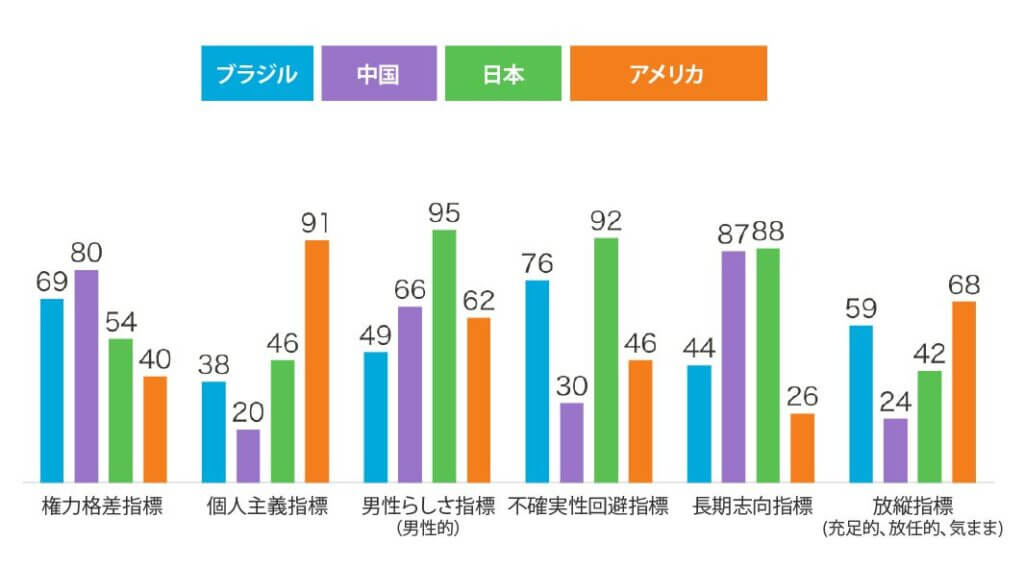
From below,6 dimensionsWe will explain each of these in more detail.
(For a quick summary, see below)Click here ↓)
A list of world cultures (6 cultural dimensions)
(1) Power Disparity Index (PDI)
Meaning: Whether or not you accept the power gap (the indicator will be high if you accept it)
Globally: High in Asian countries, low in Nordic and Anglo-American countries.
Japan: Lowest in Asia, but higher than the Nordic and Anglo-American countries.
(2) Individualism versus collectivism (IDV)
Meaning: Individualistic or collectivist orientation (the indicator is higher if the former)
Globally: High in Nordic and Anglo-American countries, low in Asian and Central and South American countries.
Japan: Second highest in Asia after India (and in the middle globally).
(3) Masculinity versus femininity (MAS)
Meaning: High if masculinity (competition and career advancement) is important, low if femininity (lifestyle) is important.
Globally: Anglo-American countries are masculine, Nordic countries are feminine, and Asian countries show significant national differences.
Japan: One of the world's top countries in terms of height, followed by China in Asia.
(4) Uncertainty avoidance index (UAI)
Meaning: High in tension-based societies that avoid uncertainty, and low in relaxed societies that accept uncertainty.
Globally: High in Southern European countries, medium to low in Northern European and Anglo-American countries, and large country-by-country differences in Asian countries.
Japan: Relatively high compared to the rest of the world; South Korea follows Japan in Asia.
(5)Long-term versus short-term orientation (LTO)
Meaning: High if you are long-term oriented and prepare for the future without being fixated on the immediate future, and low if you are short-term focused.
Globally: High in Asian and Central European countries, and low in the Middle East, Africa, Central and South America, and the United States.
Japan: Along with South Korea, China, and Taiwan, it has the highest average height in the world.
(6) Indulgence versus restraint (IVR)
Meaning: High if the proportion of very happy people is large, and low if the proportion of very happy people is small.
Globally: High in Central and South American countries and Nordic/Anglo-American countries; low in Central and Eastern European countries; medium to low in Asian countries.
Japan: High within Asia
This section summarizes Japan's performance in comparison to other countries around the world. The power gap index is slightly low, the individualism index is average, the masculinity index is top-tier, the uncertainty avoidance index is high, the long-term orientation index is top-tier, and the licentiousness-restraint index is average. In short, Japanese society highly values masculinity (competition and career advancement), avoids uncertainty, and has a very strong long-term orientation, while its power gap, individualism, and licentiousness-restraint are about average globally.
The above is a quote from Tsukushinbo's Amazon review of "Multicultural World - Learning from Differences and Exploring the Path to the Future".
Power Distance Index
"The degree to which weaker members of an organization or institution (such as a family) accept and expect that power is distributed unequally."This is how it is defined.
(*This refers to the extent to which weaker members accept the difference between power and equality. In some societies, the distance from power may be minimal, while in others, it may be very large.)
In this dimension, inequality and power are perceived by the followers (lower classes).
A higher index indicates that a clear hierarchy is established within society, and that things are done without question or reason.。
A lower index indicates that people are questioning authority and trying to decentralize power.。
In the power gap index,Latin America, Asian countries, the African region, and the Arab world all scored very high.This indicates that.
on the other hand,In Germanic countries, including English-speaking countries, the power distance is low.(The numbers are still low at 11 in Austria and 18 in Denmark.)
For example, the United States scores 40 points on the Hofstede analysis's cultural scale. Compared to Guatemala (95), which has a very high power distance, and Israel (13), which has a very low power distance, the United States is in the middle.
*Hierarchical distance is involved (click to open)
"Hierarchical distance" refers to how a society accepts the distribution of power across various institutions and organizations. Countries with low hierarchical distance prefer decentralized organizations, while countries with high hierarchical distance accept centralization of society.
It can also be defined as the degree to which "powerless" members of society accept the uneven distribution of power. Furthermore, this dimension does not necessarily measure the distribution of power in society, but rather how citizens feel about it.
A high score suggests that there are people who possess far greater power than others.
In countries with high stratification distances, individuals accept inequality and their place in society, and recognize and agree with formal hierarchies. Low scores reflect the view that people should have equal rights and obligations.
Latin America and Arab countries tend to have the highest scores in this category, while Anglo-Saxon, Scandinavian, and Germanic cultures tend to have lower scores, indicating a greater sense of equality among individuals within their communities.
(Latin America and Arab countries are authoritarian societies, while North America and the UK are egalitarian societies.)
Individualism indicators (vs. collectivism)
The "individualism index (vs collectivism)" represents the degree to which citizens value autonomy versus how much they value social rules and loyalty to their group.
This degree represents the degree to which an individual is integrated into society and their sense of belonging to a group.In this high-level society (individualistic society), individuals tend to value themselves and their close relatives..Also,"I" and "We"The relationship between these two is considered important.
on the other hand,In this lower-dimensional society (collectivist society), group ties are broader, family units are more extensive (including uncles, cousins, and grandparents), and there is unwavering loyalty to the group.It is a society where people help each other even when conflicts arise with other groups.
Collectivists share a sense of belonging within a group and prioritize the group's interests over individual interests.(Collective interests > Individual interests),Hierarchical relationshipsThey place importance on their relationships with other individuals.
Cultures considered to be individualistic include the United States, Australia, and the United Kingdom.The United States is one of the most individualistic societies. Conversely,Cultures in Guatemala, Pakistan, and Indonesia are collectivist.It is said that...
Individualism (IDV) is prevalent in the United States (91), Australia (90), and the United Kingdom (89).And it's getting higher. On the other hand,Hong Kong, Serbia (25), Malaysia (26), and Portugal (27) are collectivistIt is said that...
Masculinity indicators (vs femininity)
Masculinity is defined as "a society that favors a sense of accomplishment, heroism, self-assertion, and material rewards for success."It is defined as follows: A masculine society is one in which the entire society is a competitive society.
on the other hand,Femininity is defined as "cooperativeness, humility, consideration for the vulnerable, and concern for quality of life (QOL)."In feminine societies, consensus is highly valued.
This dimension focuses on whether society places more value on "achievement" or "development."
Masculinity is defined as emphasizing ambition and the acquisition of wealth, and clearly distinguishing between gender roles (a strong desire to strictly differentiate between the roles of men and women).That is its characteristic,Femininity emphasizes nurturing and raising children, equality and consideration for the environment, and clearly defines a more fluid division of roles based on gender.This is a characteristic feature. (A feminine society is one in which social gender roles overlap.)
Masculine societies (Japan, Venezuela, Italy, Ireland, Mexico) are characterized by strong self-assertion, competitiveness, and a focus on results.I will.
on the other hand,Feminine societies (Sweden, Norway, Finland, Denmark, and the Netherlands) tend to be modest, empathetic, focus on building good relationships, and strive to provide a high quality of life for all.There is.
In a masculine society, there is a large gap between masculine and feminine values. Women tend to be more assertive and competitive, but significantly weaker than men.
Masculinity is extremely low in the Nordic countries.。
in contrast,In Japan (95), and in European countries such as Hungary, Austria, and Switzerland, which have been influenced by German culture, masculinity is very high.。
In English-speaking countries, scores for masculinity are relatively high, for example, in the UK it is 66. In Latin America, Venezuela scores 73,Chile, in contrast, scored 28 points.is.
| Features | Masculine society | Feminine society |
|---|---|---|
| social norms | Prioritize your own desires - Emphasis on money and material things Living for work | • Emphasis on interpersonal relationships ・Emphasis on a high quality of life - To work in order to make a living |
| Politics and Economics | Economic growth is the top priority. - Resolve conflicts by force | Environmental protection is our top priority. - Resolve disputes through negotiation |
| religion | • The most important thing in life - Only men can become priests (male-dominated) | - The least important thing in life - Both men and women can become priests (gender equality) |
| work | • There is a large wage gap between men and women. - There are few women in management positions. • Prefers high wages | • The wage gap between men and women is small. • There are more women in management positions. • Prefers part-time work |
| Family and school | • Traditional family structure Girls can cry, but boys shouldn't. Boys fight, but girls do not. Failure is the root of all evil (I will not tolerate it). | Flexible family structure It's okay for both boys and girls to cry. No one fights • Small failures (don't worry about them) |
Uncertainty avoidance indicators
Defined as "social tolerance for ambiguity," it indicates whether one accepts or avoids the unexpected, the unknown, and deviations from the status quo.It is.
(To what extent are people willing to accept something uncertain and ambiguous like the future—that is, risk—and how do people feel when faced with unknown situations?(This indicates)
for example,A low score on this index indicates that the people of that country are entrepreneurial, risk-takers, and highly independent.This indicates that...
The lower the score on this indicator, the more likely people are to be open to different ideas and perspectives.Societies tend to have fewer regulations, become more accustomed to ambiguity, and develop a freer environment. Also, a low score on this index indicates that people in that country are more entrepreneurial and willing to take risks.
Jamaica and SingaporeCountries with low scores on this index tend to be more thoughtful, tolerant, and relativistic, where uncertainty is accepted as part of life, and people are generally more relaxed and flexible when faced with unknown situations.
on the other hand,Cultures with a high uncertainty control index tend to prefer stability, rules, and social norms, and are resistant to taking risks.。
(*This is also related to the degree to which men and women are resistant to certain structured activities.)
Such high-minded societies adopt strict codes of conduct, guidelines, and laws, and are based on the belief that absolute truth, the one and only truth, determines everything and that people know what it is.
Japan, Greece, RussiaCountries with high scores tend to avoid risks, unstructured situations, and unusual circumstances. These countries are more emotional, often strengthen their security through strict laws, and tend to believe in absolute truth on a philosophical and religious level.
Despite being geographically close,
Sweden (29) and Denmark (23)ComparedGermany scored highly (65), and Belgium scored even higher (94).This indicates that... However, there are also some countries with very low scores.
Long-term orientation index (vs. short-term orientation index)
This dimensionIn culture, this refers to the emphasis placed on long-term or short-term life direction in relation to certain activities.。
The concepts of long-term orientation and short-term orientation are,Note that this illustrates differences in how time is perceived across cultures and highlights the importance of the past, present, and future.It is necessary.
A low score on this indicator (short-term) indicates that traditions are respected, maintained, and unwavering.This indicates that. (←You might be surprised, but it's not the other way around.)In the long-term future society, we will not necessarily be bound by maintaining current traditions, but will create new ones.(We will continue to do so.)
AlsoA short-term orientation focuses on the present or past, prioritizing them over the future.Short-term orientation isValues placed on tradition, the current social hierarchy, and the fulfillment of social obligations.They prioritize immediate satisfaction over long-term satisfaction.
Cultures with this mindset tend to focus their efforts and beliefs on short-term issues such as saving face or fulfilling social obligations.
Furthermore, the society tends to be more traditional, more concerned with social obligations, and more extroverted and quick-witted (for example, avoiding blunt language and speaking more frankly).
Such a societyWhile respecting tradition, it encourages consumption and short-term gains.I will.United States, United Kingdom, SpainIn countries with short-sighted cultures, a member's status is not that important, and relationships are only important if they can be beneficial.
on the other hand,In societies with a high score on this indicator (in the long term), adaptability to the situation and practical problem-solving are required.
A long-term orientation isEmphasis on future rewardsIt focuses on the positive aspects. It may even be willing to delay short-term social success or emotional satisfaction in preparation for the future. Having this kind of cultural perspective,Perseverance, patience, frugality, resilienceValue can be found in these, among other things.
A long-term orientation leads to a society rich in savings and patience.The target group is one in which members of society have different social classes, the elderly must be respected, and East Asian countries such as China, South Korea, and Japan tend to have a long-term oriented national culture. Long-term orientation means...Tendencies include frugality and thrift, patience, differences in social standing, and respect for elders.This refers to...
Poor countries with a short-term focus usually experience little economic development.In contrast,Countries with a long-term perspective continue to develop to levels of prosperity.
East Asia generally scores highly in long-term orientation, with South Korea scoring the highest 100 points, Taiwan 93 points, and Japan 88 points.That's the situation. However, there isn't much data available regarding this dimension.
Indulgence (satisfaction, laissez-faire, carefree) indicators (vs. restraint)
This describes the worldview of a culture, such as an optimistic and positive culture (a culture that values laissez-faire) or a pessimistic and pessimistic culture (a culture that emphasizes restraint).
(The degree to which social norms grant freedom to satisfy the human needs of citizens)
In a generous (fulfilling) culture, people lead relaxed lives and believe that while hard work is important, enjoying life is equally important.
vice versa,In restrictive cultures, relaxing and enjoying life is seen as a lack of self-control, and the idea of enjoying life is not well considered.
*in this case,A fulfilling society is one in which people can relatively freely satisfy their basic and natural desire to enjoy life.This is how it is defined.
In response to this,"Restrained" means "a society that controls and regulates the satisfaction of desires through strict social norms."This is how it is defined.
Countries like Australia are strong and fulfilling.And,Countries like Russia and China are restrained.is.
Also,Latin America, parts of Africa, the UK, and Scandinavia all scored the highest as "sufficient (laissez-faire)."、The term "restrained" is commonly found in East Asia and Eastern Europe.
Share your thoughts on this article on social media using the button below to let your followers know!
- Cultures of various countries around the world
↓Click here if you want to find out your own or someone else's personality type↓

For those who want to learn more about Dr. Hofstede's theory of cultural dimensions, see below ↓
comment