
By comparing a country's culture with those of other cultures around the world, we can understand the factors that deeply drive its unique culture. A country's culture reflects the central trends of its society.
For example, every individual possesses uniqueness, but due to social control, most people do not deviate significantly from norms (standards).


Power Distance Index
The fact that every single person is different means that all people are inherently unequal.One of the most prominent aspects of inequality is the degree to which each person has the power to influence the thoughts and actions of others.is.
This dimension isThis addresses the fact that not all individuals in society are equal, and the cultural attitudes toward such power inequalities among us.This represents...
Power distanceThat is,The degree to which weaker members of a country's institutions or organizations are likely to accept that power is distributed unequally.This is how it is defined.
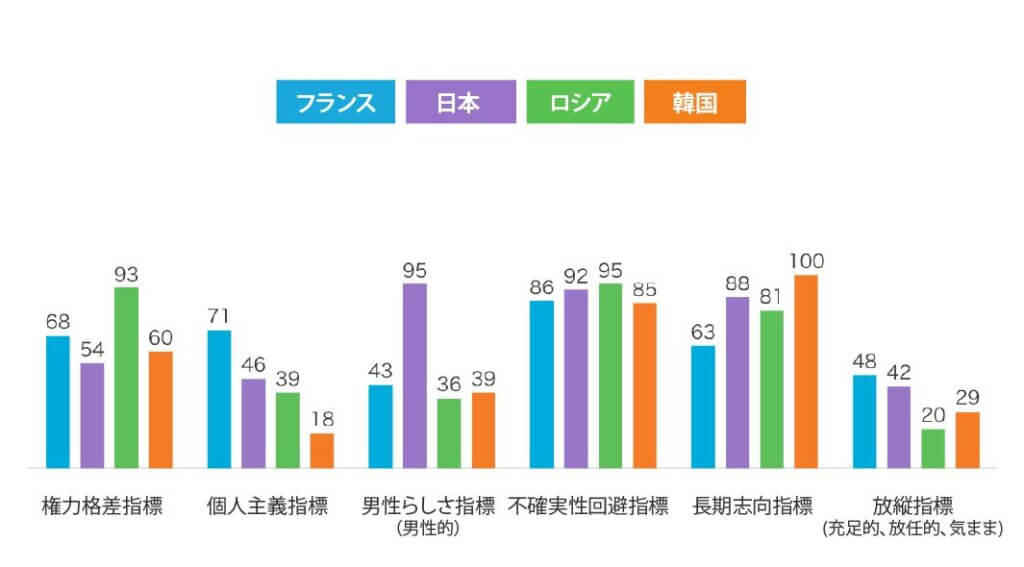
Somewhere in the middle of this dimensionSouth Korea, with a score of 60, has a somewhat hierarchical society.is.
this is,It means that people accept a hierarchical order in which everyone has a place.I will.
Hierarchical structures within organizations are seen as reflecting inherent inequality, centralization is popular, subordinates expect to be told what to do, and the ideal boss is considered a benevolent dictator.
Individualism indicators (vs. collectivism)
The fundamental issue addressed at this level is the degree of interdependence that society maintains among its members.This is it.This relates to whether people define their self-image using "I" or "we".I am doing it.
In an individualistic society, people only care about themselves and their immediate family (direct family).That's what's planned.In collectivist societies, people belong to a "group" that will take care of them in exchange for their loyalty.。
South Korea, with a score of 18, is a collectivist society.This is thought to be the case. This includes family, relatives, and kinship relationships.To be closely committed to (involved in) the group of members over the long term.This is clear from the facts.
Loyalty is of utmost importance in collectivist cultures.And most otherTakes precedence over social rules and regulationsI will.
In this society, everyone belongs to their groupA strong sense of responsibility towards one's peers is fostered.。
In collectivist societies, violations areShame and HonorThis can lead to the loss of [something], the employer-employee relationship is perceived from a moral standpoint (like a family relationship), hiring and promotion decisions are made considering the in-group (within the group) of employees, and management is seen as the management of the group.
South Korea scored 39 points in this dimension, and is a feminine society.It is thought that this is the case.
In feminine countries,"Work to make a living"Emphasis is placed on certain aspects, with managers seeking consensus and people valuing equality, solidarity, and quality in their work. Conflicts are resolved through compromise and negotiation.
Incentives such as free time and flexibility are preferred.They prioritize well-being, and status is less important. Effective managers are supportive, and decision-making is done through involvement.
Uncertainty avoidance indicators
Uncertainty aversion relates to how society deals with the fact that the future can never be known.
Will you try to control the future, or will you simply let things take their course?The uncertainty of the future leads to anxiety, and the way we deal with that anxiety varies from culture to culture.
The degree to which members of a culture have created beliefs and institutions to avoid situations they perceive as ambiguous or unknown.This is reflected in the score of the "uncertainty aversion index."
South Korea, with a score of 85, is the country with the highest uncertainty aversion score in the world.One example is a country with a high degree of uncertainty aversion. Countries have strict norms regarding beliefs and actions, and are not tolerant of different behaviors or ways of thinking.
In such a culture, "time is money," people have an internal urge to work busily, accuracy and punctuality are the norm, there is resistance to innovation, and security is a key factor in individual motivation.
Long-term orientation index (vs. short-term orientation index)
In this dimension,All societies must maintain some connection to their past while addressing present and future challenges.This explains that the priorities for these two existential goals differ depending on the society.
For example, in this dimensionA normative society with a low score maintains old traditions and norms while viewing social change with skepticism.I like to do that.
on the other hand,Cultures with high scores tend to take a more pragmatic approach, encouraging frugality for the future and emphasizing modern education.I will.
South Korea scores a perfect 100 points as the most realistic and long-term societyIt is considered one of them. For Koreans,The concept of a single, all-powerful God is unfamiliar to me.People,Living guided by virtue and practical exampleI am doing it.
Korean companies are showing a long-term approach, such as increasing their equity ratio and prioritizing steady market share expansion over quarterly profits.Enhancing the durability of businessesIt's for that purpose.
The underlying idea is that companies do not exist to make money quarterly for shareholders,It exists to serve stakeholders and society as a whole for generations to come.That's the point.
Indulgence (satisfaction, laissez-faire, carefree) indicators (vs. restraint)
One of the challenges that humanity has faced, both in the past and present, isTo what extent are young children socialized?That's the point. Without socialization, we cannot become "human beings."
This dimension isThe degree to which a person tries to control their desires and impulses based on the environment in which they grew up.It is defined as follows.
The tendency to try to control impulses with relatively little force is called "licentiousness (fulfilling, laissez-faire, carefree)." They call it,The tendency to try to control impulses relatively strongly is called "restrained." This is what we call it. In this way, cultures can be classified into "licentious" and "restrained."
The low score of 29 points suggests that Korean society is a "repressive society."This indicates that societies with low scores in this dimension areA tendency towards cynicism or pessimismThere is.
Furthermore, in contrast to a "laissez-faire" society, in a "restraint" society,I don't place much importance on leisure time, and I control the fulfillment of my desires.People with this orientation perceive their behavior as being restricted by social norms.There's something wrong with spoiling yourself.That's how I feel.
Share your thoughts on this article on social media using the button below to let your followers know!
- Cultures of various countries around the world
↓Click here if you want to find out your own or someone else's personality type↓

For those who want to learn more about Dr. Hofstede's theory of cultural dimensions, see below ↓
comment