
By comparing a country's culture with those of other cultures around the world, we can understand the factors that deeply drive its unique culture. A country's culture reflects the central trends of its society.
For example, every individual possesses uniqueness, but due to social control, most people do not deviate significantly from norms (standards).


Power Distance Index
The fact that every single person is different means that all people are inherently unequal.One of the most prominent aspects of inequality is the degree to which each person has the power to influence the thoughts and actions of others.is.
This dimension isThis addresses the fact that not all individuals in society are equal, and the cultural attitudes toward such power inequalities among us.This represents...
Power distanceThat is,The degree to which weaker members of a country's institutions or organizations are likely to accept that power is distributed unequally.This is how it is defined.
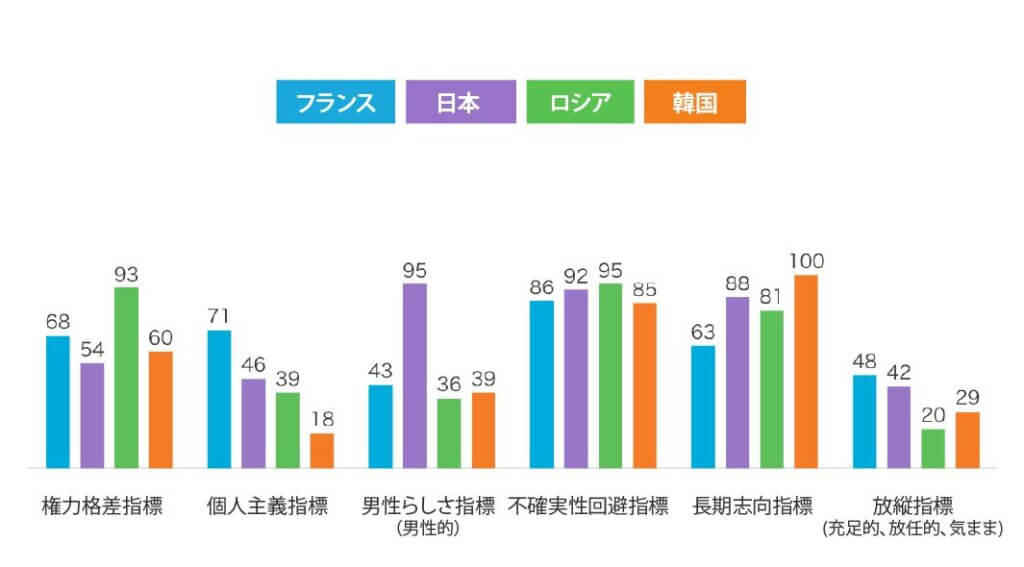
Russia, with a score of 93, is a country where those in power are very far removed from society (from the common people).is.
This means that Russia, the world's largest countryHighly centralizedThis is emphasized by the fact that it is being done.Two-thirds of foreign investment in Russia and the financial industry (80%) are concentrated in Moscow.I am doing it.
Because there is a big difference between those who are powerless and those who are powerful,Status symbols are very important.It is as it is.
Actions must be expressed in a way that reflects the role of one's position in all areas of business, including visits, negotiations, and collaborations. The approach isA top-down approach is necessary, with clear instructions given for every task.。
Individualism indicators (vs. collectivism)
The fundamental issue addressed at this level is the degree of interdependence that society maintains among its members.This is it.This relates to whether people define their self-image using "I" or "we".I am doing it.
In an individualistic society, people only care about themselves and their immediate family (direct family).That's what's planned.In collectivist societies, people belong to a "group" that will take care of them in exchange for their loyalty.。
If a Russian is going out with friends, they'll say "We with friends" rather than "I and my friends," and if they're talking about siblings, they might be talking about cousins.A low score of 39This is also expressed in language.
Family, friends, and sometimes even neighbors are all very important in our daily lives.Relationships are extremely important for obtaining information, getting introductions, and successfully negotiating.is.
To concentrate on work, personal trust is essential, and it's necessary to build considerate communication rather than relying on implicit communication styles.
Russia's relatively low score of 36While it may seem surprising that they favor status symbols, in Russia these are linked to a high power distance.
At first glance, Russians, whether at work or when meeting strangers,He speaks modestly about his own achievements, contributions, and abilities.You can see that.
They speak modestly about themselves, and scientists, researchers, and doctors are almost always expected to live at a very modest standard of living.Dominant behavior may be acceptable from a superior, but it will not be well-received among colleagues.
Uncertainty avoidance indicators
Uncertainty aversion relates to how society deals with the fact that the future can never be known.
Will you try to control the future, or will you simply let things take their course?The uncertainty of the future leads to anxiety, and the way we deal with that anxiety varies from culture to culture.
The degree to which members of a culture have created beliefs and institutions to avoid situations they perceive as ambiguous or unknown.This is reflected in the score of the "uncertainty aversion index."
A score of 95 indicates that the Russians have established one of the world's most complex bureaucracies.Because of this,I feel a great sense of crisis about this ambiguous situation.I have it.
For example, if negotiations have just begun and the focus is on building a relationship, a presentation may not be prepared, but at other times, it may be prepared in great detail.Detailed plans and explanations are also provided very well.。
Russians prefer contextual and background information.Russians, when interacting with people they don't know well, can come across as very stiff and reserved. At the same time, this formality is also a sign of respect.
Long-term orientation index (vs. short-term orientation index)
In this dimension,All societies must maintain some connection to their past while addressing present and future challenges.This explains that the priorities for these two existential goals differ depending on the society.
For example, in this dimensionA normative society with a low score maintains old traditions and norms while viewing social change with skepticism.I like to do that.
on the other hand,Cultures with high scores tend to take a more pragmatic approach, encouraging frugality for the future and emphasizing modern education.I will.
Russia achieved a very high score of 81.That is undoubtedlyRealisticIt is a country with such a mindset. In a society with a pragmatic orientation, peopleThe truth is heavily influenced by the situation, context, and time.I believe these traits demonstrate an ability to easily adapt traditions to changing circumstances, a strong inclination towards saving and investing, frugality, and perseverance to achieve results.
Indulgence (satisfaction, laissez-faire, carefree) indicators (vs. restraint)
One of the challenges that humanity has faced, both in the past and present, isTo what extent are young children socialized?That's the point. Without socialization, we cannot become "human beings."
This dimension isThe degree to which a person tries to control their desires and impulses based on the environment in which they grew up.It is defined as follows.
The tendency to try to control impulses with relatively little force is called "licentiousness (fulfilling, laissez-faire, carefree)." They call it,The tendency to try to control impulses relatively strongly is called "restrained." This is what we call it. In this way, cultures can be classified into "licentious" and "restrained."
The restrained nature of Russian culture resulted in a very low score of 20 in this dimension.This is also clear from the fact that societies with low scores in this dimension areCynicism and pessimismThere is a tendency for this to happen.
Furthermore, in contrast to a "laissez-faire" society, in a "restraint" society,Less emphasis on leisure time, and more control over satisfying desires.I will try.
People with this orientation,My actions are restricted by social norms.With that understanding,There's something wrong with spoiling yourself.That's how I feel.
Share your thoughts on this article on social media using the button below to let your followers know!
- Cultures of various countries around the world
↓Click here if you want to find out your own or someone else's personality type↓

For those who want to learn more about Dr. Hofstede's theory of cultural dimensions, see below ↓
comment