

"Ketone bodies" are short-chain fatty acids produced in the mitochondria of liver cells when glucose in the body is depleted! As explained earlier, "ketone production" is the process of producing ketone bodies. This process occurs when glucose in the body is depleted, and the mitochondria of liver cells break down fatty acids (fatty acids with large molecules) into "short-chain fatty acids," which are fatty acids with smaller molecules. These short-chain fatty acids produced in this ketone production process are collectively called "ketone bodies."
What is the difference between 'ketone bodies' and 'short-chain fatty acids'?For more information, please refer to the following article ↓
What is the difference between 'ketone bodies' and 'short-chain fatty acids'?


Ketone production
When glucose in the body is depleted, triglycerides are broken down into fatty acids and glycerol, and the resulting free fatty acids and glycerol are released into the bloodstream. These free fatty acids are then taken up by normal cells and metabolized in the mitochondria to produce energy.
(Glycerol is converted to glucose in the liver.)
However, these fatty acids have large molecules and cannot cross the blood-brain barrier, so they cannot be used as an energy source for the brain.
Only "small molecules" like glucose, ketone bodies, and short-chain fatty acids can pass through the blood-brain barrier.
When the body's glucose stores are depleted, the body must deliver fatty acids to the brain as an "alternative energy source" to replace glucose.
However, the fatty acids in the body are "large-molecule fatty acids," and because they are too large to pass through the blood-brain barrier, they cannot reach the brain as an "alternative energy source" to glucose. If this continues, brain cells will die, so the body has to do something about it.
Therefore, it becomes necessary to enlist the help of mitochondria in liver cells to break down and synthesize these "large fatty acids" into "smaller fatty acids," thereby delivering these "smaller-molecule" fatty acids (= short-chain fatty acids) that can cross the blood-brain barrier to brain cells.
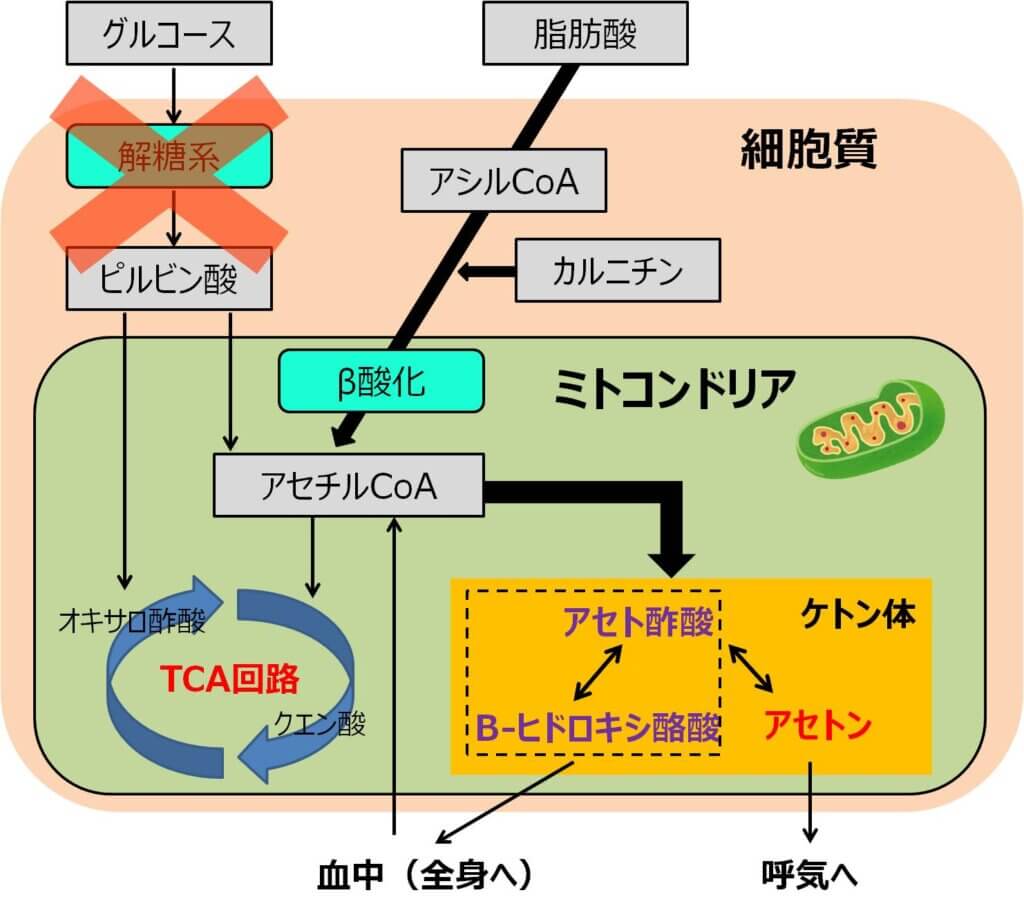
The above diagram shows,An Easy-to-Understand Guide to Ketone Bodies: The Myth of Ketone Bodies' Dangers (Quoted from)
First, in the mitochondria of liver cells, "large fatty acids" are broken down and, through the synthesis process described above, transformed into "small fatty acids." Through this ketone production process, "short-chain fatty acids" called "ketone bodies" are created by breaking down and synthesizing "large fatty acids" into "small fatty acids." These include "acetoacetate" and "β-hydroxybutyrate (which accounts for 75% of ketone bodies)." (Acetone is excreted in the breath and therefore does not serve as an energy source.)
Because the short-chain fatty acids (ketone bodies) produced through ketone generation can cross the blood-brain barrier, they can deliver an alternative energy source to brain cells instead of glucose.
Short-chain fatty acids (ketone bodies) such as acetoacetate and β-hydroxybutyrate (which account for 75% of ketone bodies), produced through ketone synthesis, have small molecules like glucose, allowing them to cross the blood-brain barrier, reach brain cells, and become an energy source for the brain.
In this way, the body urgently produces short-chain fatty acids (ketone bodies), which are small fatty acids that can cross the blood-brain barrier, in order to deliver fatty acids to brain cells as an alternative energy source to glucose, thus coping with starvation.
In summary, see below ↓
Ketone bodies are the smallest byproducts of fatty acid breakdown.
In other words, ketone bodies are "small-molecule fatty acids (short-chain fatty acids)" that have been broken down into smaller molecules that can pass through the blood-brain barrier.
What is ketone production?When glucose in the body is depleted, the body breaks down large fatty acids into smaller ones, making them smaller enough to pass through the blood-brain barrier and deliver these fatty acids, which can serve as an alternative energy source to glucose, to brain cells. This is the body's response to achieve this.

comment