

Carbohydrate restriction and carbohydrate restriction dietWe often hear things like this, but once again,”Carbohydrates“"What is that? You may have heard that it's found in large quantities in carbohydrates. Let's take a look."


What are carbohydrates? – Classification of sugars –
Sugars can be classified as follows:
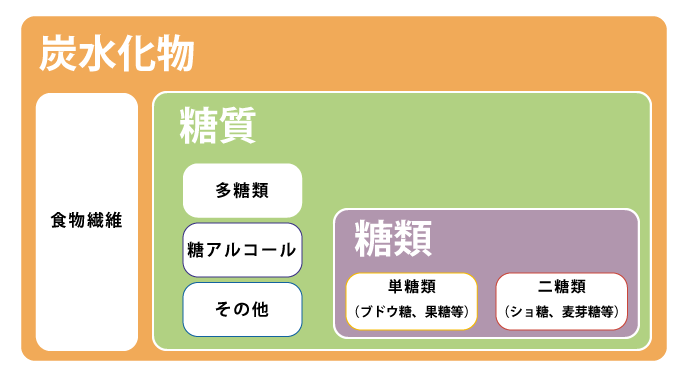
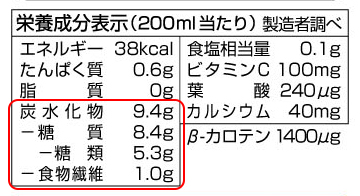
「Carbohydrates」・・・「carbohydrates"from"Dietary fiberExcluding "
*The above is from Sujata MeirakuWhat are carbohydrates, sugars, and sugars?Quoted from "
In other words,「carbohydrates」=「Carbohydrates」+「Dietary fiber」This is the result.
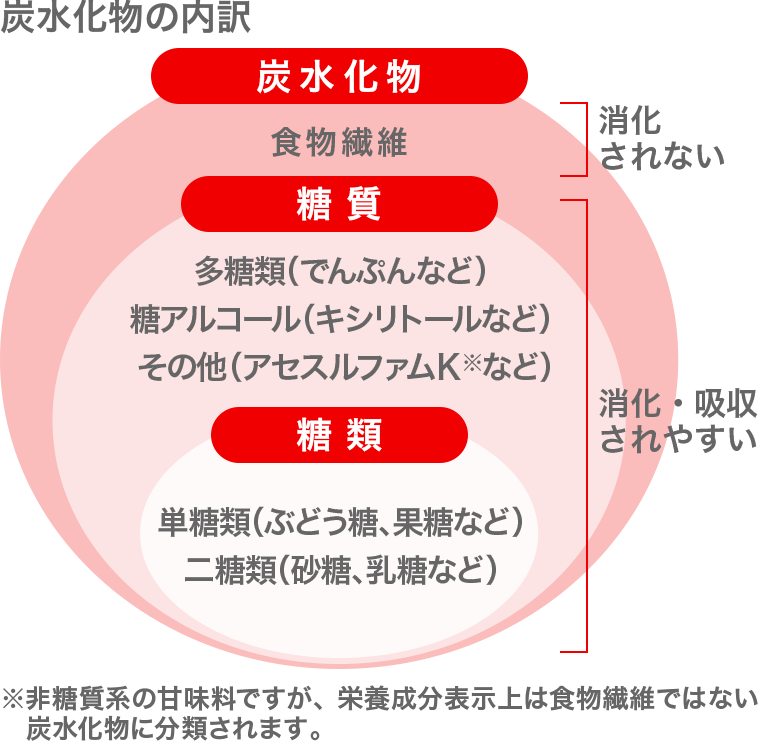
In modern nutrition, carbohydrates are classified as "sugars" if they are digested (broken down) by human digestive enzymes and become an energy source, and as "dietary fiber" if they cannot be digested (broken down) by human digestive enzymes.
However, another way of thinking is to consider all carbohydrates as "sugars," and to define those that are "digestible and absorbable," meaning they are broken down by human digestive enzymes and become an energy source.Digestive and absorbable carbohydrates" and "indigestible" substances that cannot be digested (broken down) by human digestive enzymes are "Indigestible and absorbable carbohydratesIn some cases, it is written as '.
What are "digestible and absorbable carbohydrates"?These are "digestible and absorbable" carbohydrates, such as sucrose and alpha-starch, which are digested (broken down) by human digestive enzymes and become an energy source.
Furthermore, "resistant carbohydrates" refer to carbohydrates that cannot be digested (broken down) by human digestive enzymes, such as resistant starch (beta-starch), resistant oligosaccharides and sugar alcohols, and dietary fiber.
What is "resistant starch (beta-starch)"?This refers to "raw starch," which is said to be "indigestible" because it cannot be digested (broken down) by human digestive enzymes. However, in reality, it is only "difficult to digest (hard to break down)," and although some of it is digested (broken down) into "glucose," it is not digested (broken down) as completely as the "digestible and absorbable" "carbohydrates" of "heated starch (alpha starch)."
Furthermore, it contains "indigestible" carbohydrates that cannot be digested (broken down) by human digestive enzymes, such as resistant starch (beta-starch), resistant oligosaccharides and sugar alcohols, and dietary fiber.It was previously believed that "indigestible and absorbable carbohydrates" could not be used as an energy source.
However, in reality, these substances pass through the small intestine without being digested (or broken down) and reach the large intestine, where they are fermented and broken down by intestinal bacteria to produce an energy source called "short-chain fatty acids." In addition, various nutrients such as "vitamins," "minerals," "amino acids," and "enzymes," as well as "hydrogen gas," are produced and provided to the human host.Humans ingest and utilize these beneficial components produced when intestinal bacteria ferment and break down "indigestible and absorbable carbohydrates."
This is important, so let me summarize it again.
It is a "carbohydrate" that is "digestible and absorbable"."Digestive and absorbable carbohydrates" are digested (broken down) and become glucose, which is an energy source.
It is a "carbohydrate" that is "difficult to digest"."Indigestible and absorbable carbohydrates" pass through the small intestine without being digested (not broken down) and reach the large intestine, where they are fermented and broken down by intestinal bacteria to produce "short-chain fatty acids," which are an energy source.[Other nutrients, as mentioned above, are also produced.]
In short, the only difference is the "type" of energy source obtained.Incidentally, short-chain fatty acids are a far superior energy source than glucose.is.
It is a carbohydrate that is difficult to digest and absorb.Consuming dietary fiber and increasing short-chain fatty acids is very important for good health. Among dietary fibers, "Salacia" is highly recommended.You can find more details below ↓

Sugar content of each food item
Carbohydrates tend to contain a lot of sugar, so you shouldn't eat too much of them.
Carbohydrates are found in large quantities in foods such as rice, bread, and sweets.

Sports drinks also contain a lot of sugar, so be careful.
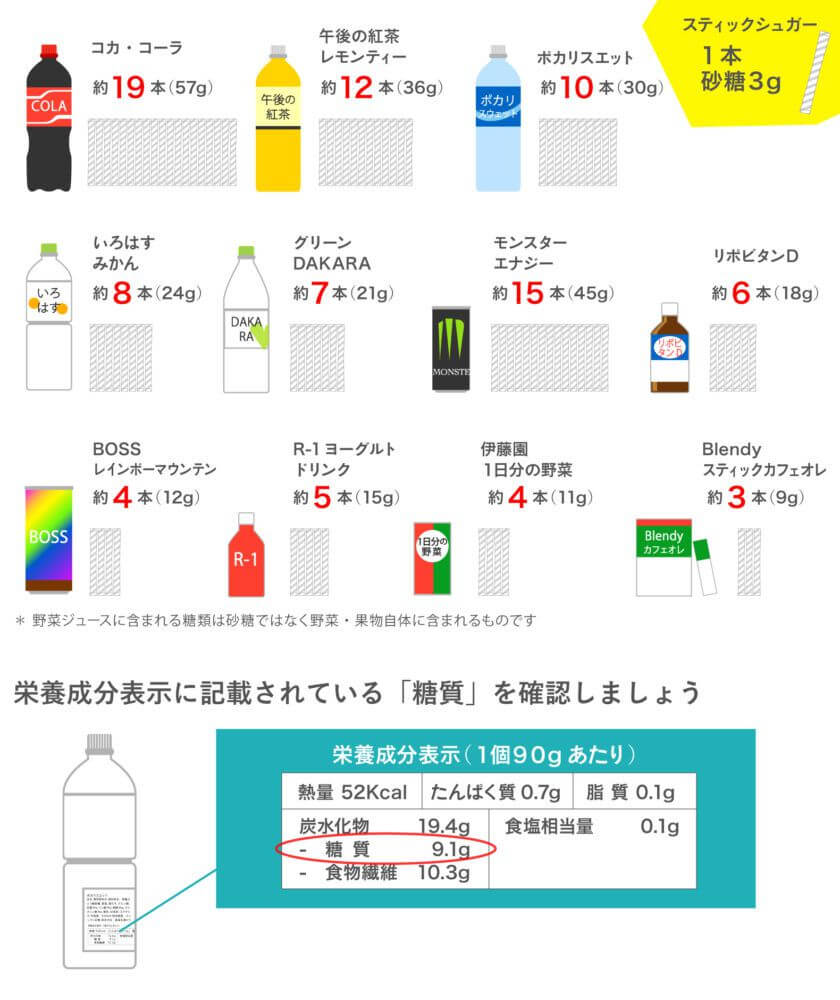
The image above isWhy is your blood sugar level high? High blood sugar caused by frequent and excessive consumption of soft drinks. (Quoted from)
More detailed information is available, including the carbohydrate content per 100g of each food item. Carbohydrate content data list (PDF) Please take a look.
Dietary fiber is good for your health.

However, among carbohydrates”Dietary fiber”"It was not absorbed, ratherEffective for healthButMany Japanese people are shortTherefore, you should try to take plenty.
The following is a breakdown of dietary fiber intake by age group in Japan:
(blue = male、Red = Female)
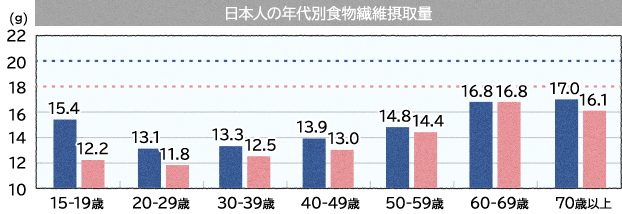
According to the Japanese Dietary Reference Intakes (2015 edition), the target intake of dietary fiber for those aged 18-69 is 20g or more per day for men and 18g or more per day for women.(Otsuka Pharmaceutical "Target intake of dietary fiber(Quoted from)
In this article, we looked at a general classification of sugars, but in the next article,Breakdown of carbohydratesLet's take a closer look at this.
The next article isHereHere it is ↓


comment