
MBTI(MBTI: Myers-Briggs Type Indicator)It is very accurate.Personality testIt is known for this, but its diagnostic items include,Sensing type (S type) and Intuitive type (N type)There is such a thing.
If you're not yet familiar with MBTI, please refer to the following article.


What are the Sensing Type (S-type) and Intuitive Type (N-type)?
Everything starts with gathering information.Sensory type (S type)とIntuitive type (Type N)There are two types.
PeopleSensory (S) aspecttoo,Intuitive (N) aspectI own both, but I usually tend to favor one over the other.
Attitude when receiving information
Sensing type (S type) <-> Intuitive type (N type)
Some people tend to perceive things as they are through their five senses, while others tend to try to grasp the connections and hidden meanings behind things.
quotation From "Let's Look at the World from the Perspective of MBTI Personality Type Theory" (website no longer exists)
Sensory type (S type)These people tend to focus on very specific facts when they perceive, observe, or collect data about the world around them.
They are practical and realistic, enjoy experiencing things with their five senses, and are interested in experiencing situations firsthand. They prefer things to unfold precisely and continuously before their eyes, and they rely primarily on their five senses to gather information.
Sensory type (S type)They tend to focus on facts and details, and don't think too much about what it all means.
Intuitive type (Type N)People like this tend to gather information through their five senses, but immediately interpret it intuitively, seeking possibilities, meaning, and connections between various things. They plan grand schemes and view things holistically. They like words like "approximately" and "haphazardly."
Characteristics of Sensing Type (S-type) and Intuitive Type (N-type)
So, eachFeaturesLet's take a look.
| Sensory type (S type) | Intuitive type (N-type) | |
|---|---|---|
| Emphasis on facts | Theory-oriented | |
| Follow existing methods | Think of novel methods | |
| Look at the details of things | View the whole picture | |
| Observation and Memory | Extracting patterns and meanings | |
| Experience is important | Emphasis on inspiration | |
| reality | ideal | |
| concrete | abstract | |
| true story | Fantasy | |
| the current | future |
The table above shows,Kubochin's Genius Blog『Explaining the difference between S (Sensitive) and N (Intuitive) types ~MBTI Classification Part 2~Quoted from '
| Sensory type (S type) | Intuitive type (N-type) | |
|---|---|---|
| continuous | Haphazard | |
| Realistic | conceptual | |
| specific | Intuitive | |
| practical | Argumentative | |
| solid | Fantasy | |
| fact | reverie | |
| Practice | Inspiration | |
| Specific topics | General Overview |
Sensory type (S type)People who are dominant in this area tend to have grounded thinking, but they may struggle with imaginative and free-thinking ideas.
Intuitive type (Type N)People who are dominant in this area can come up with new ideas that don't exist in the present moment, but they can also have thoughts that are detached from reality.
・How Sensing types (S type) and Intuitive types (N type) can get along well
・Parent-child relationships between sensing types (S-type) and intuitive types (N-type)
Intuitive type (Type N)はEmphasis on future possibilities and "things that are not here and now."I will.INFP (Psychologist type)In Ayumi Hamasaki's song "About you,"Intuitive type (Type N)This is what is shown below ↓

Things that are invisible to the eye, things that have no form.
Excerpt from Ayumi Hamasaki's "About you"
Try believing
It's very scary, but if it's possible
That's wonderful!
Intuitive type (Type N)は"(If) then..."He frequently uses analogies and metaphors like this. It's also used in the band SEKAI NO OWARI's song "Nijiro No Sensou" (see below).
If flowers had voices, what would they cry out?
Excerpt from SEKAI NO OWARI's "Nijiro No Sensou"
The song of "liberation of freedom"
It will surely resonate throughout the world.
If peace has ears
What can you hear?
A fake song of freedom
It will be very loud.
but,Intuitive type (Type N)When it goes out of control,Believing in superstitionsPlease be aware of the following:
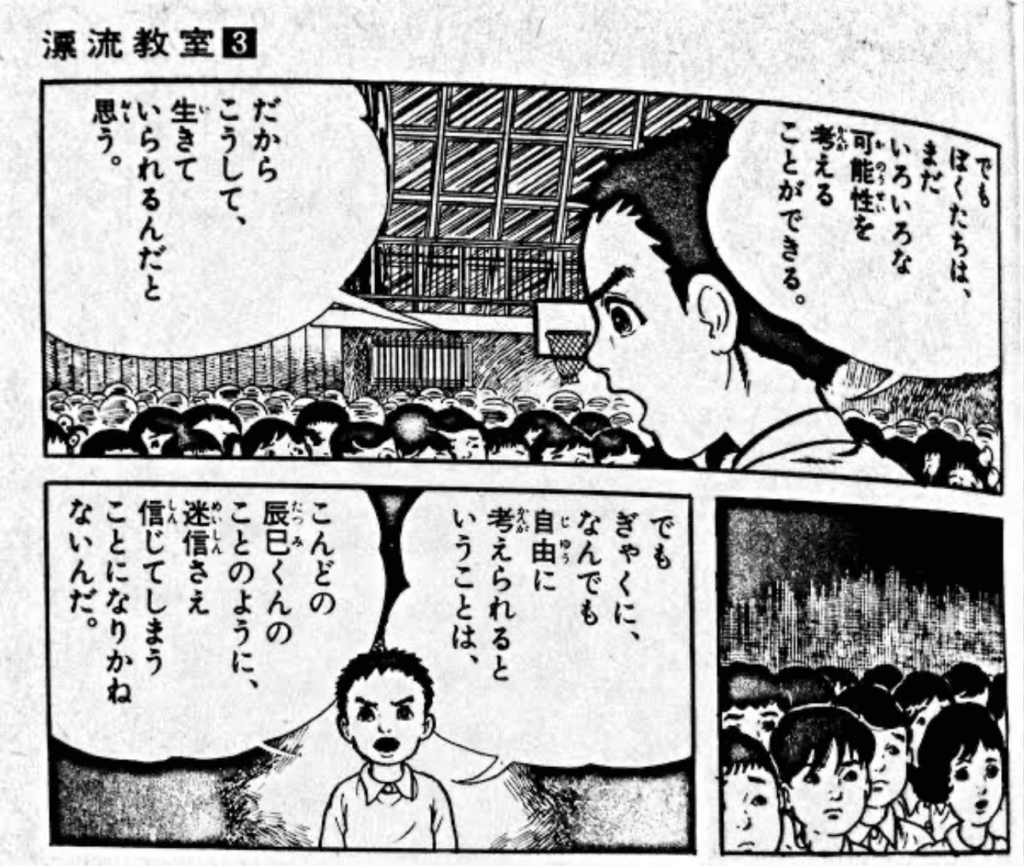
Quoted from "The Drifting Classroom" (by Kazuo Umezu)
How Sensing (S-type) and Intuitive (N-type) types perceive reality
Sensing types (S-type) prioritize the reliability of information, while intuitive types (N-type) prioritize the speed and depth of their insights.
The first difference is that intuitive types (N-types) learn to trust pattern recognition to quickly understand information and perceive hidden connections between seemingly disparate things. They are also adept at theoretical reasoning and inference about both the present and the future. Essentially, they can infer meaning from minimal data.
Of course, Sensing types (S-types) possess similar abilities. However, they don't trust them and don't hone them. Instead, they trust reliable information—that is, things that can be verified in the real world. As a result, they become experts in history, including their own history and the histories of others. Sensing types (S-types) are also good at manipulating things, have quick response times, and tend to live in the moment. They don't understand the need to question the reality in front of them. Reality is reliable. Inferences (deductions) are not always correct and can be unreliable.
Secondly, Sensing types (S) and Intuitive types (N) have different perceptions of time. If Sensing types (S) value reliable and accurate information from reality, then past and present events are of paramount importance. Sensing types (S) cannot believe in things that haven't happened yet, so they are not very interested in the future. On the other hand, Intuitive types (N) find joy in perceiving and understanding things that are not there (things that are invisible and do not exist). They only see the past as a reference point for predicting the future.
Thirdly, Sensing types (S) and Intuitive types (N) have different values and fundamental interests. For Sensing types (S), values such as "family, tradition, and enjoying the present" are all rooted in "what is known and verifiable," and therefore they can be trusted. Intuitive types (N) have values that focus on more abstract things such as meaning, narratives, imagination, possibilities, (future) prospects, and "what if" questions. Conversations generally revolve around these things, and they show little interest in small talk.
The population ratio of sensing types (S type) to intuitive types (N type) is approximately 75 to 25, with a bias towards sensing types (S type).
Both sensing types (S-types) and intuitive types (N-types) play important roles in our world. Intuitive types (N-types) are generally pioneers, creating new technologies and paradigms, and devising new ways of seeing and doing things. However, if there are too many intuitive types (N-types), too much innovation occurs (resulting in everything becoming too revolutionary), and everything collapses. But without innovation, the world stagnates.
Detailed explanation of Sensing Type (S-type) and Intuitive Type (N-type)
The following is a quote (with some modifications) from "Let's Look at the World from the Perspective of MBTI Personality Type Theory" (website no longer exists).
Here, we will consider the psychological tendencies involved in receiving information, focusing on sensation and intuition.
The senses accept what can be perceived through the five senses as it is.
Intuition attempts to grasp the meaning and overall picture behind things.
These two are psychological functions related to perception, so they don't happen intentionally but occur naturally.
Although sensation and intuition are opposing qualities and therefore difficult to reconcile simultaneously, they are actually complementary, and a balance between them can lead to accurate perception.
Now, let's go over each of them.
The term "sensation" used here refers to what is perceived through the five senses (sight, hearing, smell, touch, and taste). The meaning of "sensation" as used in everyday Japanese is broad and often ambiguous, so I would like to clarify it here.
The "S" in "Sensation" comes from the first letter of the English words "Sensation" and "Sensing." It refers to the sensations obtained through the body. It might be easier to understand if you think of it as a sensor.
Sensory types excel at capturing information concretely and in detail through their five senses. They expend energy observing and capturing things as they are in detail.
However, while we tend to focus on specific and detailed facts, we often fail to consider the connections and hidden meanings behind things.
However, when making a judgment, it is very important to grasp things concretely and in detail. Sensing types are grounded, realistic, and practical.
Intuition, or perhaps the sixth sense, is an attempt to grasp more information and a broader picture than what can be directly obtained through the five senses.
The hidden meanings, the recognition of connections and patterns, and the awareness of possibilities suddenly rise to our consciousness.
Intuitive types tend to have abstract and theoretical ideas, and are actually interested in such things.
However, while we try to find connections and possibilities, it becomes difficult to carefully observe individual events and obtain specific and detailed information.
Therefore, sometimes we end up with unrealistic and impractical ideas.
Intuition, being a cognitive function related to receiving information, is something that happens unintentionally. Nevertheless, it often reveals things that make perfect sense, which is why it's sometimes called "thinking without thinking."
This intuition, which may seem mysterious, is thought to be the result of unconscious information integration occurring in the mind.
Intuitive types prefer ideas and theories, and don't mind if they lack a bit of concreteness at first. They are well-suited to planning, starting new things, and bringing about change.
As a side note, the word "intuition" here is a translation of the English words "intuition" or "intuiting." However, to avoid overlap with the "I" in "introversion," we use the second letter, "N," to represent intuition.
End of quote from "Let's Look at the World from the Perspective of MBTI Personality Type Theory" (website no longer exists) (partially modified)
The following are reference articles for each of the psychological tendency axes.
comment