
On this page, out of the 16 types,ISFP (Artist type)This article explains their personality, characteristics, values, and views on love.
youISFP (Adventurer/Artist Type)Then
Share it on social media (tweet it) and let your followers know!
↓↓↓Share on social media (tweet)↓↓↓
↑↑↑Share on social media (tweet)↑↑↑
Classifying personalities into 16 types16-Type Personality TestCheck which type you are using the following↓↓

↑16-Type Personality Test↑
↑Diagnose↑
Your 16-type personality test result is...
"ISFP type (artist type)"
Detailed diagnosis results ↓
Let's get straight to your diagnosis results.
Share it on social media (tweet it) and let your followers know!
↓↓↓Share on social media (tweet)↓↓↓
↑↑↑Share on social media (tweet)↑↑↑
Your type,ISFP (Artist type)This explains their personality, characteristics, values, and views on love.


- ISFP (Adventurer/Artist Type): Famous People, Celebrities, and Characters
- Personality traits of ISFP (Adventurer/Artist type)
- Strengths and weaknesses of ISFP (Adventurer/Artist type)
- Hobbies and interests of ISFP (Adventurer/Artist type)
- Further characteristics of the ISFP (Adventurer/Artist type) and compatibility with other types
- ISFP (Adventurer/Artist Type) Values and Motivations
- Similar to ISFP (Adventurer/Artist type)
- Instructions for ISFP (Adventurer/Artist Type)
ISFP (Adventurer/Artist Type): Famous People, Celebrities, and Characters
first,ISFPTo give you a sense of what kind of type it is,ISFP (Adventurer/Artist Type)Let me introduce the characters.

Famous anime characters from Dragon Ball, Studio Ghibli, and more are categorized into 16 personality types!
Let's get a feel for the unique atmosphere of each type ↓
Here you can find famous people, psychologists, philosophers, and quotes for all 16 personality types.
↓
Other notable figures, celebrities, and characters who fit the ISFP (Adventurer/Artist type) description ↓
- Choji Akimichi (NARUTO)
- Tony Tony Chopper (One Piece)
- Harry Potter
- Soobin (TXT)
- Baekhyun (EXO)
- Lady Gaga (musician)
- Brad Pitt (actor)
- Michael Jackson (musician)
- Bob Dylan (musician)
- Jimi Hendrix (musician)
- Marilyn Monroe (actress)
- David Beckham (football player)
(Estimated by the author)
youISFP (Adventurer/Artist Type)Then
Share it on social media (tweet it) and let your followers know!
↓↓↓Share on social media (tweet)↓↓↓
↑↑↑Share on social media (tweet)↑↑↑
Personality traits of ISFP (Adventurer/Artist type)
ISFPs are laid-back, gentle, peace-loving, and down-to-earth people.
I value my private space and need alone time to recharge. I cherish deep connections and enjoy spending time with a small circle of close friends and family. In relationships, I prioritize depth over breadth, and I enjoy spending time slowly with a few close friends and family members.
They are compassionate and tolerant, and they cherish their own values and the people they care about. They are very compassionate, able to acknowledge and accept others, and they do their utmost to cherish their own values and the people who are important to them.
ISFPs are sometimes called "artists," "composers," or "adventurers."ENTJThis type has the exact opposite personality. (All four letters are reversed.)
ISFPs are true optimists. They often find joy in the everyday things around them and enjoy a relaxed, laid-back lifestyle. They seek to live in the present moment and enjoy being natural and carefree. They also have a broad perspective and are the type of person who can enjoy and appreciate all aspects of life in a natural way.
ISFPs are not dreamers; they have a realistic sense of reality and are pragmatic.
This type of person tries to broaden their options before attempting to accomplish something, aiming to make the most rational decision from among many possibilities. By focusing on the present moment, they can maintain a firm grasp of their surroundings.
ISFPs are not interested in and dislike abstract theories, and prefer learning methods and environments that allow them to learn through practical knowledge and real-world experience.
ISFPs are creative. Their passions and interests are diverse, and they are always seeking new ideas. They are imaginative, have a strong aesthetic sense, are curious, and try to find beauty in their surroundings.
It's important to keep in mind that while many ISFPs are gifted in the arts, when an ISFP is called an "artist," it doesn't necessarily mean an "artist" in the general sense. ISFPs are called "artists" because they treat life as a canvas for self-expression, skillfully incorporating their own individuality and creative talents into their actions.
reference
・"I just observe and don't say anything." - ISFP ~ How do gender differences affect the lives of ISFPs? ~
・ISFP Personality Guide ~ Let's delve deeper ~
Strengths and weaknesses of ISFP (Adventurer/Artist type)
Strong Points
- Being able to notice your surroundings
- Being able to think practically
- Enjoy experiential learning
- Being true to one's own values and beliefs
Disadvantages
- I dislike abstract and theoretical information.
- Sometimes, even in situations where you need to assert yourself, you might be too reserved.
- When someone approaches me too quickly, I tend to become defensive and find it difficult to become friends with them.
- They even avoid situations where discussion or confrontation is necessary.
Hobbies and interests of ISFP (Adventurer/Artist type)
Hobbies that utilize physical abilities and artistic talents, such as skiing, swimming, dance, and crafts, are very popular. They also love spending time with close friends and exploring art and nature.
Further characteristics of the ISFP (Adventurer/Artist type) and compatibility with other types
- ISFP Personality Traits 02
- ISFP hobbies
- Things that ISFPs dislike
- Advantages and disadvantages of ISFP
- Suitable occupations for ISFPs
- ISFP Leadership
- Compatibility of ISFP with other types
- ISFP Relationships and Romance
- How ISFPs Set Goals and Gather Information
- ISFP decision-making methods
- ISFP parent-child relationships
- How ISFPs can succeed
↓Learn more↓
ISFP (Adventurer/Artist Type)Compatibility chart and advice for other types
Ideal compatibility type pair
ISFPs are compatible with people who respect each other's freedom and with whom they can have positive experiences.
From an ISFP's perspective...
- INFP (Psychologist type):Fi – NeThey respect freedom and feelings.
- ENFP (Reformer type):Ne – FiThey respect individuality
- ISFJ (Parental Type):Si – FeThey treat you with consideration.
- INTP (Researcher Type):Ti – NeWe can share ideas and exchange information.
Type pairs that are prone to conflict
ISFPs tend to clash with overbearing people who don't respect their individual choices and actions.
From an ISFP's perspective...
- ESTJ (Responsible type):Te – SiThey criticize me and try to control me.
- ENTJ (Leader type):Te – NiHe is very logical, meticulous, and rational, but his demands are intense, making him difficult to be around.
Romantic compatibility type pair
ISFPs are most compatible in romantic relationships with people who offer positive experiences and who can provide reassurance during difficult times.
From an ISFP's perspective...
- ENFJ (Collaborator Type):Fe – NiThey make you feel safe and comfortable.
- INTJ (Strategist type) :Ni – Te, wisely prepare for the future and give you peace of mind
- ENFP (Reformer type):Ne – FiThey create a friendly and comfortable environment and understand your feelings.
- ISTJ (Hardworking Type):Si – TeIt reassures you even in difficult situations.
*The pairs that tend to clash and the pairs that have good romantic compatibility may overlap. This is because while people may dislike those who are the complete opposite of themselves due to disagreements, they may also be attracted to those who appear mysterious because they are different. However, it seems that these relationships often end up breaking down.
(Advice for those dating an ISFP)
ISFPs are very empathetic in relationships and often make concessions to others. Many struggle to express their feelings or assert their demands, so it's important to make an effort to understand them. When making decisions, listen to the ISFP's perspective and respect their feelings equally.
ISFP (Adventurer/Artist Type)A collection of links explaining psychological functions (for those who want to understand how the mind works)
Reading the following roadmap from top to bottom will help you understand the ISFP mindset in a logical order ↓
- Roadmap – ISFP (Artist type) –
- Introduction – What is MBTI?
- Summary of my personality
- Cognition is
- Type-specific cognitive characteristics
- Four personality indicators (psychological tendency axes)
- Conflicts over personality indicators
- “The meaning of the four letters "ISFP"
- First character:Introvert (type I) or extrovert (type E)
- Second character:Intuitive type (N type) or Sensing type (S type)
- Third character:Feeling type (F type) or thinking type (T type)
- 4th character:Perceiving type (P type) or Judging type (J type)
- About psychological functions (cognitive functions)
- What are psychological functions (cognitive functions)?
- The eight psychological functions (cognitive functions)
- Decision-making (judgment) function
- Information gathering (perceptual) function
- Understanding your own psychological functions (cognitive functions)
- The developmental process of psychological functions (cognitive functions)
- ISFP's psychological functions (cognitive functions)
- First function:Introverted Feeling (Fi)
- Second function:Extroverted Sensing (Se)
- Third function:Introverted Intuition (Ni)
- Fourth function:Extraverted Thinking (Te)
- Making good use of psychological functions (cognitive functions)
- Strengths and weaknesses of the ISTP (Practitioner type)
- Make the most of your strengths
- Reasons for focusing too much on the advantages
- How to improve your weaknesses
- If you are alone
- In a team setting: Have others compensate for your weaknesses (fourth function).
ISFP (Artist type)To truly understand this,Psychological functions (cognitive functions)* is important ↓
*Generally in cognitive science,Cognitive functions「The function by which living organisms actively collect external information, perceive and remember it, and then process it by adding reasoning and judgment in order to acquire knowledge about their subject.It is defined as "
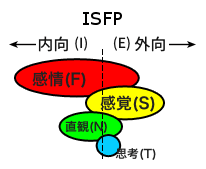
- Introverted Feeling/Fi
Very good at it /First function: Decide what you believe is right for you, what is morally right within your worldview, and what you should do according to your personal values. - Extroverted Sensing/Se
I'm a little good at it /second function: To make good use of physical space and create positive experiences for people, whether material or sensory. - Introverted Sensing/Ni
I'm not very good at it.Third functionBecause they believe they know what is right for them, they can get irritated when told what to do by others. - Extraverted Thinking/Te
I'm really bad at it /Fourth functionThey fear and worry about what others think of them. They are unable (or unwilling) to organize their thoughts rationally and logically.
<ISFP's cognitive framework>
ISFP (Adventurer/Artist Type)Related articles (Click to open)
- ISFP psychological functions
- “The meaning of the four letters "ISFP"
- ISFP's psychological functions (cognitive functions)
- Integration of ISFP's second and third functions
- The difference between introverted feeling (Fi) and extroverted feeling (Fe)
- The difference between extroverted thinking (Te) and introverted feeling (Fi)
- To train your extroverted thinking (Te)
↑Learn more↑
ISFP (Adventurer/Artist Type) Values and Motivations
ISFPs tend to be generous and unbiased, but they will be very loyal to the people, ideals, and beliefs that are important to them. They are accepting and willing to help others, but ultimately they will act based on their own values. They will also be considerate, flexible, and willing to listen attentively to your concerns. They may not get along well with people who do not do the same things they do.
ISFPs are humble and sometimes underestimate themselves. They don't like being in the spotlight and prefer to play a supporting role, and they try to avoid planned and organized actions as much as possible. This type is highly sensitive, gets things done properly, and finds satisfaction in feeling like they are making a difference in people's lives.
youISFP (Adventurer/Artist Type)Then
Share it on social media (tweet it) and let your followers know!
↓↓↓Share on social media (tweet)↓↓↓
↑↑↑Share on social media (tweet)↑↑↑
Similar to ISFP (Adventurer/Artist type)
- ESFP: E (extrovert) and I (introvert) But they are different.
- INFP: N (Intuitive type) and S (Sensing type) But they are different.
- ISTP: T (thinking type) and F (feeling type) But they are different.
- ISFJ: J (Judgment type) and P (Perception type) But they are different.
If you're not confident that you're an ISFP, you might be one of the four types mentioned above. Read the article or take some time to think about it again.diagnosisLet's try it.
Instructions for ISFP (Adventurer/Artist Type)
If your friends, colleagues, or family members are ISFPs, there are things you can do to communicate with them more effectively and deepen your relationships.
*If you are an ISFP, showing this guide to your friends and family may help improve your relationships.
To build good friendships
- ISFPs are friendly and get along well with others, but they usually need to get to know you well before they truly open up to you.
- To support an ISFP as a good friend, you need to accept them for who they are.
- ISFPs have bright and cheerful personalities, but they can sometimes become emotionally volatile. Please be aware that there are times when ISFPs want to spend time with others and times when they want to be alone and withdraw.
Learn more ↓
- Relationships and love life for ISFP (Artist type)
- How extroverts (Type E) and introverts (Type I) can get along well
- How Sensing types (S type) and Intuitive types (N type) can get along well
- How Thinking (T-type) and Feeling (F-type) People Can Get Along Well
- How to get along well with Judging type (J type) and Perceiving type (P type)
To build a good parent-child relationship
- ISFP children are perfectionists and tend to be the hardest on themselves. Because they have high expectations of themselves, they often underestimate or are underestimated for their own skills and talents.
- If your child is an ISFP type, you can support their growth by advising them to recognize their own worth and be kind to themselves.
Learn more ↓
- Parent-child relationships for ISFP (Artist type) individuals
- Parent-child relationships between extroverts (Type E) and introverts (Type I)
- Parent-child relationships between sensing types (S-type) and intuitive types (N-type)
- Parent-child relationships between thinking types (T-type) and feeling types (F-type)
- Parent-child relationships between judging types (J type) and perceiving types (P type)
List of 16 Personality Types
A Collection of Information on the 16 Personality Types – The Little-Known Truths of Each Type (Summary, Illustrations, and Analysis)
- Summary of 16 Personality Type Test Websites
- List of articles categorized by personality type (16 types)
- Compatibility chart for 16 personality types
- Suitable occupations, ideal jobs, and dream jobs for each of the 16 personality types
- Nicknames (names) for each of the 16 personality types
- What if there were a country with 16 personality types...?
- The relationship between national characteristics around the world and the 16 personality types
- List of 16 Personality Types Based on Famous Characters
- Detective Conan: A Summary of 16 Personality Types for Each Character
- Percentage of 16 personality types
- Reactions of 16 Personality Types – Heaven and Hell
- To describe the 16 personality types in one word:
- 16 Simple Explanations of Personality Types
- 16 Personality Types: Strengths, Weaknesses, and Ways to Improve Weaknesses
- 16 Personality Types: Preferences and Strengths/Weaknesses in Majors and Subjects
- 16 Personality Types: How to Enjoy Life to the Fullest…?
- 16 Personality Types: Inspiring Quotes from Great Figures
- What if each of the 16 personality types were a murderer?
- How to become an attractive husband or wife based on your personality type (16 types)
- What 16 personality types do after a breakup
- Reasons for fighting according to 16 personality types
- Income by 16 Personality Types - Misconceptions and Truths -
- Characteristics of employees based on 16 personality types
- Potential pathological tendencies of 16 personality types
- Psychological Functions of 16 Personality Types Based on Statistics
- Viewing percentage of the detailed personality pages for each of the 16 personality types
- Summary of the characteristics of the 16 personality types
- 8 psychological functions: "What if I did...?"
- Approaches to tasks based on psychological function: Intuitive (N-type) & Sensing (S-type)
- Social interaction explained by psychological functions
- Understanding Your Financial Habits Through Psychological Functions – Are You a Saver or a Spender?
- Humor (sense of humor) as revealed by psychological functions
- How extroverts (Type E) and introverts (Type I) can get along well
- How Sensing types (S type) and Intuitive types (N type) can get along well
- How Thinking (T-type) and Feeling (F-type) People Can Get Along Well
- How to get along well with Judging (J-type) and Perceiving (P-type) types
- Characteristics of parents with 16 personality types
- Parent-child relationships between extroverts (Type E) and introverts (Type I)
- Parent-child relationships between sensing types (S-type) and intuitive types (N-type)
- Parent-child relationships between thinking types (T-type) and feeling types (F-type)
- Parent-child relationships between judging (J-type) and percepting (P-type) types
- How to identify your partner's personality type: [16 Personality Types]

comment
I'm an INTJ, but perhaps because I have a retro nerd side, I often share hobbies with ISFPs.
I love history and old photographs.
What I like most about him is his gentle and kind nature.
Furthermore, I respect them because they seem to be prevalent in primary industries.
I'm not good with new trends and the latest chemical technologies; I find those kinds of things rather dubious.
It was really interesting. I was happy because many of the comments were accurate and made me feel like I was being praised.
It was a valuable learning experience, as it allowed me to see myself from a different perspective. I was disappointed that I couldn't share it on social media for some reason (I'm not sure if it was a problem with my device or the website), but I'll definitely tell my friends about it. I also found the other articles interesting. I really enjoyed it!