

Classifying personalities into 16 types16-Type Personality TestCheck which type you are using the following↓↓

↑16-Type Personality Test↑
↑Diagnose↑
This article will cover the following 16 types.ESFJ (Sociable Type)SuccessI will explain this.
youESFJ (Consul/Social Type)Then
Share it on social media (tweet it) and let your followers know!
↓↓↓Share on social media (tweet)↓↓↓
↑↑↑Share on social media (tweet)↑↑↑


What does success mean to an ESFJ (Sociable Type)?
A key factor in determining whether an ESFJ is successful is their ability to meet the needs of those around them. ESFJs are known for their gentle nature and are often described as "caring," but compassion is an inherent part of their character. They enjoy serving others, finding joy in the happiness and well-being of those around them. This becomes their standard for making decisions, and they cherish close friends and family. The happiness of loved ones is often the point of personal success for an ESFJ. If they can provide for their family and ensure their happiness, they can experience a great sense of inner success. It is important for them to do whatever it takes to protect their loved ones and bring harmony to their lives.
"Give, and it shall be given to you" is the motto of ESFJs, and their talents extend beyond family to broader areas of care, such as volunteering, primary education, nursing, elderly care, social work, and human resources, where they play a vital role in all collaborative human processes. While their judgment may be somewhat bound by rigid moral norms, ESFJs always strive to do what they believe is best for others. However, this trait can sometimes lead them to be placed in unsuitable roles. ESFJs thrive in environments where they can make decisions and organize things according to their own values. What ESFJs excel at is caring for others, and they find success in the happiness and gratitude of those they interact with.
ESFJs are highly valued by those around them because of their genuine enthusiasm, compassion, and ability to bring out the potential in others. They place interpersonal relationships at the center of their lives and dedicate a great deal of time and energy to nurturing and maintaining those bonds.
Strengths that ESFJ (Sociable Type) should develop
- Prioritizing others over oneself
- They are reliable and capable of seeing things through to the end.
- They are very conscious of what is right and what is wrong.
- Organized, loyal, and obedient
- Performing routine tasks
- I will spare no effort in fulfilling my duties and responsibilities.
- They have a strong service-oriented spirit and find satisfaction in making others happy.
- Strong loyalty
- Being able to share emotions with others
- Keep your promises, seek a lifelong relationship.
- We value a peaceful life and security.
- Because they are responsible and practical, they can do anything necessary for daily life.
- Create order, structure, and schedule
- I have a desire to be a good role model for others.
- Gentle and considerate; kind and willing to conform to others.
- Skilled in practical care
- Someone who is cooperative, supportive, and has good teamwork skills.
- She is cheerful, positive, and popular.
- Easy to empathize with others
- Skilled at managing money
- They often celebrate family holidays and traditional special events, and are very family-oriented.
- Practical and down-to-earth
- Realistic, honest
Tips for success for ESFJs (Sociable types)
- Let's look at things objectively.
To better understand others and the world, ESFJs must strive to enter into the minds of others, to discover and acknowledge their perspectives, before making judgments.
Furthermore, be aware of your tendency to discard things that don't align with your own values, and strive to weaken this tendency. You need to avoid making personal judgments about how others should feel and instead try to see how others perceive things. To view things objectively, it's recommended to use your "introverted sensing (Si)," which is the ability to deal with the real world as it is. This is because "introverted sensing (Si)" is a function that simply gathers information without emotional judgment. - Let's accept that others are different from ourselves.
ESFJs have well-developed extroverted feeling (Fe), which gives them the strength to understand and help others. However, they must be mindful that they don't always know what's right for others. It's important to recognize that what the other person truly wants is just as important as your own worldview, even if their worldview is completely different from yours. More intuitively, it's important not to be self-centered. - Be careful not to let your emotions get the better of you.
ESFJs derive great satisfaction from helping others, but they also tend to take on other people's problems as if they were their own. This can lead to emotional exhaustion and become a significant burden for ESFJs. They may become so engrossed in the suffering and worries of loved ones that they lose sight of their own need. Learning to maintain emotional distance from close friends and those they want to help is a crucial task, because the desire to help (extroverted feeling/Fe) makes it difficult to detach their emotions (Ti). - Don't make all decisions on your own; sometimes, rely on others.
Sometimes it's good to let others make the decisions. Also, remember that it's better to guide others to understand your perspective than to exclude them. - Let's strive to be accountable to others.
Are you forgetting to communicate your own needs and feelings to others, in addition to listening to their wishes? Expressing your questions, frustrations, and the reasons behind them can deepen relationships and help you become better partners. - Break free from the same old ways of thinking and habits, and gain a new perspective.
Staying in a safe and secure state indefinitely ultimately leads to self-denial. Make an effort to go outside every day and discover a little different about the world and other people. Doing so will broaden your perspective and allow you to see new ideas and opportunities. - Let's learn a little more about how rules, laws, regulations, and traditions actually came into being.
ESFJs follow the rules and respect traditional methods. However, instead of simply accepting them, they consider studying them to understand their origins.
Introverted Thinking (Ti) should. Many ideas that we take for granted today were fresh and innovative at some point in the past, often overturning previous assumptions. Understanding where self-evident truths and common sense come from helps broaden the perspective of ESFJs. And as a result, being able to accept new ideas in the present leads to growth. - When you're in trouble or unsure, ask for help.
If fear paralyzes you or you find yourself in a difficult situation, ask for help. If you are feeling anxious about something or someone, it might be helpful to hear from someone who has dealt with a similar situation. - Let's not forget that it's impossible to satisfy everyone all the time.
ESFJs crave the approval of others and constantly go to extra lengths to please them. However, it's impossible for an ESFJ to please everyone in every situation, no matter how kind and caring they are. Realizing this sooner will lead to a better life. As with anything, changing attitudes takes practice. But by accepting occasional rejection, ESFJs can find greater harmony and peace of mind. - Let's broaden our perspective.
To grow as an individual, ESFJs need to focus on broadening their perspectives in order to gain a more accurate understanding of the world and how it works. For ESFJs to be able to understand and consider data that differs from their own values, they need to recognize that their worldview is not threatened by new information. They need to consciously remind themselves that other people's judgments are not unrelated to reality, and that other people's ideas are also valid and appropriate within a broader, less rigid worldview. - Find a hobby you can enjoy by yourself.
ESF individuals tend to be overly dependent on others and may feel uneasy without someone to talk to. It's important for everyone to have time alone to reflect on themselves. Solitary hobbies and activities that encourage independence and allow for deep, independent thinking can help them confront their feelings and become more self-reliant.
For those who want to learn more about ESFJ (Sociable Type) (including compatibility)
For more information, please see below.Highly recommended (click to open) ↓
Compatibility: You can learn about compatibility and how to interact with other types.
RoadmapYou can learn about personality types and personality theories (MBTI) in a systematic way, from basic to specialized.
Related articlesLearn about the characteristics of each type (take a look at the parts that interest you)
Compatibility between ESFJ (Sociable Type) and other types (Click to view)
Ideal compatibility type pair
ESFJs tend to get along well with cooperative people who follow social rules and are good at conversation.
From an ESFJ's perspective...
- ESFP (Optimist type):Se – FiThey have excellent social skills and can quickly become friends with people they talk to.
- ENFJ (Collaborator Type):Fe – NiThey have strong social skills and are good at bringing people together.
Type pairs that are prone to conflict
Those who tend to clash with ESFJs are often those whose values do not place much emphasis on social traditions, making it difficult for them to quickly connect with ESFJs.
From an ESFJ's perspective...
- INTP (Researcher Type):Ti – NeThey are obsessively meticulous about minute details, like nitpicking, they prefer to be alone, and they don't like to open up to people.
- INFP (Psychologist type):Fi – NeTheir pursuit of their ideals has gone to an excessive level, and while they should interact with more people, they prefer to be alone.
Romantically compatible type pairs
ESFJs are compatible with charismatic people who can fulfill their inner needs.
From an ESFJ's perspective...
- ESTJ (Responsible type):Te – SiThey share the same values, including an emphasis on social rules, and can discuss their ideas with each other.
- ESTP (Adventurer type):Se – TiThey are sociable, make you feel comfortable, are good at getting along with people, and can quickly open up to you.
- ENTJ (Leader type):Te – NiThey provide practical and realistic solutions, and demonstrate strong leadership to guide the team.
- INTP (Researcher Type):Ti – NeThey help organize and explain the chaotic and uncertain situation.
*The pairs that tend to clash and the pairs that have good romantic compatibility may overlap. This is because while people may dislike those who are the complete opposite of themselves due to disagreements, they may also be attracted to those who appear mysterious because they are different. However, it seems that these relationships often end up breaking down.
(Advice for those dating an ESFJ)
In relationships, ESFJs are very devoted, supportive, and loyal. They are not interested in casual relationships and focus on building long-term commitments. You can support your partner by showing how much you love and appreciate them. It is important to respond by showing affection and returning gestures of love. ESFJs also tend to seek relationships with honest people who are open about their feelings.
ESFJ (Sociable Type) Roadmap (Click to open)
To truly understand the ESFJ (Société type),Psychological functions (cognitive functions)This is important ↓
- Extraverted Feeling/Fe
Very good at it /First functionFollow what you deem right for everyone, what is good for the group. - Introverted Sensing/Si
I'm a little good at it /second function: To bear the responsibility for social obligations and responsibilities, discipline, loyalty, and honor. - Extroverted Intuition/Ne
I'm not very good at it.Third functionThey aim for their actions and procedures to be effective in the future, but they can become neurotic if things don't go their way. - Introverted Thinking/Ti
I'm really bad at it /Fourth functionThey fear and are anxious about things that are not logically correct. They don't know how to thoroughly analyze available information (or are unwilling to do so).
<ESFJ Cognitive Axis>
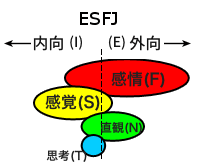
By reading the roadmap below, you can learn about cognitive functions and gain a step-by-step understanding of the ESFJ (Sociable type) ↓
- Roadmap – ESFJ (Sociable Type) –
- Introduction – What is MBTI?
- Summary of my personality
- Cognition is
- Type-specific cognitive characteristics
- Four personality indicators (psychological tendency axes)
- Conflicts over personality indicators
- “The meaning of the four letters "ESFJ"
- First character:Introvert (type I) or extrovert (type E)
- Second character:Intuitive type (N type) or Sensing type (S type)
- Third character:Feeling type (F type) or thinking type (T type)
- 4th character:Perceiving type (P type) or Judging type (J type)
- About psychological functions (cognitive functions)
- What are psychological functions (cognitive functions)?
- The eight psychological functions (cognitive functions)
- Decision-making (judgment) function
- Information gathering (perceptual) function
- Understanding your own psychological functions (cognitive functions)
- The developmental process of psychological functions (cognitive functions)
- Psychological functions (cognitive functions) of ESFJs
- First function:Extraverted Feeling (Fe)
- Second function:Introverted Sensing (Si)
- Third function:Extroverted Intuition (Ne)
- Fourth function:Introverted Thinking (Ti)
- Making good use of psychological functions (cognitive functions)
- Strengths and weaknesses of ESFJs
- Make the most of your strengths
- Reasons for focusing too much on the advantages
- How to improve your weaknesses
- If you are alone
- In a team setting: Have others compensate for your weaknesses (fourth function).
ESFJ (Consul/Société Type) – A Comprehensive Guide to Findings
- Explanation of ESFJ
- Psychological functions of ESFJs
↑Click to open↑
youESFJ (Consul/Social Type)Then
Share it on social media (tweet it) and let your followers know!
↓↓↓Share on social media (tweet)↓↓↓
↑↑↑Share on social media (tweet)↑↑↑

comment