
Classifying personalities into 16 types16-Type Personality TestCheck which type you are using the following↓↓

↑16-Type Personality Test↑
↑Diagnose↑
This article will cover the following 16 types.Success for ISTJ (Hard Worker Type)I will explain this.
youISTJ (Logistician = Hard worker type)Then
Share it on social media (tweet it) and let your followers know!
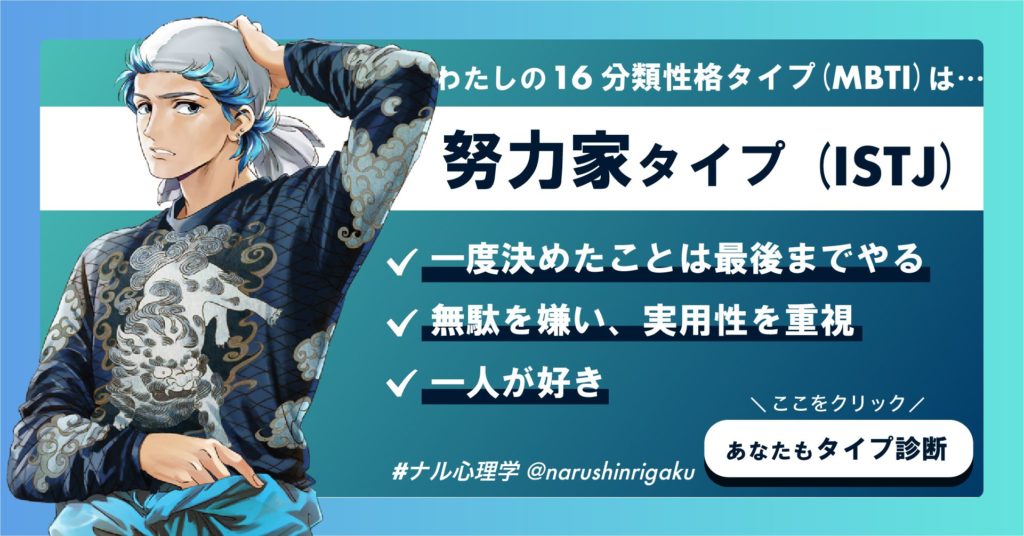
↓↓↓Share on social media (tweet)↓↓↓
↑↑↑Share on social media (tweet)↑↑↑


What does success mean to an ISTJ (hard worker type)?
ISTJs feel successful when they achieve their goals, bring stability, and continue to meet the needs of their loved ones. An indicator of success for an ISTJ is being respected in the workplace for being motivated and capable. It's also important that they are able to care for their family and shoulder their responsibilities.
People with an ISTJ personality are serious, meticulous, analytical, and hardworking. They have a strong sense of responsibility and will push themselves to the limit, even sacrificing sleep, rather than fail to fulfill their promises. They accumulate knowledge gained from experience and use that knowledge to tackle new problems and ideas. They can also draw clear conclusions to solve problems. Their analytical objectivity tends to lead to goal-oriented decision-making that is not swayed by personal concerns. They are resistant to entirely new ideas and theoretical concepts, and will not adopt them unless their practicality is clear. Because they have no direct experience with new concepts, they lack the tools to know how to handle and think about them. Before dealing with a new concept, they need to obtain the framework of that concept.
Experienced ISTJs are highly capable individuals with excellent management skills. They place great value on a trial-and-error approach and are reluctant to adopt new systems until their effectiveness is directly proven through experience. They also internalize and cherish the rules and structures of the society they live in, and will not tolerate any behavior that violates them. ISTJs highly value fundamental social institutions such as family, work, and church. Their diligent and dedicated nature is particularly well-suited to supporting these institutions. An ISTJ's success depends on their ability to leverage their experience for the benefit of the organization.
Strengths that ISTJs (hard workers) should develop
- They prefer stable, realistic, grounded, and orderly environments.
- A natural-born leader
- To perform one's duties, one must work long hours and diligently.
- I prefer working alone, but I will work in a team if necessary.
- They possess keen observational skills, perceiving facts with their five senses and accumulating them internally.
- To make objective judgments based on logical and rational thinking.
- They have a "see it through" attitude.
- They have very high standards for their own actions and the actions of others.
- We cherish tradition, security, and a peaceful way of life.
- Keep your promises
- I seriously consider my role in relationships.
- A good listener who can accurately convey their own thoughts on a regular basis.
- Being able to accept constructive criticism effectively
- To be able to endure a conflicting situation without becoming emotional.
- Family-oriented
- Excellent at time management
- They can give punishment or criticism when necessary.
- They can be expected to complete the work to the end.
- Loyal and honest
- They are not afraid of hardship and spare no effort in things that interest them.
Tips for success for ISTJs (hard-working types)
- Make the most of your strengths and put them to good use.
ISTJs tend not to jump to conclusions, instead analyzing their surroundings, verifying facts, and deriving realistic course of action. They should pursue careers that allow them to utilize their excellent organizational and logical abilities, which are supported by these strengths. Suitable professions include management, accounting, and medicine. - Try to gain experience for yourself, think for yourself, and come up with your own answers.
For ISTJs to grow as individuals, they need to focus on making judgments based on information they gather themselves, rather than on facts or opinions presented by others. Making judgments based on all the facts allows for more effective decision-making. - Suppress the urge to control others.
ISTJs may possess excellent leadership qualities and often find themselves in charge. However, remember that most people fundamentally do not want to be controlled. Turn your desire for control inward, not outward. You are the only one you can truly control. - Let's explore better procedures and methods.
Just because you've always done things the same way doesn't mean it's the best or the only way. ISTJs find comfort in continuing things the same way out of inertia. However, this can lead to missed opportunities for growth and development, both personally and professionally. Of course, you don't need to reinvent the wheel or fix something that isn't broken, but at the very least, it's essential to examine and question things. - Let's embrace change without fear.
ISTJs tend to uphold tradition and stick to established procedures, which can make them resistant to change and innovation. They are skeptical of new approaches. However, they sometimes encounter situations where existing approaches are insufficient. Accepting this is key to their growth. Taking risks is sometimes necessary to bring about change. They must remember that growth is impossible without accepting risk. - Try to create some time to be free from your schedule.
ISTJs have a strong introverted sensing (Si) when it comes to time management. This is a strength that allows them to work hard and meet deadlines, but it can also stifle their freedom. Because ISTJs are diligent, it's important for them to occasionally try not to schedule their day and just go with the flow. Enjoying a spontaneous trip without a plan can provide a different kind of stimulation. Things often don't go according to plan, and an unplanned trip might be perfect practice for that. - Confront your own feelings and the feelings of others.
ISTJs have difficulty naturally empathizing with their own feelings or the feelings of others. They may be poor at sensing emotions. Therefore, ISTJs may need to make an effort regarding emotions. Deepening their understanding of emotions is beneficial in both their personal and professional lives. Understanding and expressing their own emotions helps deepen friendships and other important relationships.
As perfectionists, they tend to take their own efforts for granted, as well as the efforts of others. However, they should remember to praise others occasionally and prioritize emotional support. Once an ISTJ notices the emotional needs of someone close to them, they will spare no effort to meet those needs. - Let's question the rules.
ISTJs believe that things work best when they follow clearly defined rules. However, this is not always the case. ISTJs are also often reluctant to bend those rules or try new things, even if the downsides are minimal. Not all rules are fair and efficient. While respecting authority and laws is generally good, actively questioning and examining them is a societal obligation, as it allows for a check on authority and its exercise of power. - Make time for leisure and for thinking deeply on your own.
ISTJs are often so busy with work, family, and community obligations that they have little time for themselves. ISTJs need time to reflect on their lives and think through the problems they face. Make sure to set aside time for this occasionally. ISTJs, who are easily overwhelmed, especially need breaks. - Make sure to set aside some time to organize your thoughts.
For ISTJs to organize vast amounts of information, it's essential to first organize their own thoughts. This requires taking the time to do so and engaging in discussions with others. Furthermore, clearly articulating their thoughts in writing is crucial for externalizing their ideas.
For those who want to learn more about the ISTJ (hard worker type) (including compatibility)
For more information, please see below.Highly recommended (click to open) ↓
Compatibility: You can learn about compatibility and how to interact with other types.
RoadmapYou can learn about personality types and personality theories (MBTI) in a systematic way, from basic to specialized.
Related articlesLearn about the characteristics of each type (take a look at the parts that interest you)
ISTJHardworking type)Compatibility with other types (click to show)
Ideal compatibility type pair
ISTJs are compatible with people who value ethics and diligence, and who are the type to work in an organizational environment.
From an ISTJ's perspective...
- ISFJ (Parental Type):Si – FeThey have a strong sense of ethics and can follow the organization's rules properly.
- ENTJ (Leader type):Te – NiThey have a clear vision and can lead the organization with strong leadership.
- INFJ (Empathy Type):Ni – FeHe has a strong sense of ethics and is respectable.
Type pairs that are prone to conflict
ISTJs tend to clash with people who challenge existing systems and established methods, and who do not value organizational cohesion or overall unity.
From an ISTJ's perspective...
- ENTP:Ne – TiTheir ideas and ways of thinking are fundamentally different and incompatible.
- ESFP (Optimist type):Se – FiThey disregard the organization's needs and schedules.
Romantic compatibility type pair
ISTJs are romantically compatible with people who are planners, stick strictly to schedules, and can provide reassurance even in difficult situations.
From an ISTJ's perspective...
- ENFJ (Collaborator Type):Fe – NiThey have a strong sense of ethics, can think about the big picture, and have excellent communication skills, so they can bring the whole group together effectively.
- ENFP (Reformer type):Ne – FiThey have a strong sense of morality and ethics, and are good at things they are not good at.
- ISFJ (Parental Type):Si – FeThey are more likely to adjust their lifestyles to each other, and they have a strong sense of morality and ethics.
*The pairs that tend to clash and the pairs that have good romantic compatibility may overlap. This is because while people may dislike those who are the complete opposite of themselves due to disagreements, they may also be attracted to those who appear mysterious because they are different. However, it seems that these relationships often end up breaking down.
(Advice for those dating an ISTJ)
ISTJs experience deep emotions, but often struggle to show this side of themselves in romantic relationships. Those in a relationship with an ISTJ can be understanding partners by not expecting the ISTJ to immediately reveal their feelings. Sometimes, an ISTJ may seem oblivious to your feelings, but you can help them understand your perspective by rationally presenting facts and logical explanations.
ISTJ (Hardworking Type)Roadmap (Click to open)
ISTJ (Hardworking Type)To truly understand this,Psychological functions (cognitive functions)* is important ↓
*Generally in cognitive science,Cognitive functions「The function by which living organisms actively collect external information, perceive and remember it, and then process it by adding reasoning and judgment in order to acquire knowledge about their subject.It is defined as "
- Introverted Sensing/Si
Very good at it /First functionThey are adept at matters of loyalty to others and themselves, and have a precise understanding of their position and civic duties. - Extraverted Thinking/Te
I'm a little good at it /second function: You are responsible for understanding and observing methodologies and systems, and for knowing whether what is currently being done is efficient in completing the action. - Introverted Feeling/Fi
I'm not very good at it.Third functionThey believe they possess the most correct ethical values. When challenged, they become rigid, arrogant, and stubborn. - Extroverted Intuition/Ne
I'm really bad at it /Fourth functionThey feel fear or anxiety towards novelty and unpredictability. They don't know how to take new measures that involve a certain degree of risk (or don't like taking them).
<ISTJ Cognitive Aspects>
Si – Ne: Accumulate sensory information to survive in a chaotic world.
Te – Fi: To show an effort to gain recognition.

By reading the following roadmap, you can learn about cognitive functions.ISTJ (Hardworking Type)You can understand it in an orderly manner ↓
- Roadmap – ISTJ (Hard Worker Type) –
- Introduction – What is MBTI?
- Summary of my personality
- Cognition is
- Type-specific cognitive characteristics
- Four personality indicators (psychological tendency axes)
- Conflicts over personality indicators
- “The meaning of the four letters "ISTJ"
- First character:Introvert (type I) or extrovert (type E)
- Second character:Intuitive type (N type) or Sensing type (S type)
- Third character:Feeling type (F type) or thinking type (T type)
- 4th character:Perceiving type (P type) or Judging type (J type)
- About psychological functions (cognitive functions)
- What are psychological functions (cognitive functions)?
- The eight psychological functions (cognitive functions)
- Decision-making (judgment) function
- Information gathering (perceptual) function
- Understanding your own psychological functions (cognitive functions)
- The developmental process of psychological functions (cognitive functions)
- Psychological functions (cognitive functions) of ISTJs
- First function:Introverted Sensing (Si)
- Second function:Extraverted Thinking (Te)
- Third function:Introverted Feeling (Fi)
- Fourth function:Extroverted Intuition (Ne)
- Making good use of psychological functions (cognitive functions)
- Strengths and weaknesses of the ISTJ (hard worker type)
- Make the most of your strengths
- Reasons for focusing too much on the advantages
- How to improve your weaknesses
- If you are alone
- In a team setting: Have others compensate for your weaknesses (fourth function).
ISTJ (Logistician = Hard Worker Type) – A Comprehensive Guide to Understanding This Type
- Explanation of ISTJ
- Psychological functions of ISTJ
- “The meaning of the four letters "ISTJ"
- Psychological functions (cognitive functions) of ISTJs
- Integration of the ISTJ's second and third functions
- The difference between extroverted thinking (Te) and introverted feeling (Fi)
- The difference between extroverted thinking (Te) and introverted thinking (Ti)
- The difference between introverted thinking (Ti) and extroverted thinking (Te) [Part 2]
- SJ type: Parental temperament
↑Click to open↑
youISTJ (Logistician = Hard worker type)Then
Share it on social media (tweet it) and let your followers know!
↓↓↓Share on social media (tweet)↓↓↓
↑↑↑Share on social media (tweet)↑↑↑

comment