

Classifying personalities into 16 types16-Type Personality TestCheck which type you are using the following↓↓

↑16-Type Personality Test↑
↑Diagnose↑
This article will cover the following 16 types.ESFP (Optimist type)This explains the success of [the company/organization].
youESFP (Entertainer = Optimistic type)Then
Share it on social media (tweet it) and let your followers know!
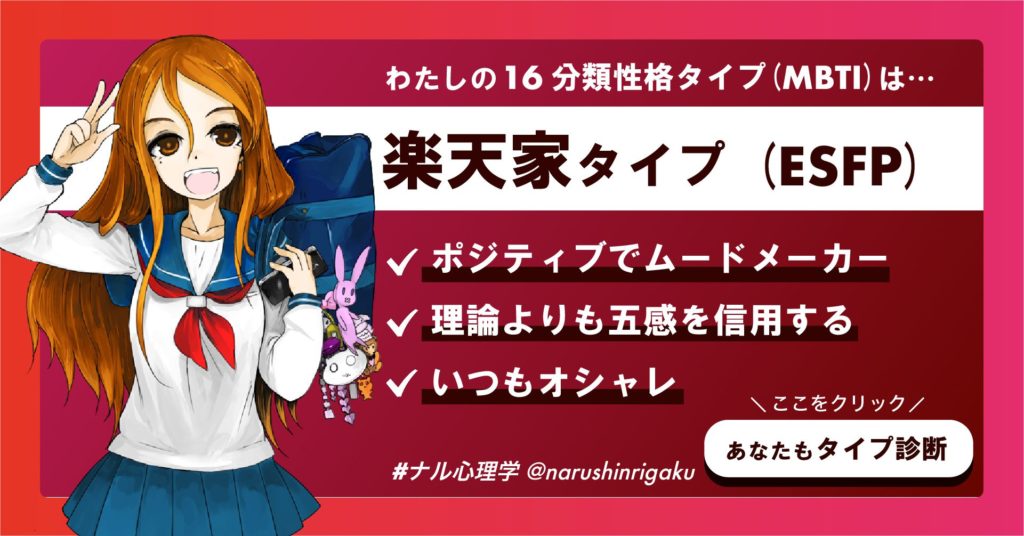
↓↓↓Share on social media (tweet)↓↓↓
↑↑↑Share on social media (tweet)↑↑↑


What does success mean to an ESFP (Optimist type)?
For ESFPs, happiness and satisfaction come from spending time with people they enjoy being around. Therefore, the measure of success for ESFPs is often how much they are cared for and loved by others. They aspire to be someone people care about and want to feel that they have helped bring positivity and light into the lives of those they love. For ESFPs, success isn't just about work; relationships and the people they connect with are far more important.
A key characteristic of ESFPs is their ability to connect with others and express what resonates with them. They can easily connect with others and, with their charisma, build relationships with new people, which can lead to long-term relationships with important individuals. While an ESFP's success may come through various methods and preferences that may not be perceived as success by other types, successful ESFPs will always find themselves in places where they can openly connect with people and express their talents, gratitude, and joy.
ESFPs possess many abilities that allow them to bring about significant change in their surroundings. Their optimistic and flexible nature enables them to adapt to different situations. ESFPs can connect with others, improve difficult situations, and positively impact both their work and family lives.
ESFPs enjoy new sensations and experiences and can easily adapt to new situations. They remain unfazed by unexpected events and may even help others adapt. While they may appear to others as only interested in accumulating new experiences or reliving old ones, they actually care about people and their surroundings. ESFPs remain optimistic even in difficult situations. Their natural positivity allows them to help others even in challenging circumstances.
While ESFPs are active, they sometimes prioritize immediate pleasures, neglecting their duties and responsibilities. They distrust abstract concepts, hypotheses about the future, and big-picture predictions, making long-term planning difficult. ESFPs are the type to adapt to the situation as it unfolds. In that sense, jobs involving interaction with people may be ideal. Service-oriented jobs such as event planner, sales representative, travel planner, and tour guide are perfect for them, as they allow them to interact with people and see their reactions up close.
Strengths that ESFP (Optimist type) should develop
- You can connect with various types of people.
- Excellent musical and theatrical talents
- I feel a special bond with children and animals.
- Talkative and witty
- Even in difficult situations, take a positive approach.
- bold
- Focus on current challenges
- They are enthusiastic, love having fun, and can make anything fun.
- Recognize and nurture the talents of others.
- Excellent interpersonal skills
- Aesthetic sense and attention to appearance
- Quickly distinguish between what is important to the situation and what is not.
- Generous, warm, and tolerant attitude
- Intelligent, witty, frank, and popular, people are drawn to him.
- The talent to learn anything by watching and imitating.
- I am stimulated and excited by new experiences.
- They have a high aesthetic sense for things, and are artistic and creative.
- The ability to adapt to new situations
- Make the most of it, no matter the situation or location.
- They are flexible, versatile, and very good at "going with the flow."
- Try to cherish every single moment
- Detect subtle changes in the environment and recognize their impact.
- Practical and realistic
- They know how to have fun and how to entertain others.
- Independent and able to adapt to changing circumstances
Tips for success for ESFP (Optimistic) types
- Let's be tolerant of criticism.
Remember that even people who care about you may not necessarily agree with you or understand you. Criticism isn't meant to be a personal attack. ESFPs are sensitive to all kinds of criticism. You may take it personally and sometimes even get angry. However, it's important to take disagreements and criticism seriously, as they are opportunities for growth. First, try telling yourself that all the criticism you receive is constructive. - Create a list and write down your goals.
Because ESFPs have an impulsive nature, they may sometimes experience setbacks. To avoid making impulsive decisions, it's important to set goals in advance, create lists and schedules, and organize your actions. This way, even when faced with temptation, you can reaffirm your clear goals and stay on track. - When abstract theories are difficult to understand, learn from practical experience.
ESFPs often struggle in abstract, theoretical situations. They prefer practical learning that equips them with concrete, real-world skills. Fortunately, many learning environments suitable for ESFPs exist, including internships, practical training, vocational schools, and individualized online university programs. For ESFPs, moving away from traditional educational models and engaging in practical learning and activities is key to success. - Let's also consider the long-term effects.
ESFPs can sometimes miss opportunities to improve their lives or set long-term goals because they focus too much on immediate matters. It's important for them to broaden their perspective and take a step back to see things from a different angle. Building relationships with people who have a broader perspective will yield better results, so cherish those relationships especially. - Try not to run away from negative feelings or serious situations.
ESFPs tend to avoid unpleasant topics and situations. However, running away from trouble only exacerbates the problem, and leaving tension unresolved can ruin relationships. It's ultimately better to confront problems before they arise rather than avoiding unpleasant ones. Also, try not to bottle up your worries. If you have doubts or anxieties, talk to someone you're close to.
For those who want to learn more about ESFP (Optimist type) (compatibility, etc.)
For more information, please see below.Highly recommended (click to open) ↓
Compatibility: You can learn about compatibility and how to interact with other types.
RoadmapYou can learn about personality types and personality theories (MBTI) in a systematic way, from basic to specialized.
Related articlesLearn about the characteristics of each type (take a look at the parts that interest you)
Compatibility between ESFP (Optimistic type) and other types (click to view)
Ideal compatibility type pair
ESFPs are compatible with people who understand their practical perspective, who think simply, have a sense of humor, and focus on taking quick action.
From an ESFP's perspective...
- ENFP (Reformer type):Ne – FiHe has a quick mind, a good sense of humor, and can come up with many ideas.
- ESTP (Adventurer type):Se – TiThey possess practical insight and can act quickly depending on the situation.
- ESFJ (Sociable Type):Fe – SiThey create a good atmosphere and help expand your circle of acquaintances.
- ISTP (Practitioner type):Ti – SeThey have good athletic ability and the ability to apply their knowledge in a realistic and practical way.
Type pairs that are prone to conflict
ESFPs tend to clash with people who are insensitive, critical, and lack a sense of humor.
From an ESFP's perspective...
- INTJ (Strategist type) :Ni – TeA serious person who is overly critical and nitpicky, while doubting other people's opinions.
- INFJ (Empathy Type):Ni – FeThey lack a sense of humor, and despite having overly high ideals, they rarely take action.
- ESTJ (Responsible type):Se – TiThey are excessively strict and conservative, and critical.
Romantic compatibility type pair
ESFPs are most compatible in romantic relationships with charming individuals who don't interfere too much with their lifestyle and make them feel comfortable.
From an ESFP's perspective...
- ESFJ (Sociable Type):Fe – SiYou can quickly make friends and enjoy shared hobbies together.
- ISFJ (Parental Type):Si – Fe, makes you feel comfortable
- ENFP (Reformer type):Ne – FiWe can respect each other's freedom and share our thoughts.
- ISTJ (Hardworking Type):Si – Te, guarantees a stable life
*The pairs that tend to clash and the pairs that have good romantic compatibility may overlap. This is because while people may dislike those who are the complete opposite of themselves due to disagreements, they may also be attracted to those who appear mysterious because they are different. However, it seems that these relationships often end up breaking down.
(Advice for those dating an ESFP)
ESFPs tend to be honest and straightforward in relationships. In romantic relationships, they are warm and passionate, without playing games. It's important to note that ESFPs tend to take criticism personally and dislike conflict. While being straightforward is important in relationships with ESFPs, try to avoid being overly confrontational or harsh.
ESFP (Optimist Type) Roadmap (Click to open)
To truly understand ESFP (Optimist type),Psychological functions (cognitive functions)This is important ↓
- Extroverted Sensing/Se
Very good at it /First functionThey are familiar with the real physical space ("what is happening right now") and possess high spatial awareness. - Introverted Feeling/Fi
I'm a little good at it /second functionIf your actions are based on moral reasons aligned with your vision, you can take responsibility for how others feel. - Extraverted Thinking/Te
I'm not very good at it.Third functionI prefer an environment where everyone can feel comfortable. Once an environment is disrupted, it cannot be fixed by avoiding responsibility. - Introverted Sensing/Ni
I'm really bad at it /Fourth functionThey feel anxious and fearful because they don't know what will happen in the future. They are unable to (or do not like) making long-term predictions.
<ESFP's cognitive axis>
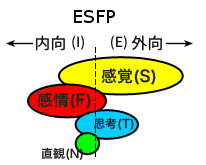
By reading the roadmap below, you can learn about cognitive functions and gain a systematic understanding of the ESFP (Optimist type) ↓
- Roadmap – ESFP (Optimist type) –
- Introduction – What is MBTI?
- Summary of my personality
- Cognition is
- Type-specific cognitive characteristics
- Four personality indicators (psychological tendency axes)
- Conflicts over personality indicators
- “The meaning of the four letters "ESFP"
- First character:Introvert (type I) or extrovert (type E)
- Second character:Intuitive type (N type) or Sensing type (S type)
- Third character:Feeling type (F type) or thinking type (T type)
- 4th character:Perceiving type (P type) or Judging type (J type)
- About psychological functions (cognitive functions)
- What are psychological functions (cognitive functions)?
- The eight psychological functions (cognitive functions)
- Decision-making (judgment) function
- Information gathering (perceptual) function
- Understanding your own psychological functions (cognitive functions)
- The developmental process of psychological functions (cognitive functions)
- ESFP's psychological functions (cognitive functions)
- First function:Extroverted Sensing (Se)
- Second function:Introverted Feeling (Fi)
- Third function:Extraverted Thinking (Te)
- Fourth function:Introverted Intuition (Ni)
- Making good use of psychological functions (cognitive functions)
- Make the most of your strengths
- Reasons for focusing too much on the advantages
- How to improve your weaknesses
- If you are alone
- In a team setting: Have others compensate for your weaknesses (fourth function).
↑Click to open↑
youESFP (Entertainer = Optimistic type)Then
Share it on social media (tweet it) and let your followers know!
↓↓↓Share on social media (tweet)↓↓↓
↑↑↑Share on social media (tweet)↑↑↑

comment