
ESTP (Adventurer type)のdecision making methodI will explain this.
It may seem obvious, but decision-making methods vary greatly depending on the individual and their personality. Some are social decision-makers who prefer to discuss their ideas with various people, get feedback, and refine them until they are perfect. Others prefer to carefully analyze things alone, considering various datasets and implications. Still others prefer a combination of strategies, such as brainstorming in a group, then considering options individually, and finally presenting their clarified ideas for critique. There is no right or wrong way to make decisions. There is only your way of making decisions, and the method that works best for you.
However, when people with different decision-making styles work together, tension can rise. Understanding each other is key to maintaining communication and ensuring the success of the project.MBTIThis provides crucial insights needed to increase efficiency and lower stress levels.


Decision-making methods of ESTP (Adventurer type)
ESTPs are often enthusiastic about decision-making and want to act and make decisions quickly, even if they may need to be revised later. For ESTPs, when making decisions, long-term needs (=Introverted Intuition: NiRather than the current situation (=Extroverted Sensing: Se) is important. For example, they value things that are readily available, such as spontaneous trips, and make decisions based on logic and facts. While it is important to carefully consider the current situation, those involved with ESTPs may find it helpful to structure the decision-making process into concrete steps to provide further support to them.
The next step is to generate decision-making options. When ESTPs begin this process, they brainstorm with a strong focus on their immediate actions and current situation. Speed and ease of execution are crucial for this type. Therefore, they often test decision-making options in a small environment before moving to large-scale implementation. While practicality is clearly important in any decision, ESTPs may need support in considering the long-term impact of each decision and comparing the costs and benefits of each option, especially those that are difficult to implement.
ESTPs are not afraid to move forward when making decisions.They tend to act quickly.(Extroverted Sensing: Se), reduce labor,I prefer decision-making that increases efficiency.(Introverted Thinking: Ti). This often involves abandoning traditional approaches and standard methods to adopt more innovative approaches and values. They quickly adapt to changing situations and circumstances and do not hesitate to pursue specific results or outcomes. However, ESTPs benefit from other members of the team evaluating and monitoring the progress and development of the implementation process. Those working with ESTPs should actively support traditional approaches and routines when they seem to be the optimal or most efficient approach.
ESTPs tend to accept that no decision, process, or problem is perfect when looking back and evaluating decisions afterward, and they are more likely to realize that a project was particularly enjoyable or interesting. ESTPs may move on to a new project before fully absorbing all the lessons and learning opportunities from the given situation, and in this regard, patience and perseverance may be necessary.
ESTPs need to improve themselves and their decision-making process by making an effort to stick to their decisions and becoming accustomed to considering multiple aspects of a situation before acting. They also need to become accustomed to taking their time to evaluate and reflect on their actions and decisions. After all, swift action is not always the best action. Because ESTPs tend to make decisions quickly, adding a little structure to their decision-making process can be very effective in streamlining it.
Other types of "decision-making methods"If you would like to read more about this,Click here ↓
16 Types of Decision-Making Methods
For those who want to learn more about ESTP (Adventurer type) (compatibility, etc.)
For more information, please see below.Highly recommended (click to open) ↓
Compatibility: You can learn about compatibility and how to interact with other types.
RoadmapYou can learn about personality types and personality theories (MBTI) in a systematic way, from basic to specialized.
Related articlesLearn about the characteristics of each type (take a look at the parts that interest you)
Compatibility between ESTP (Adventurer type) and other types (click to show)
Ideal compatible type pair
ESTPs are most compatible with people who share their realistic and grounded worldview and sense of urgency.
From an ESTP's perspective...
- ESFP (Optimist type):Se – FiThey have high physical abilities and agility, high self-esteem, and a good sense of humor.
- ESTJ (Responsible type):Te – SiThey excel at practical application and are quick to act.
Compatible type pairs that are prone to conflict
ESTPs tend to clash with people who are not athletic, are insensitive, and lack teamwork skills.
From an ESTP's perspective...
- INTJ (Strategist type) :Ni – TeThey are very particular, spend too much time on things, and lack adaptability.
- INFJ (Empathy Type):Ni – FeHe is unrealistic, idealistic, and slow to bring his ideas to fruition.
Romantic compatibility type pair
ESTPs are most compatible in love with someone who can keep up with their pace of action, is captivating and charming, and makes them feel secure.
From an ESTP's perspective...
- ISTP (Practitioner type):Ti – SeThey have a worldview that emphasizes a realistic and practical environment.
- ESFJ (Sociable Type):Fe – SiYou can deepen your relationship quickly and share hobbies.
- INFJ (Empathy Type):Ni – FeIt provides reassurance even in difficult situations.
- INTJ (Strategist type) :Ni – Te, providing a practical environment and reassuring
*The pairs that tend to clash and the pairs that have good romantic compatibility may overlap. This is because while people may dislike those who are the complete opposite of themselves due to disagreements, they may also be attracted to those who appear mysterious because they are different. However, it seems that these relationships often end up breaking down.
(Advice for those dating an ESTP)
ESTPs love excitement and fun, but they quickly get bored with the routine. They don't like long, philosophical discussions, but they enjoy keeping a conversation going by talking about shared interests and passions. If your partner is an ESTP, keep in mind that they like to cherish each day, but they are not good at making long-term commitments, so planning for the future with them may be difficult.
ESTP (Adventurer Type) Roadmap (Click to open)
To truly understand the ESTP (Adventurer type),Psychological functions (cognitive functions)This is important ↓
- Extroverted Sensing/Se
Very good at it /First functionThey are familiar with the real physical space ("what is happening right now") and possess high spatial awareness. - Introverted Thinking/Ti
I'm a little good at it /second function: They are responsible for verifying the facts, determining whether statements and findings make logical sense, and what is true or false. - Extraverted Feeling/Fe
I'm not very good at it.Third functionThey want to make people happy and feel positive. When that's not the case, it tends to turn into insults, sarcasm, and imposing a sense of superiority. - Introverted Sensing/Ni
I'm really bad at it /Fourth functionThey feel anxious and fearful because they don't know what will happen in the future. They are unable to (or do not like) making long-term predictions.
<The cognitive axis of ESTP>
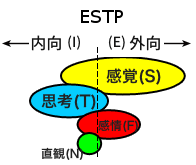
By reading the roadmap below, you can learn about cognitive functions and understand ESTP in a logical order ↓
- Roadmap – ESTP (Entrepreneur-Adventurer Type) –
- Introduction – What is MBTI?
- Summary of my personality
- Cognition is
- Type-specific cognitive characteristics
- Four personality indicators (psychological tendency axes)
- Conflicts over personality indicators
- “The meaning of the four letters "ESTP"
- First character:Introvert (type I) or extrovert (type E)
- Second character:Intuitive type (N type) or Sensing type (S type)
- Third character:Feeling type (F type) or thinking type (T type)
- 4th character:Perceiving type (P type) or Judging type (J type)
- About psychological functions (cognitive functions)
- What are psychological functions (cognitive functions)?
- The eight psychological functions (cognitive functions)
- Decision-making (judgment) function
- Information gathering (perceptual) function
- Understanding your own psychological functions (cognitive functions)
- The developmental process of psychological functions (cognitive functions)
- Psychological functions (cognitive functions) of ESTPs
- First function:Extroverted Sensing (Se)
- Second function:Introverted Thinking (Ti)
- Third function:Extraverted Feeling (Fe)
- Fourth function:Introverted Intuition (Ni)
- Making good use of psychological functions (cognitive functions)
- Strengths and weaknesses of ESTPs
- Make the most of your strengths
- Reasons for focusing too much on the advantages
- How to improve your weaknesses
- If you are alone
- In a team setting: Have others compensate for your weaknesses (fourth function).
ESTP (Entrepreneur-Adventurer Type) - A Comprehensive Guide to Links
- Explanation of ESTP
- ESTP personality
- ESTP Personality Traits 02
- ESTP hobbies
- Things that ESTPs dislike
- Strengths and weaknesses of ESTPs
- Suitable occupations for ESTPs
- ESTP leadership
- Compatibility between ESTP and other types
- ESTP Relationships and Romance
- ESTP's Decision-Making Methods
- How ESTPs set goals and gather information.
- ESTP parent-child relationships
- For ESTPs to succeed
- ESTP psychological functions
- “The meaning of the four letters "ESTP"
- Psychological functions (cognitive functions) of ESTPs
- Integration of the second and third functions of ESTP
- The difference between extroverted thinking (Te) and introverted thinking (Ti)
- The difference between introverted thinking (Ti) and extroverted thinking (Te) [Part 2]
- EP Type: A curious challenger
↑Click to open↑

comment