
Classifying personalities into 16 types16-Type Personality TestCheck which type you are using the following↓↓

↑16-Type Personality Test↑
↑Diagnose↑
This article will cover the following 16 types.Adventurer type (ESTP) I will explain the personality traits of [this person/character].


Personality traits of the Adventurer type (ESTP)
The following is a quote (with some modifications) from "Let's Look at the World from the Perspective of MBTI Personality Type Theory" (website no longer exists).
They are highly curious, proactive, and fearlessly take on challenges and risks in search of excitement. They have their own opinions, even if they don't express them to others, and they make calm, logical judgments and act with self-discipline.
In interpersonal relationships, you are relaxed and attentive to what others need. You naturally gravitate towards people and often attract attention with your charming words and actions. If necessary, you will persuade others and encourage their cooperation to achieve your goals.
Above all, I believe that actually doing things is essential. Spending time worrying about meticulous planning and doing nothing only leads to physical and mental stagnation. It's pointless if you lose motivation and opportunities in the process. Taking action leads to new discoveries and sparks new ideas. Only through your own actions can you understand others' reactions and move on to the next step. I hope for a fast pace and quick change.
They possess excellent observational skills and can calmly analyze situations, enabling them to determine the next course of action. Through repeated practice and reflection, their unique system of knowledge becomes organized and expands within their minds.
Even if we fail, we calmly analyze the reasons, revise our approach, and try again. We don't dwell on the past or wallow in sentimentality. All that matters is that we persevere, overcome difficulties, solve problems, and achieve our goals.
Above all, I desire freedom. I want to spread my wings and relax freely. I want to observe, touch, and understand the diverse aspects of the real world with my own eyes. I want to surrender myself to fast-paced, exciting experiences and enjoy the thrill of avoiding danger through my own judgment. I also find joy in releasing physical energy through sports. When these thoughts come to mind, I am driven by an urge to make them a reality. I dislike being bound by rules. If I am forced to stay still for too long, I become bored. Furthermore, I become increasingly irritated. If I spend a long time alone like that, I become trapped in unhealthy thoughts and emotions.
In this world, it's rare to know everything from the start. Reality is constantly changing, and you have to elicit your own reactions. Then, you should decide on your course of action based on the actual situation. Certainly, with this kind of strategy, failures caused by insufficient thinking are inevitable, but I believe it is far more effective than sitting still at your desk and not looking outwards.
Even if you think it's a long shot, it might be worth trying. Following your unique ideas and curiosity, you may take bold actions that surprise those around you. When you act on your own ideas, you are not bound by common sense, morals, manners, authority, rules, or traditions. For ESTPs, these are merely guidelines. If you are convinced, you will take action even if most people hesitate. This attitude is often perceived by those around you as reckless or eccentric. You are especially unlikely to be well-liked by teachers. However, this attitude is essential for breaking through conventional wisdom and opening up new discoveries and opportunities.
These unconventional actions are a result of staying true to one's own beliefs. Common sense and rules are meaningful as long as they are genuine and work effectively, but often they do not reflect reality. Also, when faced with emergencies or unprecedented situations, there are times when one must think and act for oneself in an instant. ESTPs have unconsciously developed this kind of attitude.
It would be foolish to put off this opportunity that has come my way for the sake of the future. There's no guarantee that it will wait forever. I can deal with future problems when they arise. I won't sacrifice the present. I can live and enjoy this moment to the fullest.
Since childhood, I've loved physical activity and may have been mischievous and playful. I have well-developed observational and discerning skills, and I can concentrate on using my five senses. I excel at physical activities and manual work while thinking things through logically. I have a grounded and realistic way of thinking and am interested in practical things.
They are determined to do things their own way, which can sometimes come across as pushy and make others uncomfortable. On the other hand, they do listen to the opinions of others. If they realize they are in the wrong, they will apologize.
We are deeply moved and respectful of others' sincere attitudes. Generally, we respect our parents, care for our families, and express our love. However, our own personal preferences and emphasis on efficiency can lead to a lack of formality in our manners.
They have an intuitive understanding of what others need and enjoy working collaboratively. They observe others carefully and analyze what each person can and cannot do. They don't necessarily expect everything to go exactly as they envision or be done in their own way. Rather, they prioritize moving forward to achieve their goals and are willing to let their collaborators work independently. At times, they take the initiative, motivate others, and become leaders.
I dislike situations where progress is stalled due to interpersonal conflicts. While I may intervene as a mediator, it is solely to facilitate smooth progress. I do not patiently observe discussions or take on the role of counselor.
Basically, I think things through deeply and only do what I believe is necessary. My self-discipline is strict, and I never indulge in laziness or complacency. On the other hand, I sometimes don't listen to what others say about responsibility. I only do things because I believe I should, and I never let others force me to do them.
Sometimes, they hold cynical opinions based on self-serving ideas. Driven by a desire to uncover the raw truth and a rational mindset, they may disregard others' feelings, ask bold and blunt questions, and make ruthless judgments.
In learning, it's crucial to learn through hands-on experience. Things that are easy to visualize or involve calculations are relatively easy to understand. However, when the content becomes abstract, interest wanes, and motivation is lost. Engaging in abstract discussions seems impractical and a waste of time.
Nevertheless, in the real world, we can sometimes deduce, through simple observation, what is happening behind the scenes, the consequences that are now manifesting, and what will happen next.
Most ESTPs believe only what they can see and feel, and are skeptical of anything without clear evidence. However, some have mystical experiences and become interested in paranormal and psychic phenomena. Some even recognize the secrets of existence in this world.
When I express my experiences, I speak the facts plainly and frankly. I rarely use unnecessary embellishments or roundabout metaphors. Occasionally, I might mix in some of my emotions.
End of quote from "Let's Look at the World from the Perspective of MBTI Personality Type Theory" (website no longer exists) (partially modified)
reference
・ESTP personality
・"Ultimate Realist" (ESTP) ~ How do gender differences affect the lives of ESTPs? ~
・A guide to the ESTP personality type
For those who want to learn more about ESTP (Adventurer type) (compatibility, etc.)
For more information, please see below.Highly recommended (click to open) ↓
Compatibility: You can learn about compatibility and how to interact with other types.
RoadmapYou can learn about personality types and personality theories (MBTI) in a systematic way, from basic to specialized.
Related articlesLearn about the characteristics of each type (take a look at the parts that interest you)
Compatibility between ESTP (Adventurer type) and other types (click to show)
Ideal compatible type pair
ESTPs are most compatible with people who share their realistic and grounded worldview and sense of urgency.
From an ESTP's perspective...
- ESFP (Optimist type):Se – FiThey have high physical abilities and agility, high self-esteem, and a good sense of humor.
- ESTJ (Responsible type):Te – SiThey excel at practical application and are quick to act.
Compatible type pairs that are prone to conflict
ESTPs tend to clash with people who are not athletic, are insensitive, and lack teamwork skills.
From an ESTP's perspective...
- INTJ (Strategist type) :Ni – TeThey are very particular, spend too much time on things, and lack adaptability.
- INFJ (Empathy Type):Ni – FeHe is unrealistic, idealistic, and slow to bring his ideas to fruition.
Romantic compatibility type pair
ESTPs are most compatible in love with someone who can keep up with their pace of action, is captivating and charming, and makes them feel secure.
From an ESTP's perspective...
- ISTP (Practitioner type):Ti – SeThey have a worldview that emphasizes a realistic and practical environment.
- ESFJ (Sociable Type):Fe – SiYou can deepen your relationship quickly and share hobbies.
- INFJ (Empathy Type):Ni – FeIt provides reassurance even in difficult situations.
- INTJ (Strategist type) :Ni – Te, providing a practical environment and reassuring
*The pairs that tend to clash and the pairs that have good romantic compatibility may overlap. This is because while people may dislike those who are the complete opposite of themselves due to disagreements, they may also be attracted to those who appear mysterious because they are different. However, it seems that these relationships often end up breaking down.
(Advice for those dating an ESTP)
ESTPs love excitement and fun, but they quickly get bored with the routine. They don't like long, philosophical discussions, but they enjoy keeping a conversation going by talking about shared interests and passions. If your partner is an ESTP, keep in mind that they like to cherish each day, but they are not good at making long-term commitments, so planning for the future with them may be difficult.
ESTP (Adventurer Type) Roadmap (Click to open)
To truly understand the ESTP (Adventurer type),Psychological functions (cognitive functions)This is important ↓
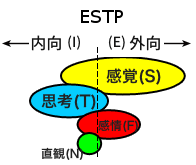
- Extroverted Sensing/Se
Very good at it /First functionThey are familiar with the real physical space ("what is happening right now") and possess high spatial awareness. - Introverted Thinking/Ti
I'm a little good at it /second function: They are responsible for verifying the facts, determining whether statements and findings make logical sense, and what is true or false. - Extraverted Feeling/Fe
I'm not very good at it.Third functionThey want to make people happy and feel positive. When that's not the case, it tends to turn into insults, sarcasm, and imposing a sense of superiority. - Introverted Sensing/Ni
I'm really bad at it /Fourth functionThey feel anxious and fearful because they don't know what will happen in the future. They are unable to (or do not like) making long-term predictions.
<The cognitive axis of ESTP>
By reading the roadmap below, you can learn about cognitive functions and understand ESTP in a logical order ↓
- Roadmap – ESTP (Entrepreneur-Adventurer Type) –
- Introduction – What is MBTI?
- Summary of my personality
- Cognition is
- Type-specific cognitive characteristics
- Four personality indicators (psychological tendency axes)
- Conflicts over personality indicators
- “The meaning of the four letters "ESTP"
- First character:Introvert (type I) or extrovert (type E)
- Second character:Intuitive type (N type) or Sensing type (S type)
- Third character:Feeling type (F type) or thinking type (T type)
- 4th character:Perceiving type (P type) or Judging type (J type)
- About psychological functions (cognitive functions)
- What are psychological functions (cognitive functions)?
- The eight psychological functions (cognitive functions)
- Decision-making (judgment) function
- Information gathering (perceptual) function
- Understanding your own psychological functions (cognitive functions)
- The developmental process of psychological functions (cognitive functions)
- Psychological functions (cognitive functions) of ESTPs
- First function:Extroverted Sensing (Se)
- Second function:Introverted Thinking (Ti)
- Third function:Extraverted Feeling (Fe)
- Fourth function:Introverted Intuition (Ni)
- Making good use of psychological functions (cognitive functions)
- Strengths and weaknesses of ESTPs
- Make the most of your strengths
- Reasons for focusing too much on the advantages
- How to improve your weaknesses
- If you are alone
- In a team setting: Have others compensate for your weaknesses (fourth function).
ESTP (Entrepreneur-Adventurer Type) - A Comprehensive Guide to Links
- Explanation of ESTP
- ESTP personality
- ESTP Personality Traits 02
- ESTP hobbies
- Things that ESTPs dislike
- Strengths and weaknesses of ESTPs
- Suitable occupations for ESTPs
- ESTP leadership
- Compatibility between ESTP and other types
- ESTP Relationships and Romance
- ESTP's Decision-Making Methods
- How ESTPs set goals and gather information.
- ESTP parent-child relationships
- For ESTPs to succeed
- ESTP psychological functions
- “The meaning of the four letters "ESTP"
- Psychological functions (cognitive functions) of ESTPs
- Integration of the second and third functions of ESTP
- The difference between extroverted thinking (Te) and introverted thinking (Ti)
- The difference between introverted thinking (Ti) and extroverted thinking (Te) [Part 2]
- EP Type: A curious challenger
↑Click to open↑
youESTP (Entrepreneur-Adventurer Type) Then
Share it on social media (tweet it) and let your followers know!
↓↓↓Share on social media (tweet)↓↓↓
↑↑↑Share on social media (tweet)↑↑↑

comment