
Classifying personalities into 16 types16-Type Personality TestCheck which type you are using the following↓↓

↑16-Type Personality Test↑
↑Diagnose↑
This article will cover the following 16 types.Adventurer type (ESTP) I will explain the personality traits of [this person/character].
youESTP (Entrepreneur-Adventurer Type) Then
Share it on social media (tweet it) and let your followers know!
↓↓↓Share on social media (tweet)↓↓↓
↑↑↑Share on social media (tweet)↑↑↑


ESTP (Adventurer type) personality: "The ultimate realist"
A typical motto for ESTPs is, "Just do it! You can read the instructions last!"
This action-oriented person lives for "this moment." Reading a manual only delays "this moment," so it's a waste of time for them.
ESTPs are "ultimate realists" who "cannot tolerate theories that seem unrelated to reality."
- He mainly focuses his attention on people and things (Extrovert/E)
- Gathering information based on what can be experienced with the five senses (Senses/S)
- We will objectively analyze and examine that information.Thought/T)
- (At the same time) we can be willing and flexible to accept new options.Perception/P)。
thisFour personality indicators (psychological tendency axes)These elements work together synergistically, enabling us to respond quickly, accurately, objectively, and effectively to any situation.
ESTPs feel better doing something than doing nothing. They're okay with the results of their actions being seen the next day. They're the type who "do it now and pay the price later." Because of this, other personality types often perceive them as "restless" or "unusually active." ESTPs are often seen as exceptionally restless.
ESTPs have a restless lifestyle. They always have things in progress, and on top of that, there's still more to do, and they never have enough time. This type of person actually enjoys this situation.
Sports day, the end of summer vacation, starting a new job, achieving good grades—any event can be used as an excuse for a party. While they diligently prepare for and actively participate in these events, sometimes it ends up being nothing more than a busy day. They can't stand not being the center of attention, and their aversion to lengthy explanations and logical reasoning can sometimes irritate others.
Furthermore, ESTPs expect a return on their investment in whatever they do, commensurate with the energy they put in. And if they decide something isn't worth doing, they'll move on to the next thing. For example, they won't finish reading a book they don't find interesting. They think it's a waste of time to read a boring book to the end just because they started it, or because it's supposed to be useful. Similarly, while tidying up their room might be worthwhile if there's a specific purpose, such as finding something lost, they consider it a waste of time to tidy up simply out of obligation.
In terms of social interactions, ESTPs are sociable and good at entertaining others, so they often find themselves at the center of attention. They are adept at improvising and responding spontaneously, and their sense of humor makes them fun to be around. They also have the ability to tackle and complete difficult tasks, a willingness to try anything at least once, a fearless attitude, and a strong competitive spirit, making them reliable problem solvers and dependable when tackling interesting challenges. However, they don't follow the rules of the work, and they lose interest and boredom when the work becomes routine, wanting a change of environment.
This type (EP typeA dilemma that plagues ESTPs (and similarly for others) is that they often forget established procedures and quotas. As a result, they frequently clash with superiors. While some of the 16 types enjoy defying authority and challenging its legitimacy, ESTPs are not like that. They simply don't care about authority. When faced with a task or problem, this type doesn't first check if there are established procedures; instead, they think there must be a way to get it done and just start working. As a result, they think they are doing the right thing, but those around them don't see it that way, and they end up being labeled as "troublemakers." This is a typical example of an ESTP failure. Fortunately, however, even when they fail, ESTPs don't blame themselves too much and have the talent to move on to something else.
Regarding the differences between male and female ESTPs, first of all, ESTPs are generally described as having a typical masculine personality.
ESTP women often enjoy sports, and they tend to be passionate about one-on-one competitions. Their competitive nature and love of competition are often seen as masculine, so when ESTPs behave according to their natural personality, they are often seen as tomboys. Their tendency to "charge ahead with a 'nothing to lose' attitude" deviates from societal expectations of women, which can make them seem eccentric.
reference
・ESTP personality
・A guide to the ESTP personality type
For those who want to learn more about ESTP (Adventurer type) (compatibility, etc.)
For more information, please see below.Highly recommended (click to open) ↓
Compatibility: You can learn about compatibility and how to interact with other types.
RoadmapYou can learn about personality types and personality theories (MBTI) in a systematic way, from basic to specialized.
Related articlesLearn about the characteristics of each type (take a look at the parts that interest you)
Compatibility between ESTP (Adventurer type) and other types (click to show)
Ideal compatible type pair
ESTPs are most compatible with people who share their realistic and grounded worldview and sense of urgency.
From an ESTP's perspective...
- ESFP (Optimist type):Se – FiThey have high physical abilities and agility, high self-esteem, and a good sense of humor.
- ESTJ (Responsible type):Te – SiThey excel at practical application and are quick to act.
Compatible type pairs that are prone to conflict
ESTPs tend to clash with people who are not athletic, are insensitive, and lack teamwork skills.
From an ESTP's perspective...
- INTJ (Strategist type) :Ni – TeThey are very particular, spend too much time on things, and lack adaptability.
- INFJ (Empathy Type):Ni – FeHe is unrealistic, idealistic, and slow to bring his ideas to fruition.
Romantic compatibility type pair
ESTPs are most compatible in love with someone who can keep up with their pace of action, is captivating and charming, and makes them feel secure.
From an ESTP's perspective...
- ISTP (Practitioner type):Ti – SeThey have a worldview that emphasizes a realistic and practical environment.
- ESFJ (Sociable Type):Fe – SiYou can deepen your relationship quickly and share hobbies.
- INFJ (Empathy Type):Ni – FeIt provides reassurance even in difficult situations.
- INTJ (Strategist type) :Ni – Te, providing a practical environment and reassuring
*The pairs that tend to clash and the pairs that have good romantic compatibility may overlap. This is because while people may dislike those who are the complete opposite of themselves due to disagreements, they may also be attracted to those who appear mysterious because they are different. However, it seems that these relationships often end up breaking down.
(Advice for those dating an ESTP)
ESTPs love excitement and fun, but they quickly get bored with the routine. They don't like long, philosophical discussions, but they enjoy keeping a conversation going by talking about shared interests and passions. If your partner is an ESTP, keep in mind that they like to cherish each day, but they are not good at making long-term commitments, so planning for the future with them may be difficult.
ESTP (Adventurer Type) Roadmap (Click to open)
To truly understand the ESTP (Adventurer type),Psychological functions (cognitive functions)This is important ↓
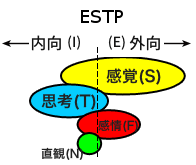
- Extroverted Sensing/Se
Very good at it /First functionThey are familiar with the real physical space ("what is happening right now") and possess high spatial awareness. - Introverted Thinking/Ti
I'm a little good at it /second function: They are responsible for verifying the facts, determining whether statements and findings make logical sense, and what is true or false. - Extraverted Feeling/Fe
I'm not very good at it.Third functionThey want to make people happy and feel positive. When that's not the case, it tends to turn into insults, sarcasm, and imposing a sense of superiority. - Introverted Sensing/Ni
I'm really bad at it /Fourth functionThey feel anxious and fearful because they don't know what will happen in the future. They are unable to (or do not like) making long-term predictions.
<The cognitive axis of ESTP>
By reading the roadmap below, you can learn about cognitive functions and understand ESTP in a logical order ↓
- Roadmap – ESTP (Entrepreneur-Adventurer Type) –
- Introduction – What is MBTI?
- Summary of my personality
- Cognition is
- Type-specific cognitive characteristics
- Four personality indicators (psychological tendency axes)
- Conflicts over personality indicators
- “The meaning of the four letters "ESTP"
- First character:Introvert (type I) or extrovert (type E)
- Second character:Intuitive type (N type) or Sensing type (S type)
- Third character:Feeling type (F type) or thinking type (T type)
- 4th character:Perceiving type (P type) or Judging type (J type)
- About psychological functions (cognitive functions)
- What are psychological functions (cognitive functions)?
- The eight psychological functions (cognitive functions)
- Decision-making (judgment) function
- Information gathering (perceptual) function
- Understanding your own psychological functions (cognitive functions)
- The developmental process of psychological functions (cognitive functions)
- Psychological functions (cognitive functions) of ESTPs
- First function:Extroverted Sensing (Se)
- Second function:Introverted Thinking (Ti)
- Third function:Extraverted Feeling (Fe)
- Fourth function:Introverted Intuition (Ni)
- Making good use of psychological functions (cognitive functions)
- Strengths and weaknesses of ESTPs
- Make the most of your strengths
- Reasons for focusing too much on the advantages
- How to improve your weaknesses
- If you are alone
- In a team setting: Have others compensate for your weaknesses (fourth function).
ESTP (Entrepreneur-Adventurer Type) - A Comprehensive Guide to Links
- Explanation of ESTP
- ESTP personality
- ESTP Personality Traits 02
- ESTP hobbies
- Things that ESTPs dislike
- Strengths and weaknesses of ESTPs
- Suitable occupations for ESTPs
- ESTP leadership
- Compatibility between ESTP and other types
- ESTP Relationships and Romance
- ESTP's Decision-Making Methods
- How ESTPs set goals and gather information.
- ESTP parent-child relationships
- For ESTPs to succeed
- ESTP psychological functions
- “The meaning of the four letters "ESTP"
- Psychological functions (cognitive functions) of ESTPs
- Integration of the second and third functions of ESTP
- The difference between extroverted thinking (Te) and introverted thinking (Ti)
- The difference between introverted thinking (Ti) and extroverted thinking (Te) [Part 2]
- EP Type: A curious challenger
↑Click to open↑
youESTP (Entrepreneur-Adventurer Type) Then
Share it on social media (tweet it) and let your followers know!
↓↓↓Share on social media (tweet)↓↓↓
↑↑↑Share on social media (tweet)↑↑↑

comment