
Classifying personalities into 16 types16-Type Personality TestCheck which type you are using the following↓↓

↑16-Type Personality Test↑
↑Diagnose↑
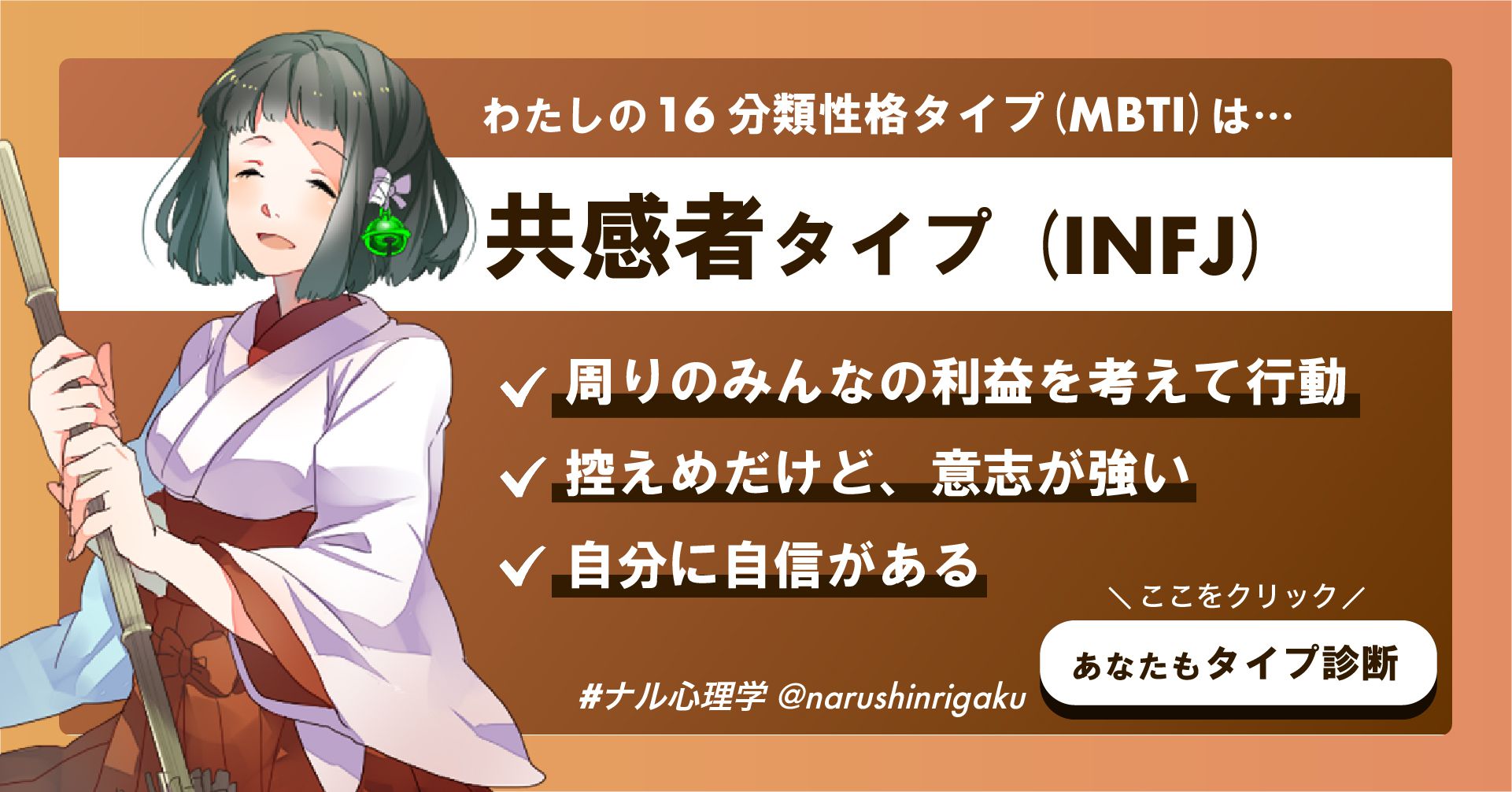
This article will cover the following 16 types.INFJ (Advocate = Empathizer type)I will explain the personality traits of [this person/character].
youINFJ (Advocate = Empathizer type)Then
Share it on social media (tweet it) and let your followers know!
↓↓↓Share on social media (tweet)↓↓↓
↑↑↑Share on social media (tweet)↑↑↑


A personality guide for INFJ (Innovator/Empathizer type)
The following is a quote (with some modifications) from "Let's Look at the World from the Perspective of MBTI Personality Type Theory" (website no longer exists).
They are modest, polite, humble, and intelligent. Innerly, they frequently experience confident flashes of insight, leading to profound discoveries. They can grasp the interconnectedness and trends of things, and come up with concepts that are broadly applicable to the real world.
By interacting with people and observing nature and urban landscapes, one calmly reflects on their experiences and arrives at a universal and general understanding. The reasons for intuitive convictions cannot always be explained in words, but there are many coincidences, and in most cases, they seem to be trustworthy.
INFJHis interests lie in the human mind, emotions, consciousness, human relationships, literature, nature, society, politics, philosophy, science, technology, art, and abstract questions concerning the fundamental nature of existence in this world. He finds beauty in systems where the interrelationships of its parts are ingenious and balanced, and where the whole has a single meaning.
Even from simple observations and experiences, we can gain insights into universal images and concepts, what is happening in the world, and the consequences of those events.
First, I intuitively grasp the overall picture, then gradually focus on making consistent inferences to gain a thorough understanding. I concentrate on what truly interests me, dedicating time to reflection and refining my ideas.
As long as I feel my ideas are incomplete, I'm reluctant to share them with others. I need a long time to surrender my attention to my inner inspiration and ponder them alone. During such times, I avoid the stimuli of noisy environments and unnecessary chatter, and go to a quiet place where I can be by myself.
The repeated flashes of inspiration eventually converge into a single core image, leading to the determination of a concrete plan for what to do next. Once you are convinced of that plan, you will have a strong desire to bring your ideas to life.
Once this process is complete, they actively seek interaction with others and try to express their opinions. It is important to consider whether their conclusions are correct and applicable, and to listen to the reactions and opinions of others.
A firm conviction, born from careful consideration, can lead to extreme perfectionism in the process of realizing a vision. One might believe that even the slightest flaw, contradiction, or imbalance would ruin everything. While the arduous process of execution may not be particularly enjoyable, one strives to complete the vision consistently and precisely, even if it means exhausting oneself.
At times, they listen empathetically to those in need. They possess an almost frighteningly keen ability to read people. They have firm opinions on personality and relationship problems and can provide clear answers to help resolve them.
However, it seems that there is much that is difficult to understand about oneself. When emotional problems arise, one seeks to resolve them by talking to others. One is interested in other people's ways of thinking and perspectives. Interacting with others is important for organizing one's own feelings, forming values, and understanding relationships.
I only reveal my core self to those I'm truly close to. Even with people I've known for many years, I'm sometimes surprised to discover a side of myself they've never seen before. Because of this, I'm sometimes perceived as difficult to understand.
Nevertheless, they are kind, gentle, behave appropriately in public, and are considerate of others, so they don't seem to be misunderstood very often. Despite being individualistic and eccentric, they usually manage to fit in well with society.
They are expressive, observant, and can communicate effectively. Sometimes, their expressions and words can seem exaggerated. They behave gracefully and are always grateful. In conversation, they entertain others with jokes and insightful metaphors. They tend to use many visual metaphors.
I aspire to build constructive relationships and strive to avoid being self-centered. I am considerate of others and willing to put my own needs aside or set them aside if necessary.
Because they are honest, they may not immediately see through the malice or lies of others. Nevertheless, with careful observation and keen insight, they will notice the deceit and selfish true intentions of others. If they feel that goodwill is being trampled upon, they will quietly withdraw and avoid getting involved. However, if they anticipate that others will also be inconvenienced, they will use their wits to try and stop it. They will behave as peacefully and gentlemanly as possible, but they may also openly show their disgust and express their anger.
They possess the ability to grasp the consensus of human groups and empathize with the feelings of the masses. They feel heartache when they see people in oppressive environments and being oppressed. They are quick to condemn harmful behavior, exploitation, and injustice towards others. They constantly question what is right and how things should be, and they advocate for their own views. They encourage people to cooperate and take action for improvement.
They are bold when it comes to opportunities, and they also take political considerations into account. It's a struggle to realize their vision.
I warn of potential dangers in the future. While I generally prefer not to draw attention, when necessary, I will step forward to guide people, instruct, and encourage a change in individual awareness. These actions stem from intuition and empathy for others, not from personal glory or power. Certainly, I would be pleased to receive praise and commensurate benefits, but these are not the ultimate goals.
Ideas that disregard ethics can arise. Sometimes they may be cruel, cunning, oppressive, and exploitative. Especially in their youth, they may be overconfident in their own intelligence and commit evil deeds for their own pleasure, intellectual curiosity, or profit. However, they can actually imagine how much such actions will hurt themselves and others. If they honestly reflect on their actions, they will no longer act on unethical ideas. Nevertheless, their imaginations may wander to crimes that someone, somewhere, might commit, or to the worst-case scenarios that humanity might one day experience. They may be haunted by nightmares. These imaginations may manifest as warnings to the world or as motifs in literary works. Some INFJs possess a prophetic charisma.
When I become interested in major problems in human society, I begin to think theoretically in an attempt to find universal solutions. I may feel disgusted by the selfish aspects of human nature, but I always try not to forget the positive aspects of humanity.
I can calmly observe myself and feel the conflict between my cruel, wild nature and my warm, humane side. I acknowledge that such conflicts can occur within every human being, but I believe that the latter will eventually prevail.
INFJs are often described as idealistic not because they take a lighthearted view of human nature or the future of society, but because they have a strong belief in a universal and unifying framework and a desire to realize it through dedicated effort.
I believe that dedication to others determines the value of one's life. While valuing cooperative relationships and striving to serve others with dedication, I think everyone should have sound judgment and the ability to realize it. The challenge is to be as independent as possible, without settling for dependence. A constructive cooperative relationship between independent individuals is ideal. Of course, I believe that young people and beginners should be properly educated and supported until they become independent.
When analytical abilities are fully developed, natural phenomena and artificial systems can be understood theoretically and scientifically. There are those who demonstrate creativity in the field of science. They may be able to fully utilize the workings of introverted intuition and introverted thinking to enjoy even somewhat complex things, and to generate original ideas and methods.
INFJ ideas are often metaphysical, sometimes leaving ambiguity. They may feel at a disadvantage when faced with hard theories or rigorous treatment. They may work with NT types, exchanging opinions and receiving feedback on scientifically inaccurate points. In academia, they seem to be more drawn to liberal arts than science.
The INFJ's life is not easy because they earnestly engage in various internal conflicts, perfectionism in realizing their ideas, and a desire to meet the needs of those they encounter. Some may experience major setbacks before developing ideally and realizing their vision. Furthermore, they often find it difficult to enjoy an energetic life solely for themselves. However, this allows them to gain a profound understanding of the world.
It is the dominant psychological function.Introverted Intuition (Ni)This is a psychological function for receiving information, so inspiration arises naturally and unintentionally. It can become active when you are relaxed and your mind is at rest. Therefore, it feels more like a natural phenomenon of brain activity than something you have to make an effort for. For people with faith, it may feel like a revelation. It is also an auxiliary psychological function.Extraverted Feeling (Fe)This involves setting aside one's own needs for the sake of others' demands and striving to achieve a sense of oneness with all human beings. These two psychological functions work together, leading to thoughts of a consciousness beyond oneself. One begins to perceive everything as interconnected and as a single, complete system. In a sense, one may even feel as if they do not exist. Some experience mystical consciousness beyond physical sensations and personal awareness.
End of quote from "Let's Look at the World from the Perspective of MBTI Personality Type Theory" (website no longer exists) (partially modified)
reference
・INFJ (Advocate = Empathy Type) Personality
・"To inspire others"INFJ (Advocate/Empathy Type) ~ How do gender differences affect the lives of INFJs? ~
Further characteristics of INFJ (Advocate/Empathy type) and compatibility with other types
- INFJ personality
- "Inspires others" - INFJ How do gender differences affect the lives of INFJs?
- INFJ Personality Guide
- INFJ hobbies
- Things that INFJs dislike
- Strengths and weaknesses of INFJs
- Suitable occupations for INFJs
- INFJ leadership
- Compatibility between INFJ and other personality types
- INFJ and relationships
- INFJ and romance
- How INFJs Set Goals and Gather Information
- INFJ's Decision-Making Methods
- INFJ parent-child relationships
- How INFJs can succeed in life and tips for doing so.
↓Learn more↓
Compatibility chart and advice for INFJ (Advocate = Empath) types with other types.
Ideal compatibility type pair
INFJs get along well with people with whom they can discuss future plans, ideas, and goals.
From an INFJ's perspective...
- ENFP (Reformer type):Ne – FiWe can have a positive discussion about the possibility of positive events happening in the future.
- INFP (Psychologist type):Fi – NeBecause they are highly empathetic and understand your feelings, talking to them makes it easier to reflect on your own thoughts and helps with self-awareness.
- ISFJ (Parental Type):Si – FeIt is calm and soothing.
Type pairs that are prone to conflict
INFJs tend to clash with types of people who don't prioritize the whole or the group, and who don't value harmony between people.
From an INFJ's perspective...
- ESTP (Adventurer type):Se – TiCommunication breaks down, and you naturally become vulnerable to being taken advantage of.
Romantic compatibility type pair
INFJs are most compatible in love with sincere, genuine people who can encourage them.
From an INFJ's perspective...
- ENFJ (Collaborator Type):Fe – NiThey can think about everyone and the whole, and they can also encourage and inspire themselves.
- ENFP (Reformer type):Ne – FiWe can think of each person as important, respect individuals, and have various discussions.
- ESTP (Adventurer type):Se – TiThey encourage me and reassure me about my weaknesses.
- INTP (Researcher Type):Ti – NeYou can discuss ideas and exchange information freely.
*The pairs that tend to clash and the pairs that have good romantic compatibility may overlap. This is because while people may dislike those who are the complete opposite of themselves due to disagreements, they may also be attracted to those who appear mysterious because they are different. However, it seems that these relationships often end up breaking down.
(Advice for those dating an INFJ)
INFJs have a knack for understanding others' feelings and enjoy intimate relationships. They tend to thrive in romantic relationships with people who share their values. As a partner, it's important to create an intimate atmosphere and provide the support an INFJ needs. The qualities an INFJ seeks in a partner are sincerity, honesty, and a genuine, authentic approach.
A collection of links explaining the psychological functions of the INFJ (Advocate/Empath) personality type (for those who want to understand how the mind works).
Reading the following roadmap from top to bottom will help you understand the INFJ mindset in a logical order ↓
- Roadmap – INFJ (Advocate = Empathizer) type –
- Introduction – What is MBTI?
- Summary of my personality
- Cognition is
- Type-specific cognitive characteristics
- Four personality indicators (psychological tendency axes)
- Conflicts over personality indicators
- “The meaning of the four letters "INFJ"
- First character:Introvert (type I) or extrovert (type E)
- Second character:Intuitive type (N type) or Sensing type (S type)
- Third character:Feeling type (F type) or thinking type (T type)
- 4th character:Perceiving type (P type) or Judging type (J type)
- About psychological functions (cognitive functions)
- What are psychological functions (cognitive functions)?
- The eight psychological functions (cognitive functions)
- Decision-making (judgment) function
- Information gathering (perceptual) function
- Understanding your own psychological functions (cognitive functions)
- The developmental process of psychological functions (cognitive functions)
- INFJ's psychological functions (cognitive functions)
- First function:Introverted Intuition (Ni)
- Second function:Extraverted Feeling (Fe)
- Third function:Introverted Thinking (Ti)
- Fourth function:Extroverted Sensing (Se)
- Making good use of psychological functions (cognitive functions)
- Strengths and weaknesses of INFJs
- Make the most of your strengths
- Reasons for focusing too much on the advantages
- How to improve your weaknesses
- If you are alone
- In a team setting: Have others compensate for your weaknesses (fourth function).
INFJ (Empathy Type)To truly understand this,Psychological functions (cognitive functions)* is important ↓
*Generally in cognitive science,Cognitive functions「The function by which living organisms actively collect external information, perceive and remember it, and then process it by adding reasoning and judgment in order to acquire knowledge about their subject.It is defined as "
List of articles related to INFJ (Empathy Type)
↑Learn more↑
moreoverEmpathy type (INFJ)If you'd like to learn more, we also recommend the following article.
youINFJ (Advocate = Empathizer type)Then
Share it on social media (tweet it) and let your followers know!
↓↓↓Share on social media (tweet)↓↓↓
↑↑↑Share on social media (tweet)↑↑↑

comment