

INFP (Psychologist type)のdecision making methodI will explain this.
Have you ever felt frustrated with the decision-making methods of your colleagues or friends? Were they illogical or disorganized? If not addressed early, these problems can snowball and cause widespread disruption in the workplace. Decision-making methods vary greatly depending on the individual and their personality. There is no right or wrong way to make decisions. However, there is a decision-making method that is right for you and that works best for you.
However, when people with different decision-making styles work together, tension can rise. Understanding each other is key to maintaining communication and ensuring the success of the project.MBTITaking the time to understand your own personality type can help improve and streamline decision-making for you and your team, and build a deeper mutual understanding in the process.


Decision-making methods of INFP (Psychologist type)
INFP people,"What is the most compassionate choice?"(=Introverted Feeling: FiINFPs often prioritize this above all else. When faced with a decision-making opportunity, they define the problem itself and their goals from the perspective of how they can most effectively serve and benefit everyone involved in the decision-making process, as well as those who may be positively affected by the decision itself.
Therefore,Examine the entire situation from multiple perspectives.(=Extroverted Intuition: NeThey tend to spend ample time on this. What will they lose from others by satisfying one person's needs? Because INFPs want the best possible outcome for everyone, they risk getting lost in their own minds (or the vast mountain of possibilities and information) in their pursuit of the ideal strategy. However, in reality, it is impossible to satisfy everyone, and as much as possible...Develop a realistic win-win strategy.(=Extraverted Thinking: TeYou should focus on that. While it is certainly beneficial for INFP types to seek opinions from others, they need to make an effort to maintain their focus, such as gradually narrowing down the options while brainstorming.
INFPs tend to procrastinate on decisions. This is because they prioritize the needs of others over their own. They strive to make fair decisions centered around those who are important to them. This type of person keeps their moral promises and makes decisions based on what they believe is important.
This type of person,Logical thinking(=Extraverted Thinking: TeThey tend to struggle with this. INFPs may ignore information that is actually beyond their control, so it is important to list as many cause-and-effect situations as possible. Another way for INFPs to make decisions quickly is to set a deadline by which the decision must be made and make sure they do not miss that deadline.
Sharing this "day of decision" with family and friends increases the likelihood of succeeding. Writing it down in a place you see every day is also an effective way to make a decision. Most importantly, have confidence in your decision.
INFPs truly shine when the choices are narrowed down to a few options. Decisions made by this type of person are ethical, compassionate, and thoughtful. When they begin to think about what to do, remember that the simplest and easiest solution is often the best. Such a solution may not be perfect, but sometimes a decision that can be implemented more easily and in a timely manner is more effective than debating trivial matters. INFPs can quickly and easily adapt their decisions to changing circumstances, especially since necessary changes often directly benefit people.
However, you must be mindful of communicating any changes in the vision or goals to other members of the team, because if the plan changes without their knowledge, it can hurt the feelings of some people.
When INFPs and their teams reflect on their decisions and evaluate their impact, they must strive to recognize both the positive strengths and areas for improvement and growth. Evaluating results is crucial for motivation, and reinforcing the positive aspects is essential for this. This not only makes goals more specific and achievable, but also helps in sharing the vision with those who help and support them.
The important point here is that the INFP's greatest strength—consideration and empathy for others—can become their Achilles' heel if not kept in check. There are two questions that an INFP can ask themselves when making a decision.
(1) If you didn't have to worry about other people's feelings, how would you make a decision?
(2) Is the decision both empathetic and economic?
Based on these factors, a well-developed INFP will be able to make compassionate, practical, innovative, and highly efficient decisions for the team.
Other types of "decision-making methods"If you would like to read more about this,Click here ↓
16 Types of Decision-Making Methods
For those who want to learn more about INFP (psychologist type) (including compatibility, etc.)
For more information, please see below.Highly recommended (click to open) ↓
Compatibility: You can learn about compatibility and how to interact with other types.
RoadmapYou can learn about personality types and personality theories (MBTI) in a systematic way, from basic to specialized.
Related articlesLearn about the characteristics of each type (take a look at the parts that interest you)
Compatibility between INFP (Psychologist type) and other types (click to show)
Ideal compatibility type pair
INFPs are most compatible with people who respect each individual's values.
From an INFP's perspective...
- ISFP (Artist type):Fi – SeThey respect my feelings just as they are.
- INTP (Researcher Type):Ti – NeThey can discuss their ideas and exchange information.
- INFJ (Empathy Type):Ni – Fe, give personal advice
Type pairs that are prone to conflict
INFPs tend to clash with pushy types who don't respect individual values and exert psychological pressure.
From an INFP's perspective...
- ESTJ (Responsible type):Te – SiThey criticize while trying to control you.
- ESFJ (Sociable Type):Fe – SiSometimes they are too meddlesome.
- ENTJ (Leader type):Te – NiHe is very logical, meticulous, and rational, but his demands are intense, making him difficult to be around.
Romantic compatibility type pair
INFPs are most compatible in romantic relationships with people with whom they can easily discuss opinions and who can complement their weaknesses and shortcomings.
Similar to friendships, INFPs can sometimes struggle to get close to potential romantic partners. Once a relationship is established, they are fiercely loyal. However, their romantic views on love can be overly idealistic, leading them to have excessively high expectations of their partner, which can be difficult for the other person to handle. They also tend to take things personally and try to avoid conflict.
From an INFP's perspective...
- ENFP (Reformer type):Ne – Fi, respecting each individual and being able to have productive discussions
- ESTJ (Responsible type):Te – SiIt provides a sense of long-term security.
- ISTJ (Hardworking Type):Si – TeIt allows you to build a stable relationship, and you can trust and feel at ease.
*The pairs that tend to clash and the pairs that have good romantic compatibility may overlap. This is because while people may dislike those who are the complete opposite of themselves due to disagreements, they may also be attracted to those who appear mysterious because they are different. However, it seems that these relationships often end up breaking down.
(Advice for those dating an INFP)
If your partner is an INFP, keep in mind that you may have difficulty getting them to open up, they can be overly sensitive to criticism, and they may prioritize your happiness over their own.
INFP (Psychologist Type) Roadmap (Click to open)
To truly understand the INFP (Psychologist type),Psychological functions (cognitive functions)* is important ↓
*Generally in cognitive science,Cognitive functions「The function by which living organisms actively collect external information, perceive and remember it, and then process it by adding reasoning and judgment in order to acquire knowledge about their subject.It is defined as "
- Introverted Feeling/Fi
Very good at it /First function: Decide what you believe is right for you, what is morally right within your worldview, and what you should do according to your personal values. - Extroverted Intuition/Ne
I'm a little good at it /second functionIt reveals the negative consequences of current actions, future outcomes, and the intentions behind people's actions. - Introverted Sensing/Si
I'm not very good at it.Third functionThey use past experiences to justify their current attitudes. They may also become risk-averse and unable to leave their comfort zone. - Extraverted Thinking/Te
I'm really bad at it /Fourth functionThey fear and worry about what others think of them. They are unable (or unwilling) to organize their thoughts rationally and logically.
<INFP's Cognitive Framework>
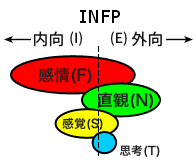
By reading the roadmap below, you can learn about cognitive functions and gain a systematic understanding of INFPs ↓
- Roadmap – INFP (Mediator = Psychologist) type –
- Introduction – What is MBTI?
- Summary of my personality
- Cognition is
- Type-specific cognitive characteristics
- Four personality indicators (psychological tendency axes)
- Conflicts over personality indicators
- “The meaning of the four letters "INFP"
- First character:Introvert (type I) or extrovert (type E)
- Second character:Intuitive type (N type) or Sensing type (S type)
- Third character:Feeling type (F type) or thinking type (T type)
- 4th character:Perceiving type (P type) or Judging type (J type)
- About psychological functions (cognitive functions)
- What are psychological functions (cognitive functions)?
- The eight psychological functions (cognitive functions)
- Decision-making (judgment) function
- Information gathering (perceptual) function
- Understanding your own psychological functions (cognitive functions)
- The developmental process of psychological functions (cognitive functions)
- The psychological functions (cognitive functions) of INFPs
- First function:Introverted Feeling (Fi)
- Second function:Extroverted Intuition (Ne)
- Third function:Introverted Sensing (Si)
- Fourth function:Extraverted Thinking (Te)
- Making good use of psychological functions (cognitive functions)
- The strengths and weaknesses of INFPs
- Make the most of your strengths
- Reasons for focusing too much on the advantages
- How to improve your weaknesses
- If you are alone
- In a team setting: Have others compensate for your weaknesses (fourth function).
INFP (Mediator = Psychologist Type) – A Comprehensive Link Guide
- INFP Explanation
- INFP Personality Trait 01
- INFP Personality Traits 02
- INFP Personality Trait 03
- INFP's hobbies
- Things that INFPs dislike
- The strengths and weaknesses of INFPs
- Suitable occupations for INFPs
- INFP leadership
- Compatibility between INFP and other personality types
- INFP Relationships and Romance
- How INFPs can grow and achieve their dreams
- How INFPs set goals and gather information
- INFP's Decision-Making Methods
- INFP parent-child relationships
- For INFPs to succeed
- INFP psychological function
- “The meaning of the four letters "INFP"
- The psychological functions (cognitive functions) of INFPs
- The integration of the second and third functions of the INFP (Psychologist type)
- The difference between introverted feeling (Fi) and extroverted feeling (Fe)
- The difference between extroverted thinking (Te) and introverted feeling (Fi)
- IP Type: People who develop through self-discipline
↑Click to open↑

comment