
Classifying personalities into 16 types16-Type Personality TestCheck which type you are using the following↓↓

↑16-Type Personality Test↑
↑Diagnose↑
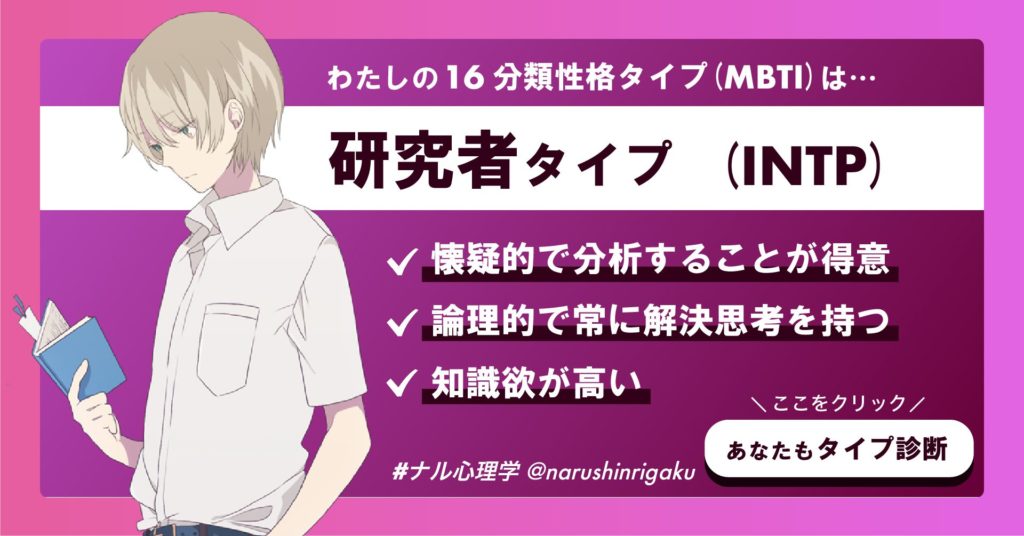
This article will cover the following 16 types.INTP(Researcher typeThis explains the success of ).
youINTP (Logician/Researcher Type)Then
Share it on social media (tweet it) and let your followers know!
↓↓↓Share on social media (tweet)↓↓↓
↑↑↑Share on social media (tweet)↑↑↑


What does success mean to an INTP (Researcher Type)?
INTPs are hard on themselves and often struggle to measure their own success. They may not feel truly successful, even when they've accomplished much more than they realize. Feeling completely successful or accomplished in life is difficult, and sometimes challenging. An INTP's sense of success is determined by opportunities to pursue and discover truth, their relationships, and their extroverted lifestyle.
For INTPs, happiness comes from intellectual activities such as using logic and reasoning to uncover the truth about reality. INTPs constantly seek truth and hold it in the highest esteem. For INTPs, reaching conclusions about the truth is not easy. Their auxiliary function, extroverted intuition, encourages them to consider each possibility before drawing a conclusion. INTPs also tend to spend a lot of time thinking of creative solutions to complex problems. Because they can think about things from various perspectives, they can consider possible ideas, compare possible outcomes, and prevent unnecessary mistakes.
Furthermore, they want to know that the principles of their understanding are correctly grasped, and when explaining those principles, they often seek confirmation from others that they understand. At the same time, they strive to convey their knowledge accurately. They also have a great respect for metaphysical principles, facts, and truths, and INTPs find great pleasure in engaging in logic and intellectual and logical activities such as learning concepts or theories. As a result, they tend to delve deeply into specific topics. They enjoy acquiring vast knowledge on their favorite subjects and may possess impressive expertise in several fields.
When this trait is utilized, INTPs can become exceptionally talented writers. By immersing themselves in work they excel at, INTPs find happiness and can work more productively. Because they proactively engage in their work and utilize their strengths, they may be able to stay in their position for the long term.
INTPs are naturally solitary types, but neglecting important relationships will prevent them from reaching their peak. Isolated INTPs rarely experience happiness or success. NTPs are prone to isolation, and this is especially true when dealing with difficult problems. While they may not be interested in having many friends or relationships, INTPs who can intentionally cultivate social and professional connections can be more successful and ultimately happier. Because INTPs spend a lot of time alone, they may not have many opportunities to hear the opinions of others that can help them keep themselves on track. By drawing others into their inner world, INTPs can not only improve their relationships but also gain crucial feedback that helps them clarify their higher-level thoughts and make them more understandable and useful to a wider audience.
The ability to have good interpersonal relationships largely depends on the development of extroverted intuition. Compared to other types, INTPs have simpler expectations of relationships, so it's very important for them to maintain extroverted relationships and not try to handle everything on their own. INTPs can make good friends and partners, but they don't pay excessive attention to or warmth to the feelings and cues of others.
Strengths that INTPs (Researcher Type) should cultivate
- They have a strong understanding of the environment and can act quickly.
- Problem solving in complete secrecy
- Curiosity and a strong desire to learn
- Ideas and solutions that break away from conventional thinking
- To have a holistic perspective
- The ability to grasp the big picture
- I can approach any problem logically.
- In other words, they tend to prioritize facts and logic over emotions. This ability helps them make objective judgments and remain calm even in emotional situations.
- They have a natural talent for focusing and entering a "zone" when tackling problems.
- We value accuracy in communication.
- Open to new ideas and methods
- He has a good sense of humor, is cheerful and kind-hearted.
- Excellent expertise in the desired field
- Highly intelligent and capable of understanding complex concepts.
- Committed to truth and reality
- Attractive and compelling
- Don't make excessive demands on relationships, and keep your daily needs simple.
Tips for success for INTPs (Researcher types)
- Confirm your feelings and express them.
INTPs sometimes don't fully understand the feelings they have for others (even though they actually do have some kind of emotion). However, understanding these feelings is important. If you determine that you care about that person, communicate it each time. That is the best way to make them feel secure and build a lasting relationship. - Let's talk about your thoughts.
Discussing your thoughts and perceptions with others helps deepen your "extroverted intuition/Ne" and, consequently, your understanding of the world. Knowing how to effectively utilize your auxiliary function, "extroverted intuition/Ne," is crucial for your health and happiness. - Let's listen to a variety of ideas and opinions.
Let's avoid immediately dismissing everything. Let's take our time to evaluate things and make judgments. Let's not dismiss things that seem illogical. They're not illogical. - Consider whether it is practically useful.
This may be difficult for INTPs, who prioritize theory and lack a utilitarian or pragmatic approach. This doesn't mean they disregard efficiency, but rather that they believe in the value of thinking and experimenting for its own sake, even if it doesn't yield practical value or results. While there's a need for people to take on ambitious projects and experiments simply because they're good, in reality, there may be few who share that sentiment. INTPs should take a step back and consider projects from a realistic standpoint.
INTPs are also good at coming up with new ideas and solutions to difficult problems. They are not bound by conventional thinking and can find unique and sustainable ways to solve troublesome problems. However, they may not have considered the feasibility of their ideas. INTPs truly shine when they consider questions such as: Will this idea actually work? Will it be accepted by the world? Is this a product or function that people will actually use? Does it have practical value? - Let's recognize the principles of society.
We must recognize that our society functions around several fundamental social principles, and that if these principles are not recognized and upheld, our society will fail. In a democracy, people vote. At a red light, people stop. If people stopped voting because it didn't concern them, who would hold power? If people stopped stopping at red lights because they didn't fit their plans, how could we drive safely? Your priorities and plans are important, but you must also recognize that external issues are important. Do not deny the importance of principles that do not directly affect your life. - Let's cultivate your strengths.
Recognize your talent for dealing with logical problems and situations, and give yourself plenty of opportunities to utilize that ability. Much of your happiness will come from such experiences. - Let's pay attention to the details.
INTPs can see the big picture with a broad perspective without getting bogged down in details, allowing them to have many different viewpoints. However, on the other hand, they may overlook or be careless with details, which can sometimes hold them back, so they need to be careful. - Let's cultivate compassion and empathy.
INTPs are always committed to what is right, truthful, and logical, but with time and effort, they can become more compassionate. This involves understanding and considering the importance of caring for the emotional well-being of others, and striving to develop empathy and compassion. INTPs may also benefit from starting by examining and understanding their own emotions.
For those who want to learn more about INTPs (researcher type) (compatibility, etc.)
For more information, please see below.Highly recommended (click to open) ↓
Compatibility: You can learn about compatibility and how to interact with other types.
RoadmapYou can learn about personality types and personality theories (MBTI) in a systematic way, from basic to specialized.
Related articlesLearn about the characteristics of each type (take a look at the parts that interest you)
Compatibility between INTPs and other personality types (click to view)
Ideal compatibility type pair
INTPs are compatible with people who understand their own arguments and can engage in logical discussions and debates.
From an INTP's perspective...
- INTJ (Strategist type) :Ni – TeThey can exchange information and share ideas.
- ISTP (Practitioner type):Ti – Se, it is possible to exchange specialized information.
Type pairs that are prone to conflict
INTPs tend to clash with people who attack them simply because their thoughts or positions differ from their own, or those who are largely incapable of logical reasoning.
From an INTP's perspective...
- ESFJ (Sociable Type):Fe – SiThey can be illogical and pushy.
- ESTJ (Responsible type):Te – SiThey are negative towards new ideas, controlling, and try to control you.
Romantic compatibility type pair
INTPs are most compatible in romantic relationships with partners with whom they can share ideas and create exciting experiences, as well as partners who can complement their weaknesses.
From an INTP's perspective...
- ENFJ (Collaborator Type):Fe – NiThey are responsible and listen attentively.
- ENFP (Reformer type):Ne – FiWe can share ideas and introduce each other to friends and communities.
- ESTJ (Responsible type):Te – SiThey think about my future stability and give me peace of mind.
- ESFJ:Fe – SiIt compensates for weaknesses and improves the stability of life.
*The pairs that tend to clash and the pairs that have good romantic compatibility may overlap. This is because while people may dislike those who are the complete opposite of themselves due to disagreements, they may also be attracted to those who appear mysterious because they are different. However, it seems that these relationships often end up breaking down.
(Advice for those dating an INTP)
INTPs often become engrossed in thinking things through on their own, which can make them difficult to get close to. In relationships, they tend to remain silent and not take action until they feel the other person is worthy of hearing their deepest feelings.
One thing to remember is that INTPs enjoy relationships based on deep mutual affection, but they don't play games. INTPs are not good at reading other people's feelings, so in this regard, you may need to be direct about what you need and want. Also, INTPs are not good at expressing their own thoughts and feelings, so you may need to pay attention to the subtle signals they give you.
INTP (Researcher Type) Roadmap (Click to open)
To truly understand INTP (Researcher Type),Psychological functions (cognitive functions)This is important ↓
By reading the roadmap below, you can learn about cognitive functions and gain a systematic understanding of INTPs ↓
- Roadmap – INTP (Researcher Type) –
- Introduction – What is MBTI?
- Summary of my personality
- Cognition is
- Type-specific cognitive characteristics
- Four personality indicators (psychological tendency axes)
- Conflicts over personality indicators
- “The meaning of the four letters "INTP"
- First character:Introvert (type I) or extrovert (type E)
- Second character:Intuitive type (N type) or Sensing type (S type)
- Third character:Feeling type (F type) or thinking type (T type)
- 4th character:Perceiving type (P type) or Judging type (J type)
- About psychological functions (cognitive functions)
- What are psychological functions (cognitive functions)?
- The eight psychological functions (cognitive functions)
- Decision-making (judgment) function
- Information gathering (perceptual) function
- Understanding your own psychological functions (cognitive functions)
- The developmental process of psychological functions (cognitive functions)
- INTP's psychological functions (cognitive functions)
- First function:Introverted Thinking (Ti)
- Second function:Extroverted Intuition (Ne)
- Third function:内向Sense of sensation (Si)
- Fourth function:Extraverted Feeling (Fe)
- Making good use of psychological functions (cognitive functions)
- Advantages and disadvantages of INTPs
- Make the most of your strengths
- Reasons for focusing too much on the advantages
- How to improve your weaknesses
- If you are alone
- In a team setting: Have others compensate for your weaknesses (fourth function).
INTP (Logician/Researcher Type) – A Comprehensive Guide with Links
- INTP explanation
- INTP psychological functions
- “The meaning of the four letters "INTP"
- INTP's psychological functions (cognitive functions)
- Integration of INTP's second and third functions
- The difference between extroverted thinking (Te) and introverted thinking (Ti)
- The difference between introverted thinking (Ti) and extroverted thinking (Te) [Part 2]
- IP Type: People who develop through self-discipline
- Comparison with other types
↑Click to open↑
youINTP (Logician/Researcher Type)Then
Share it on social media (tweet it) and let your followers know!
↓↓↓Share on social media (tweet)↓↓↓
↑↑↑Share on social media (tweet)↑↑↑

comment