16-Type Personality TestIt is very accurate.Personality testIt is known that each person has their own strengths (things they use often)Psychological functions (cognitive functions)It is believed that there are some. One of them is"Extroverted Intuition (Ne)"So, people who are good at this feature,They are highly curious and can see the essence of things.。
As shown in the diagram below,Extroverted Intuition (Ne) isVarious timelinesPsychological functions that focus on (but ratherfuture(The focus is on this.)They are good at expanding possibilities and are willing to take on challenges in the unknown.
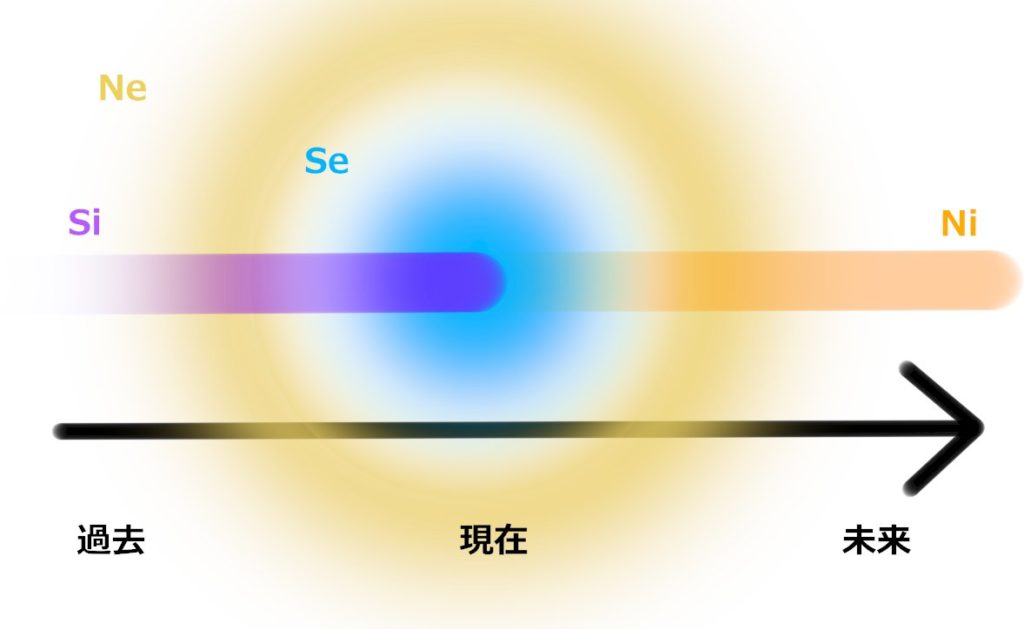
Extroverted Intuition (Ne)The type that is strong is,ENFP (Reformer type), ENTP (Inventor Type), INFP (Psychologist type), INTP (Researcher Type)such asNPIt's my type.
↓Click here if you want to find out your personality type from the 16 personality types↓
↑Try taking the 16-type personality test↑
16-Type Personality TestIf you are not yet familiar with this topic, please refer to the article below.

Also, in advanceFour psychological tendency axesKnowing the following will also help you understand morePsychological functions (cognitive functions)You can understand this.


What is Extroverted Intuition (Ne)?
Extroverted Intuition (Ne) is an intuitive process that utilizes pattern recognition to infer what lies behind it. It relies on sensory processes and prefers reliable and verifiable information.Extroverted Sensing (Se)、Introverted Sensing (Si)Unlike people who rely on their intuition, those with a dominant extroverted intuition (Ne) feel no discomfort at all in assuming "what might be possible."
If you strongly relate to Ne, you've likely been fascinated since childhood by tinkering with your environment to understand how things work. You viewed the world as a laboratory filled with discoveries. Therefore, you found the world fascinating because you could observe the patterns that emerged from the buttons you pressed. You were also able to uncover relationships between things that others missed.
As I gained experience and deepened my learning, the process of exploration became more refined. Over time, the world became a vast spiderweb of connections and relationships, and I became better at seeing these connections and inferring how things are connected. And that process became faster.
As an extroverted process, Ne is responsible for recognizing patterns in the external world. The easiest way to discover new patterns is to tinker with the environment. Pulling levers, pressing buttons, walking into restricted areas—these are often mistaken for rebellion against society, but in reality, they are attempts to break the status quo that everyone takes for granted. For people with a dominant extroverted intuition (Ne), there is nothing more enjoyable than discovering new ways to use old things.
Questions that begin with "What if..." lead to highly satisfying discussions for people with a dominant extroverted intuition (Ne). Brainstorming-like conversations with creative people who are enthusiastically scribbling ideas on a whiteboard are incredibly enjoyable.
People with a dominant extroverted intuition (Ne) tend to get bored with things that are too familiar. They may also change perfectly functioning and usable systems (even though there is no need to change them) in order to keep themselves from getting bored.
Details of Extroverted Intuition (Ne)
This is a psychological function that allows us to objectively receive information from a broad perspective. Through intuition, we grasp the underlying dynamics and relationships at work, and gain an overview of the whole picture.
keyword
Seeing the essence, flashes of insight, inspiration, insight, speculation, clever, witty, nuanced, multifaceted, comprehensive, creative, abstract, theoretical, possibilities, ideas, concepts, the big picture, grasping meaning, thinking in shapes, symbols, diversity, broad perspective, intellectual curiosity, trial and error, adaptability, open, objective, universal, unbiased, argumentative, brainstorming, challenging, metaphor, similarity, application, solutions, eccentric, unconventional, novelty, new combinations, laws, pattern recognition, trend recognition, innovation, ingenuity, easily bored, fickle, charming, playful, new relationships
For types whose primary psychological function is extroverted intuition,ENFP (Reformer type), ENTP (Inventor Type)is.
For types whose second psychological function is extroverted intuition,INFP (Psychologist type), INTP (Researcher Type)is.
They quickly grasp the essence of things and notice hidden meanings.
We interpret things from multiple perspectives and consider and discuss various possibilities.
They are curious about the outside world and notice many things, but their intuition kicks in quickly, so they have limited time to perceive the real world as it is. As a result, they often find themselves in a state of absentmindedness.
They are creative and playful. Those with strong extroverted intuition may suddenly imagine quirky and eccentric things and begin to play with them by putting them into words. This can sometimes be perceived as fooling around by other types. Of course, they aren't always fooling around like this. This psychological function can be used to entertain children in various ways.
I have an intellectual curiosity and I'm constantly drawn to ideas that haven't yet become concrete or abstract theories, and I get excited wondering what will happen.
They try to skillfully process countless ideas, perspectives, and values all at once. At the moment they are driven by an idea, they themselves don't know what will happen next. However, they expect something to happen through the combination of new opportunities and ideas.
And they actually have a keen sense for such things, finding potential in things that others overlook. That's how you can trust brainstorming and arrive at new perspectives.
Ideas come to us suddenly while we're experiencing or reading various things. They can even happen in seemingly unrelated contexts. These are unconscious processes, not the result of intentional reasoning like thinking.
We discover similarities, such as "it's just like...", and inductively conceive abstract concepts, and then we want to know if they are true.
However, this intellectual curiosity is boundless, and interests tend to shift from one thing to the next. As a result, it sometimes ends up remaining at the stage of a vague "hunch." At that point, no clear conclusion is reached, and no guidance for action is provided.
To actually develop a solid theory or create a finished work requires focused effort.
Being open to possibilities and open to conclusions makes it difficult to focus, which can be a burden for the individual and can cause frustration for others.
Because it's an extroverted psychological function, this premonition can be easily communicated to others. Therefore, it becomes possible to reach an answer through discussion with the help of others.
Ideas gained through intuition are free from preconceived notions. They don't involve judging others, nor are they hindered by perspectives of morality, manners, economics, efficiency, profit and loss, good and evil, beauty and ugliness, or authority. Those are the roles of other psychological functions.
First, we can come up with a series of possible scenarios and discuss them from those perspectives. As a result, we can reach understandings that were not previously recognized, learn about the true nature of others, and even sense the dangers of things.
With so many possibilities swirling in my mind and so many things sparking my interest, it becomes difficult to patiently complete routine tasks and tedious procedures. However, I need to realize that ideas and new possibilities are only realized through such diligent effort; otherwise, they remain mere fantasies.
In fact, by trusting the insights gained from extroverted intuition and focusing on them without distraction, it becomes possible to foresee future events and even create the future. Furthermore, as these results gain acceptance from many people, they gradually become traditional.
While I quickly get bored with routine work, I can come up with quick-witted solutions on the fly when faced with unexpected situations.
I feel especially motivated when adapting to changing times and starting new projects. The excitement of being able to respond flexibly to unprecedented situations and unpredictable solutions can inspire others.
They are open to opportunities and not only discern the relationships between ideas and theories, but also play a role in connecting people. They strive to build new relationships and act as intermediaries.
Furthermore, from a neuroscience perspective, people with strong extroverted intuition (Ne) tend to...Innovation and inspirationThis indicates that you are effectively utilizing a brain mode called the "default mode network" mode. You can read more about the relationship between neuroscience and extroverted intuition (Ne) in the following article.
.jpg)
The Big Five personality traits and extroverted intuition (Ne)
The Big Five personality model is considered the most reliable personality analysis in the world, and was proposed by Lewis R. Goldberg, an American psychologist and professor emeritus at the University of Oregon. As the name suggests, the Big Five classifies a person's personality into five factors.
Explanation of the five personality traits (factors) of the Big Five personality model ← Tap
- Neurotic tendencies: A tendency towards emotional instability, such as being prone to depression.。I tend to get into negative moods.
- Relationship with the 16 personality types: This factor is not measured by the 16 personality types.
- High scoreThey are prone to stress, impulsive, and anxious. Keywords: anxiety, irritability, depression, low self-esteem
- Low score: Stress-resistant and emotionally stable
This property (when scoring high)...- Positive aspects: Ability to be cautious and make an effort
- Negative aspects: Increased anxiety and susceptibility to depression
- Biological mechanism: Response to threat (amygdala and limbic system, serotonin)
- Extraversion (E): One's attention and energy are directed towards other people or things.。It's easy to feel positive.
- Relationship with the 16 personality types:A high score indicates an extroverted (Type E) personality.、A low score indicates an introverted (Type I) personality.
- High score (Extroverted/E): Sociable and passionate about things. Keywords: proactive, sociable, active, adventurous, cheerful
- Low score (introvert/I): distant and quiet
This property (when scoring high)...- Positive aspects: High motivation to seek rewards and achieve results, and a willingness to take on challenges.
- Negative aspects: Often puts oneself in danger. Difficult to build stable relationships.
- Biological mechanism: Response to reward (midbrain dopamine reward system)
- Openness (N): Receptiveness to new cultural, aesthetic, and intellectual experiences. Having an open mind.
- Relationship with the 16 personality types:High scores indicate an intuitive (N-type) personality.、A low score indicates a sensory type (S-type).
- High score (Intuition/N): Highly original and creative, unconventional. Wants to encounter, explore, and experience beautiful and intellectual things. Keywords: curiosity, imagination, aesthetic sense, broad interests
- Low score (perception/S): To think realistically, to adhere to tradition
This property (when scoring high)...- Positive aspects: High artistic sensitivity and the ability to think in a divergent manner.
- Negative aspects: Prone to holding abnormal beliefs and having psychotic tendencies.
- Biological mechanisms: The expansion of mental associations
- Cooperativeness (F): Able to act with the needs of others in mind, rather than just oneself.
- Relationship with the 16 personality types:High scores indicate an emotional type (F type).、A low score indicates a thinking type (T-type).
- High score (emotion/F)They are trusting and highly empathetic. Keywords: Compassionate and trusting, altruistic, kind, obedient, modest.
- Low score (Thinking/T)Uncooperative and hostile
This property (when scoring high)...- Positive aspects: It can smooth interpersonal relationships and stabilize society as a whole.
- Negative aspect: (Being too considerate of others) reduces your own profits or share.
- Biological mechanism: Consideration for others (theory of mind, empathy element)
- Conscientiousness (strong judgment function*): Able to plan towards goals, discipline oneself, and work diligently with a sense of responsibility without giving up.
- Relationship with the 16 personality types:A high score indicates strong judgment function.、A low score indicates strong perceptual function.
- High score (strong judgment ability)Competent and self-disciplined. Keywords: self-discipline, perseverance, deliberation, patience, grit, careful consideration, effort to achieve.
- Low score (strong perceptual function)They are often careless and impulsive.
This property (when scoring high)...- Positive aspects: You can make plans, discipline yourself according to them, and easily achieve your goals.
- Negative aspect: Inability to act flexibly according to the situation at hand, lack of flexibility.
- Biological mechanism: Response inhibition (dorsolateral prefrontal cortex)
*A strong judging function means that the primary function is either thinking (T) or feeling (F), while a strong perceptual function means that the primary function is either intuitive (N) or sensing (S).
The relationship between the Big Five personality traits and the 16 personality types has been investigated, and the table below shows the correlations. By comparing which personality traits and their sub-traits (facets) each psychological function correlates with, you can gain a more detailed understanding of the tendencies of each psychological function.

Extroverted Intuition (Ne) has three attributes: Extroversion (E), Intuition (N), and Perceiving (N or S). The Big Five personality traits corresponding to each attribute are as follows:
- Extrovert (E) → extraversion (high)
- Intuitive type (N) → Openness (high)
- Perceptual function (Ne) → Conscientiousness (low)
Below is a list of high-scoring and low-scoring characteristics for each sub-characteristic ↓
List of sub-characteristics of the five Big Five personality traits (factors) ← Tap
Neurotic tendencies ↓
| 低 | 高 | |||
| explanation | words | Lower characteristics | words | explanation |
| I don't get angry very often. | mild | anger | passionate | Especially when things don't go as planned, Emotions become intensely heightened. |
| They tend to be calm and confident. | I am confident | anxiety | worrier | things that might happen I tend to worry about a lot of things. |
| I'm generally satisfied with myself. | satisfaction | melancholy | pessimistic | I often think about uninteresting things. |
| My desires aren't particularly strong. You can control your desires. | Self-control | selfish | Hedonism | They feel desires intensely and are easily tempted by them. |
| There is almost no chance of being confused. In most cases, they are full of confidence. | Confident | Overly self-conscious | Self-awareness | They are sensitive to what others think of them. |
| Deal with unexpected situations calmly and effectively. | Strong under pressure | Easily damaged | Low stress tolerance | They are prone to succumbing to stressful situations. |
Extraversion ↓
| 低 | 高 | |||
| explanation | words | Lower characteristics | words | explanation |
| I like a relaxed pace of life. | leisurely | Activity level | energetic | I prefer having a busy schedule filled with many appointments. |
| Especially within a group, I prefer listening to talking. | Modest | self-assertion | Strong self-assertion | Clearly state your opinion and take control of the situation. I find satisfaction in leading the group. |
| He's always serious and doesn't tell many jokes. | steep | clarity | Cheerful | A fun person who shares that fun with others. |
| They prefer quiet, calm, and safe environments. | Seeking peace | stimulation seeking | Seeking stimulation | I get excited about taking risks. I get bored if nothing exciting happens. |
| Introverted and doesn't easily open up to people. | Hesitant | Approachability | extraversion | I make friends easily and feel satisfied when I'm with people. |
| I strongly desire to dedicate time to myself. | Independent | sociability | Good at socializing | Enjoy being with other people. |
Openness↓
| 低 | 高 | |||
| explanation | words | Lower characteristics | words | explanation |
| I feel comfortable with routines I'm familiar with. They don't like to deviate from that. | steady | adventure | adventurous | I am eager for new experiences. |
| Compared to most people, artistic activities and They have little interest in creative activities. | Indifferent to art | Artistic interest | He has an eye for art. | I like beautiful things, I am seeking creative experiences. |
| Thinking about my own feelings, They rarely show their emotions. | Calm | Emotionality | Aware of emotions | Being aware of one's own emotions, They know how to express their emotions. |
| Prioritize facts over imagination. | Grounded | imagination | fanciful | They have a rich imagination. |
| I prefer to see the world as it is. I rarely engage in abstract thinking. | concrete | intelligence | philosophical | Open to new ideas, I am interested and want to know more. |
| Follow tradition and maintain stability. They like to maintain things. | Respect for power | liberalism | Challenging authority | Challenging power and traditional values I want to bring about change. |
Cooperation↓
| 低 | 高 | |||
| explanation | words | Lower characteristics | words | explanation |
| I'd rather do things for myself than spend time on other people. | self-centered | altruism | altruistic | I find fulfillment in helping others. To serve others. |
| Don't shy away from contradicting others. | Stubborn | cooperativeness | tolerance | They actively try to avoid conflict. |
| They respect themselves and are content with themselves. | Arrogance | Humility | Modest | I feel uneasy when I'm the center of attention. |
| I will use any means necessary to achieve my goals. | Unjust and immoral | Morality | indomitable | I believe it is wrong to use people for the sake of career advancement. |
| People generally do not depend on others, I believe it's something I should do myself. | ruthless | Empathy | Kindness | They are sensitive to other people's feelings and have compassion. |
| Be wary of people's intentions and don't trust them easily. | Be wary of people | credibility | Trust people | They believe in people's good intentions and trust people easily. |
Honesty ↓
| 低 | 高 | |||
| explanation | words | Lower characteristics | words | explanation |
| I am satisfied with the level I have achieved. I don't feel the need to set ambitious goals. | satisfaction | effort to achieve | ambitious | Set high goals for yourself, We will work diligently to achieve that. |
| Rather than being cautious and spending time making a decision, I will execute it immediately. | bold | Caution | Careful | Think carefully before making a decision. |
| Ignore rules and obligations, and do what you want to do. | Relaxed | Loyalty | Obedient | Even if rules and obligations are inconvenient, follow them diligently. |
| I don't dedicate a lot of time to the organization in my daily life. | unorganized | orderliness | organized | I strongly feel the need for organizational structure in my daily life. |
| I can't stick with difficult things for a long time. | interruption | self-control | Sustain | I face difficult challenges head-on and never give up. |
| I often doubt my own ability to achieve my goals. | I lack confidence. | Self-efficacy | I am confident | I feel I can succeed at anything I set my mind to. |
Extroverted Intuition (Ne) is characterized by a tendency to look outward, discover various possibilities, and boldly take on unknown challenges. Individuals with this trait are also sociable and not shy.
This aligns in many ways with the Big Five personality traits of extraversion and openness. Extraversion in the Big Five relates to sociability and activity level, while openness relates to adventurousness and liberalism (not being bound by authority).
Extroverted Intuition (Ne) has a significantly positive score in the Big Five personality tests for extroversion and openness, but introverted Sensing (Si), the opposite cognitive function to Extroverted Intuition (Ne), has a significantly negative score.
.jpg)
comment