
By comparing a country's culture with those of other cultures around the world, we can understand the factors that deeply drive its unique culture. A country's culture reflects the central trends of its society.
For example, every individual possesses uniqueness, but due to social control, most people do not deviate significantly from norms (standards).


Power Distance Index
The fact that every single person is different means that all people are inherently unequal.One of the most prominent aspects of inequality is the degree to which each person has the power to influence the thoughts and actions of others.is.
This dimension isThis addresses the fact that not all individuals in society are equal, and the cultural attitudes toward such power inequalities among us.This represents...
Power distanceThat is,The degree to which weaker members of a country's institutions or organizations are likely to accept that power is distributed unequally.This is how it is defined.
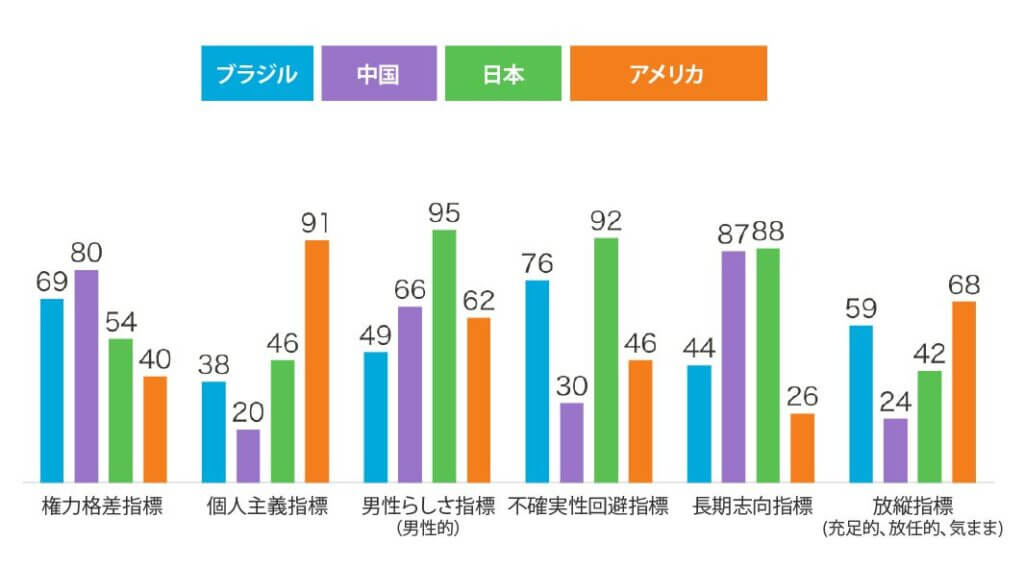
Brazil, with a score of 69, believes that hierarchical relationships should be respected.And,A society that considers inequality among people to be acceptable (or tolerable).This represents...
Differences in the distribution of power justify the fact that those in power reap greater benefits than those with less power in society.
In Brazil,It is important to show respect to the elderly.(Children take care of their elderly parents.)In a company, the supervisor bears full responsibility.There are some.Status symbols of power are extremely important as a way to "communicate" that one is showing social status and respect.is.
Individualism indicators (vs. collectivism)
The fundamental issue addressed at this level is the degree of interdependence that society maintains among its members.This is it.This relates to whether people define their self-image using "I" or "we".I am doing it.
In an individualistic society, people only care about themselves and their immediate family (direct family).That's what's planned.In collectivist societies, people belong to a "group" that will take care of them in exchange for their loyalty.。
Brazil's score was 38 points, and in this country, people are born into groups with strong bonds.(Especially represented by extended families such as uncles, aunts, grandparents, and cousins)Protecting members in exchange for loyaltyIt means that they continue to do so.
This is also an important point in the workplace environment, for example,An older, influential family member is expected to "help" their younger nephew get hired by their company.It will be done.
In business, building trustworthy, long-term relationships is crucial.
usually,Business begins with casual conversations to get to know each other, followed by meetings.。
Furthermore, a communication style that values context is preferred, and many people speak eloquently or write elaborate sentences.
Brazil's score was 49, which is roughly an average score in this category.is.
Uncertainty avoidance indicators
Uncertainty aversion relates to how society deals with the fact that the future can never be known.
Will you try to control the future, or will you simply let things take their course?The uncertainty of the future leads to anxiety, and the way we deal with that anxiety varies from culture to culture.
The degree to which members of a culture have created beliefs and institutions to avoid situations they perceive as ambiguous or unknown.This is reflected in the score of the "uncertainty aversion index."
Brazil's score was a high 76 points.The situation is similar in most Latin American countries.
In these societies,Rules and sophisticated legal systems are strongly required to structure daily life.。
However, individuals have little obligation to abide by these laws. However, if the rules are not followed, additional rules will be imposed.
In Brazil, as is the case in all other societies with a high degree of uncertainty aversion,Bureaucracy, laws, and regulations are extremely important.This is to make the world a safer place.
Brazilians need time in their daily lives to have fun and relax, whether it's chatting with colleagues, enjoying long meals, or dancing with guests and friends.
Due to the high score in this dimension,Brazilians are very passionate and straightforward people, and their emotions are easily expressed through body language.It will appear there.
Long-term orientation index (vs. short-term orientation index)
In this dimension,All societies must maintain some connection to their past while addressing present and future challenges.This explains that the priorities for these two existential goals differ depending on the society.
For example, in this dimensionA normative society with a low score maintains old traditions and norms while viewing social change with skepticism.I like to do that.
on the other hand,Cultures with high scores tend to take a more pragmatic approach, encouraging frugality for the future and emphasizing modern education.I will.
Brazil's score of 44 points is an average score at this level.
Indulgence (satisfaction, laissez-faire, carefree) indicators (vs. restraint)
One of the challenges that humanity has faced, both in the past and present, isTo what extent are young children socialized?That's the point. Without socialization, we cannot become "human beings."
This dimension isThe degree to which a person tries to control their desires and impulses based on the environment in which they grew up.It is defined as follows.
The tendency to try to control impulses with relatively little force is called "licentiousness (fulfilling, laissez-faire, carefree)." They call it,The tendency to try to control impulses relatively strongly is called "restrained." This is what we call it. In this way, cultures can be classified into "licentious" and "restrained."
Brazil's high score of 59 points is attributed to its "laissez-faire society."This indicates that...
People in societies classified as having a high laissez-faire score,Generally, people try to fulfill their impulses and desires to enjoy life.I have a will.
TheyPositive and optimistic tendenciesThey also place more importance on leisure time, acting as they please and spending money as they like.
Share your thoughts on this article on social media using the button below to let your followers know!
- Cultures of various countries around the world
↓Click here if you want to find out your own or someone else's personality type↓

For those who want to learn more about Dr. Hofstede's theory of cultural dimensions, see below ↓
comment