
By comparing a country's culture with those of other cultures around the world, we can understand the factors that deeply drive its unique culture. A country's culture reflects the central trends of its society.
For example, every individual possesses uniqueness, but due to social control, most people do not deviate significantly from norms (standards).


Power Distance Index
The fact that every single person is different means that all people are inherently unequal.One of the most prominent aspects of inequality is the degree to which each person has the power to influence the thoughts and actions of others.is.
This dimension isThis addresses the fact that not all individuals in society are equal, and the cultural attitudes toward such power inequalities among us.This represents...
Power distanceThat is,The degree to which weaker members of a country's institutions or organizations are likely to accept that power is distributed unequally.This is how it is defined.
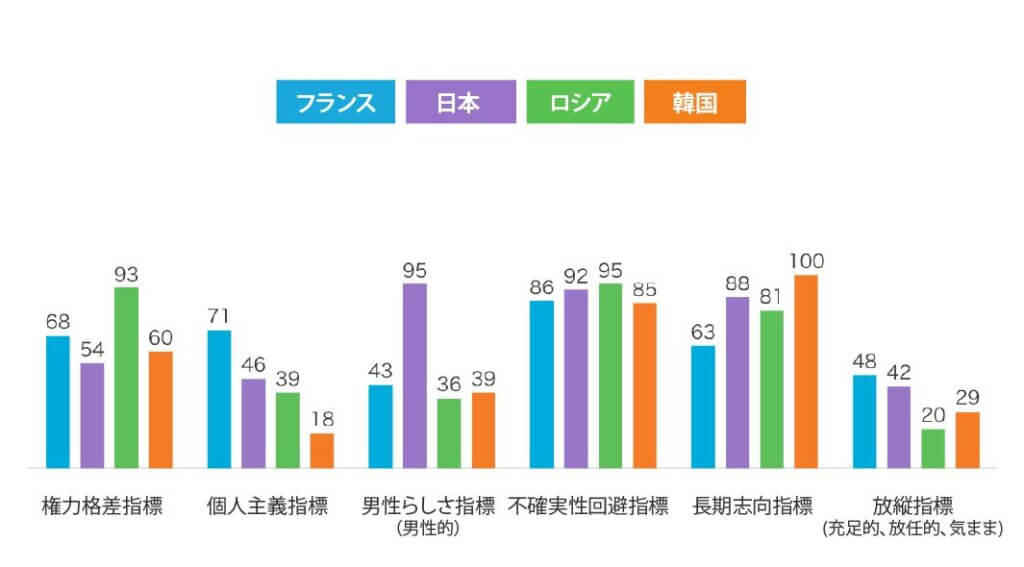
France scored a very high 68 points in "power distance."They have earned it.
Children are raised to a certain extent to be emotionally dependent on their parents.
This dependency can spread to teachers and later to superiors. Therefore,A society in which a considerable degree of inequality is acknowledged.It can be said that this is the case.Power is concentrated not only in corporations and governments, but also geographically.Yes, if you look at the road network in France, most highways connect to Paris.
Numerous comparative studies indicate that French companies typically have one to two more levels of hierarchy than their German or British counterparts. Supervisors are often privileged and unapproachable.
CEOs of large corporations are often referred to as Mr. PDG, a more prestigious abbreviation than CEO (President, Director, General). These PDSs frequently attend the most prestigious universities known as "Grandes Écoles."
Individualism indicators (vs. collectivism)
The fundamental issue addressed at this level is the degree of interdependence that society maintains among its members.This is it.This relates to whether people define their self-image using "I" or "we".I am doing it.
In an individualistic society, people only care about themselves and their immediate family (direct family).That's what's planned.In collectivist societies, people belong to a "group" that will take care of them in exchange for their loyalty.。
France, with a score of 71, is an individualistic society.This indicates that parents emotionally instill independence in their children regarding the groups they belong to.People should only take care of themselves and their families.That's the point.
France's combination of high "power distance" and high "individualism index" is quite unique.That's right. Similar combinations can be found in Belgium, and to some extent in Spain and northern Italy as well.
This combination is not only unique, but it also creates a kind of contradiction, because the model's score has no effect whatsoever; it simply structurally reflects reality. This contradiction manifests itself in France in the following way:
One reason why the French have a lower obesity rate than people in other EU countries is that, compared to other EU countries,It still has a strong influence on children.It is said that...
We don't know if this is true or not.
but,Families have stronger emotional ties compared to other individualistic cultures.That is a fact. This is,This reflects a strong sense of respect for the elderly and a high power distance score.。
While subordinates usually treat their superiors with courtesy and respect, they may sometimes do the opposite of what they promised, behind their superiors' backs.
Another reflection of a high power distance is,To completely reject those in power, contrary to formal obedience.Therefore, there is no way for it to change (gradually) through evolution.Change only through strikes, rebellions, and revolutions.That's the point.
Employers and unions rarely speak together because they view each other as belonging to almost completely different species.
The need to clearly separate work and private life is stronger in France than in America, despite America scoring higher on individualism scales. This is because Americans are emotionally dependent on the words and actions of their superiors.Employees in France feel more pressure than those in the United States.This reflects the fact that...
In cultures with high scores for the "normal" combination of power distance and collectivism, such dependence is welcomed—at least, if those in power behave like benevolent fathers.
The French prefer to rely on the central government.
The central government is an inhumane center of power that cannot easily intrude upon private life.
While it is a human matter, it is more pronounced in France, where strong leadership is needed during times of crisis.
Nevertheless, once the crisis is resolved, the president must create room to weaken his leadership.
Many French people need to be "patrons," whether they are the mayor of a small village or the president of a bridge club. Customer service is shoddy in the eyes of all Anglo-Saxons who believe the customer is king.
That's how it is in France. French people proactively strive to do their best in their work. Therefore, they expect their work to be respected, and on top of that, they try to provide good service to their customers.
France, with a score of 43, has a somewhat feminine culture.I have it.
this is,A well-known welfare system (social security system), a 35-hour work week, 5 weeks of holidays per year, and a focus on quality of life.These are all things that are immediately apparent. However, French culture as a model has another unique characteristic.The upper class was perceived as "feminine," and the working class as "masculine."This is a characteristic not seen in other countries. This difference is reflected in the following:
The average salary of top managers is lower than what would be expected based on a high "power distance" score.
In the upper class, married couples were able to publicly announce their relationships without negative consequences, at least in the past.The Clinton-Lewinsky scandal in America is not understood in France. Furthermore, "crime passionel" (passionate crimes, love crimes) have always received much more lenient sentences compared to other murder trials.
Uncertainty avoidance indicators
Uncertainty aversion relates to how society deals with the fact that the future can never be known.
Will you try to control the future, or will you simply let things take their course?The uncertainty of the future leads to anxiety, and the way we deal with that anxiety varies from culture to culture.
The degree to which members of a culture have created beliefs and institutions to avoid situations they perceive as ambiguous or unknown.This is reflected in the score of the "uncertainty aversion index."
French culture scored a high 86 in "uncertainty avoidance."This is evident in the following:
The French don't like surprises. Structure and planning are necessary.They prefer to receive all the necessary information before meetings or negotiations. As a result, the French are adept at developing complex technologies and systems in stable environments, such as in the nuclear power plant, high-speed rail, and aviation industries.
Furthermore, a high uncertainty aversion score, combined with high power distance and high individualism, reinforces each other, so an emotional safety valve is also necessary.
For example, the French are very talkative, and you often hear them making a clicking sound with their tongues, known as an "engrouler."Laws, rules, and regulations are strongly required to structure one's life.。However, as with other Latin countries, most French people do not try to follow all of these rules.
A high "power gap" score indicates that those in power do not necessarily feel they must abide by all of these rules intended to control people. At the same time, commoners also try to build relationships with those in power so that they can claim exceptions to the rules.
Long-term orientation index (vs. short-term orientation index)
In this dimension,All societies must maintain some connection to their past while addressing present and future challenges.This explains that the priorities for these two existential goals differ depending on the society.
For example, in this dimensionA normative society with a low score maintains old traditions and norms while viewing social change with skepticism.I like to do that.
on the other hand,Cultures with high scores tend to take a more pragmatic approach, encouraging frugality for the future and emphasizing modern education.I will.
France scored highly in this category (63 points), and is pragmatic.It can be said that this is the case.
In a pragmatic society, people believe that truth is heavily influenced by circumstances, context, and time.These traits demonstrate an ability to easily adapt traditions to changing circumstances, a strong inclination towards saving and investing, frugality, and perseverance to achieve results.
Indulgence (satisfaction, laissez-faire, carefree) indicators (vs. restraint)
One of the challenges that humanity has faced, both in the past and present, isTo what extent are young children socialized?That's the point. Without socialization, we cannot become "human beings."
This dimension isThe degree to which a person tries to control their desires and impulses based on the environment in which they grew up.It is defined as follows.
The tendency to try to control impulses with relatively little force is called "licentiousness (fulfilling, laissez-faire, carefree)." They call it,The tendency to try to control impulses relatively strongly is called "restrained." This is what we call it. In this way, cultures can be classified into "licentious" and "restrained."
France scores a somewhat middle ground of 48 points in the relationship between "licentiousness" and "restraint."This is because, combined with a high score in "uncertainty avoidance,"This suggests that the French are less likely to relax and enjoy life than is generally believed.I am doing it.In fact, France doesn't rank very highly on happiness indicators.
Share your thoughts on this article on social media using the button below to let your followers know!
- Cultures of various countries around the world
↓Click here if you want to find out your own or someone else's personality type↓

For those who want to learn more about Dr. Hofstede's theory of cultural dimensions, see below ↓
comment