
ESTJ (Responsible type)This explains how to interact with people.


Interacting with ESTJs
The following is a quote (with some modifications) from "Let's Look at the World from the Perspective of MBTI Personality Type Theory" (website no longer exists).
Because I have clear goals, I enjoy talking with people who can offer helpful opinions and advice. Therefore, I interact with a wide range of people, including those with similar or higher levels of understanding, or those with whom I have a collaborative relationship.
Perhaps you've encountered many people you respect since childhood. You might also find role models for your own life in historical figures.
They have a sociable and cheerful side, and they particularly enjoy positive topics. They will try to encourage people who are determined and enthusiastic.
They proactively plan and assign roles to others. They then decide on policies to ensure safety and communicate those decisions to people.
They value relationships with their community and relatives, participate in gatherings, enjoy casual conversations, and sometimes get involved in decision-making.
To understand this type, it's necessary to acknowledge and appreciate their rational judgment, which is based on experience and reality. Even if they appear somewhat pushy or insensitive, they are genuinely sincere.
With this type of person, it's important to be open and transparent about the information needed for decision-making. Because they try to get involved in a wide range of things, their involvement in individual matters can be superficial. Even so, they become dissatisfied if they don't receive the information necessary to see the big picture and make informed decisions.
Furthermore, when dealing with this type of person, it's important to maintain a positive and determined attitude, even when facing some difficulties, rather than dwelling on them too much.
They might be impressed by your determination and offer you various forms of assistance.
Sometimes, they make humorous remarks or gaffes that don't consider the feelings of others, and they can also be outspoken, sometimes appearing forceful or critical. However, this is unavoidable because their extroverted thinking (Te) function is dominant. If you are sensitive, just accept that this is how they are and try not to get hurt unnecessarily.
ESTJs themselves may not even realize it, Extraverted Thinking (Te)はIntroverted Feeling (Fi)This is what underpins it. In other words, even what may appear to be straightforward criticism is often an attempt to warn of danger.
This is a form of compassion and caring, though it's not often perceived that way by others.
If you're in a relationship with an ESTJ, knowing this sad aspect of their nature and being able to honestly consider their opinions might help you become a more mature adult.
And let's notice the root cause that the person themselves is unaware of, and gently accept it.
They have grand ideals, but they also adapt to the current situation. However, they can become so engrossed in their responsibilities and goal achievement that they neglect building close relationships. Good friends and family should be understanding and supportive in this regard.
End of quote from "Let's Look at the World from the Perspective of MBTI Personality Type Theory" (website no longer exists) (partially modified)
reference ESTJ and romance
youESTJ (Executive/Responsible Type)Then
Share it on social media (tweet it) and let your followers know!
↓↓↓Share on social media (tweet)↓↓↓
↑↑↑Share on social media (tweet)↑↑↑
Further characteristics of ESTJ (the responsible type) and compatibility with other types
- What is ESTJ? – Main Page –
- "Taking on one challenge after another" - ESTJ ~ How do gender differences affect the lives of ESTJs? ~
- A Personality Guide for ESTJs
- ESTJ's hobbies
- Things that ESTJs dislike
- Strengths and weaknesses of ESTJs
- Suitable occupations for ESTJs
- ESTJ leadership
- Compatibility between ESTJ and other types
- ESTJ and relationships
- ESTJ and romance
- How ESTJs set goals and gather information.
- ESTJ parent-child relationships
- For ESTJs to succeed
↓Learn more↓
Compatibility chart and advice for ESTJ (the leader type) and other personality types.
Ideal compatibility type pair
ESTJs are compatible with people who value practical application in external settings, the knowledge of predecessors, and information that is actually useful.
From an ESTJ's perspective...
- ESTP (Adventurer type):Se – Ti, put knowledge into practice and quickly implement what can be done in reality.
- ISTJ (Hardworking Type):Si – Te, maintain and preserve order
- ESFJ (Sociable Type):Fe – SiTo show respect and reverence to society
Type pairs that are prone to conflict
ESTJs tend to clash with idea-driven individuals who don't share a realistic worldview and don't place much value on tradition.
From an ESTJ's perspective...
- INFP (Psychologist type):Fi – NeThey pursue ideals, value personal values, and crave alone time.
- INTP (Researcher Type):Ti – NeHe has a unique personality, is always thinking about something, and is difficult to deal with.
Romantic compatibility type pair
ESTJs are compatible with people who are open and willing to discuss their thoughts intimately, without regard for personal gain.
From an ESTJ's perspective...
- ESFJ (Sociable Type):Fe – SiRespecting society and being able to discuss ideas
- ISFJ (Parental Type):Si – Fe, respecting the organization and traditions
- ISTJ (Hardworking Type):Si – TeThey value the organization and possess practical insight.
- INFP (Psychologist type):Fi – NeYou can enjoy your hobbies intimately and relieve stress.
*The pairs that tend to clash and the pairs that have good romantic compatibility may overlap. This is because while people may dislike those who are the complete opposite of themselves due to disagreements, they may also be attracted to those who appear mysterious because they are different. However, it seems that these relationships often end up breaking down.
(Advice for those dating an ESTJ)
reference ESTJ and romance
ESTJs are trustworthy and keep their promises seriously. While they can be inflexible, once they build a relationship, they will likely maintain it for life. However, they often avoid touching on emotions and feelings, prioritize their own opinions, and don't listen to others', which can be difficult for their partners. Remember that while they may not always express their feelings in words, they often communicate through actions.
For example, ESTJs put a great deal of effort into fulfilling their obligations to loved ones. Social events are also important to them, and ESTJs remember important events such as birthdays and anniversaries.
ESTJ (Responsible Type) Roadmap (Click to open)
Reading the following roadmap from top to bottom will help you understand the ESTJ mindset in a logical order ↓
- Roadmap – ESTJ (Executive/Responsible Type) –
- Introduction – What is MBTI?
- Summary of my personality
- “The meaning of the four letters "ESTJ"
- What are the personality traits of the four pairs?
- First character:Introvert (type I) or extrovert (type E)
- Second character:Intuitive type (N type) or Sensing type (S type)
- Third character:Feeling type (F type) or thinking type (T type)
- 4th character:Perceiving type (P type) or Judging type (J type)
- The quirks (tendencies) and conflicts of the four pairs of personality traits
- Cognitive mechanisms
- What are the personality traits of the four pairs?
- About psychological functions (cognitive functions)
- What are psychological functions (cognitive functions)?
- The eight psychological functions (cognitive functions)
- Decision-making (judgment) function
- Information gathering (perceptual) function
- Understanding your own psychological functions (cognitive functions)
- The developmental process of psychological functions (cognitive functions)
- Psychological functions (cognitive functions) of ESTJs
- First function:Extraverted Thinking (Te)
- Second function:Introverted Sensing (Si)
- Third function:Extroverted Intuition (Ne)
- Fourth function:Introverted Feeling (Fi)
- Making good use of psychological functions (cognitive functions)
- Strengths and weaknesses of ESTJs
- Make the most of your strengths
- Reasons for focusing too much on the advantages
- How to improve your weaknesses
- If you are alone
- In a team setting: Have others compensate for your weaknesses (fourth function).
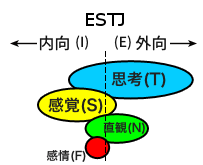
To truly understand the ESTJ (Responsible Type),Psychological functions (cognitive functions)This is important ↓
- Extraverted Thinking/Te
Very good at it /First functionThey are skilled at objectively grasping specific facts using inductive reasoning (practical observation that leads to immediate conclusions). - Introverted Sensing/Si
I'm a little good at it /second function: To bear the responsibility and obligations to society, discipline, loyalty, and honor. - Extroverted Intuition/Ne
I'm not very good at it.Third functionThey aim for their actions and procedures to be effective in the future, but they can become neurotic if things don't go their way. - Introverted Feeling/Fi
I'm really bad at it /Fourth functionI feel anxious or afraid that I am not moral. I don't know how to confront (or don't want to confront) my own moral values.
<The cognitive axis of ESTJ>
List of articles related to ESTJ (Responsible Type)
↑Learn more↑

comment