
Classifying personalities into 16 types16-Type Personality TestCheck which type you are using the following↓↓

↑16-Type Personality Test↑
↑Diagnose↑
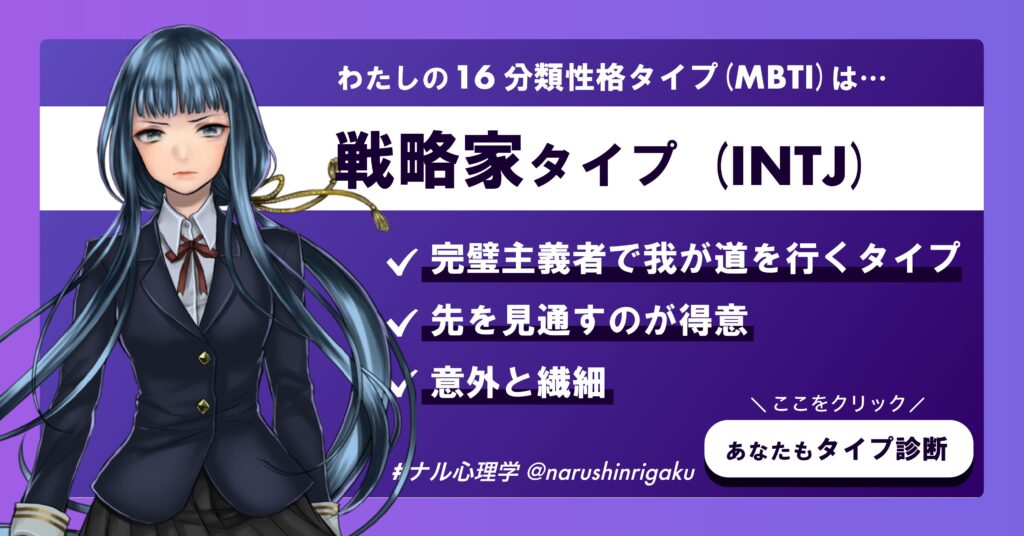
This article will cover the following 16 types.INTJ (Strategist type)SuccessI will explain this.
youINTJ (Architect/Strategist type)Then
Share it on social media (tweet it) and let your followers know!
↓↓↓Share on social media (tweet)↓↓↓
↑↑↑Share on social media (tweet)↑↑↑


What does success mean to an INFJ (Empathic Type)?
INTJs judge success by whether they can continue to grow and move forward. They never feel satisfied with having accomplished something or with themselves, always striving for improvement and wanting to be better than before. INTJs also place great importance on the amount of knowledge they possess and how they can create something from it. The more ignorance they can eliminate from themselves and the world around them, the more successful they feel in their lives.
INTJs are serious, analytical, and often perfectionists. They approach problems and ideas from multiple angles, systematically analyzing them with objective logic, discarding those that are problematic and deepening their understanding with new information that proves useful. Few people are as naturally inclined to do this as INTJs. They are born scientists and mathematicians. Once given an idea, they try to understand it as thoroughly as possible. They typically have very high standards for their own understanding and achievements, and only value and consider others who can meet or surpass their understanding of a particular issue. INTJs value clarity and conciseness. Social flattery may be unnecessary and even superficial to them. While INTJs highly value interactions centered on meaningful exchanges of ideas, they tend to downplay the importance of being friendly or likeable in other social situations and may struggle with emotional relationships.
INTJs value structure, order, knowledge, ability, and logic. Above all, they cherish their own ideas and intuitions about the world. An INTJ's sense of success largely depends on their own understanding and intuition, as well as their ability to respect the structural level of life and the intelligence and abilities of those they share their lives with.
INTJs always have goals and a "see it through" attitude. They are not afraid to work hard and will put in tremendous effort for things that interest them. This tenacity helps INTJs achieve their identified goals. When given a goal and context, INTJs can generate all sorts of possibilities. They can look at problems from various angles and derive solutions that are appropriate to the situation.
Strengths that INFJs (Empathic types) should develop
- Good listener
- Take a future-oriented approach to see the big picture.
- Calm, composed, analytical
- I value depth and quality in human relationships.
- Don't be afraid of conflict or criticism.
- Formulate strategies with a view to the future.
- Understanding of extremely complex theories
- Conclusions should be drawn based on research and analysis, rather than relying on half-baked assumptions.
- They possess strong insight and intuition.
- Think seriously about relationships and agreements
- Highly intelligent and capable
- Original, independent, and acts spontaneously.
- I am interested in "optimizing" human relationships.
- Even when opinions clash, stick to your own beliefs.
- Emphasis on knowledge and efficiency
- I like theoretical challenges.
- The ability to solve complex problems
- I am confident in myself on a regular basis.
- Extremely logical, rational, and brilliant.
- Unwavering ambition and drive
- I get bored in my ordinary daily life.
- High motivation to learn
- ambitious and goal-oriented
- They have an open mind that seeks out new ways of thinking.
- Solving even difficult problems creatively
Tips for success for INFJs (Empathic Personalities)
- Let's do something that allows us to utilize our analytical and critical thinking skills.
INTJs excel at systematically analyzing information from multiple perspectives, recognizing its usefulness and validity, and then deciding whether to reject or retain it. They would likely thrive in jobs requiring analytical thinking. They possess keen insight, seeing things others miss. This ability to discern patterns and meanings in the world can benefit INTJs in many ways. Furthermore, they don't take criticism to heart and readily change their opinions if offered better ideas or methods. These abilities could allow them to make significant contributions to society, such as discovering a cure for cancer. They might excel as scientists, doctors, mathematicians, or corporate strategists. - Let's not forget that we don't need to discuss every single thing.
Thinking (T) types like INTJs tend to argue and refute inconsistencies, but it's not necessary to do so for every single thing. To move forward better in all areas of life, and even to achieve great things in the long run, you may need to understand that sometimes you have to let small things go. - When making judgments or decisions, try to be mindful of your motivations.
Are you interested in finding outward flaws, or are you more interested in gaining a deeper understanding of yourself? Try to understand yourself first, and then make a judgment. - Try engaging in extroverted activities.
INTJs are internal processors, accustomed to finding the right answers and best plans within their own minds. However, this inward focus can cause them to miss important details and insightful contributions from others. Isolation also means missing opportunities for growth. Try to recognize the value the outside world offers and strive to interact in a style that feels natural to you. Seeking feedback from friends, family, and colleagues can help refine your ideas and plans.
Joining clubs or social media groups to discuss topics that interest you in depth is also a good idea. You can find like-minded individuals with similar abilities and understanding, and cultivate friendships. While INTJs are confident in their own abilities, discussing with others can breathe new life into outdated approaches and uncover blind spots. - Let's actively promote ourselves.
When INTJs lack influence within hierarchical organizations, it's not necessarily due to a lack of ability, but rather a low interest in self-promotion. As a result, they may miss opportunities to secure positions that are more favorable to them. INTJs, being results-oriented, especially need to recognize the importance of promoting themselves. - Let's cherish our relationships.
Try to get along with everyone, even those you consider beneath you. Remember that everyone has the potential to offer something. - Pay attention to your own emotional state.
INTJs don't spend much time reflecting on their own emotional state. While they focus on many ideas and abstract concepts, they often avoid activities that involve looking at themselves or their emotions. Try to make time to examine your emotions and reactions. This won't come naturally, but it will be a great help in your interpersonal relationships. - Let go of perfectionism.
One of the strengths of an INTJ is their ability to do everything perfectly, but this can also mean they are slow to act even under immense pressure. Of course, planning ahead is important, but an INTJ wouldn't want to accomplish nothing because of it. - Take some time to think things through before making a decision.
Don't dismiss an idea prematurely just because you don't respect the person who came up with it, or because you think you already know everything. After all, everyone can offer something, and no one knows everything. Before judging someone's idea, make sure to listen to it fully. Do whatever it takes to understand it, such as asking questions if necessary. Don't make any judgments about an idea until you fully understand it.
The reason INTJs make quick decisions is often related to their introverted intuition (Ni) and extroverted thinking (Te). Introverted intuition (Ni) is a personality function that constantly gathers information and views everything from multiple perspectives. Therefore, they are constantly absorbing and thinking about new information. Introverted intuition is like a framework for understanding that exists in the mind. When something is perceived, it merges with the existing intuitive framework. If a person perceives completely new information with introverted intuition (Ni), they have to redefine their entire framework. In other words, introverts take a relatively long time to process and understand. This can be a problem for INTJs. There are many things to consider in order to fully understand an idea or situation, and it is not uncommon for them to feel overwhelmed.
When introverted intuition (Ni) dominates an INTJ, and other functions are unable to fulfill their purpose, the INTJ will block out information that should be considered. If presented with information similar to what introverted intuition (Ni) has processed in the past, they will use extroverted thinking (Te) to quickly discard that information. By using extroverted thinking (Te) to reject the idea rather than analyzing the information within an intuitive framework, the likelihood that the framework will need to be reshaped and redefined decreases.
Using extroverted thinking in this way is beneficial to the INTJ's mind in two ways: 1) it saves energy that would otherwise have to be expended to truly consider new information, and 2) it protects the INTJ's sacred inner world. In either case, it is not ideal.
INTJs may overlook information that could help them gain a deeper understanding of a problem, or even important information. This can also lead others to perceive them as overly opinionated or materialistic.
A better use of an INTJ's extroverted thinking (Te) would be to use it to appreciate their rich insights and compare them to the outside world. When an INTJ uses extroverted thinking (Te) to shut out incoming information rather than to judge it with introverted intuition (Ni), they are effectively deceiving themselves. It's easier to get an answer quickly than to grasp everything. Taking shortcuts is very appealing. Most INTJs do this to some extent. The real problem arises when the INTJ's personality becomes too unbalanced, extremely self-centered, and they hardly consider the opinions or thoughts of others.
To grow as an individual, INTJs need to focus on making decisions after consulting their intuition. This means they need to be mindful not to prematurely dismiss ideas based on their own judgment. They cannot effectively judge something they don't understand. To understand things, INTJs need to grasp them entirely through intuition. INTJs should use their judgment not to dismiss ideas, but to restructure their own thought processes.
For those who want to learn more about INTJ (Strategist type) (compatibility, etc.)
For more information, please see below.Highly recommended (click to open) ↓
Compatibility: You can learn about compatibility and how to interact with other types.
RoadmapYou can learn about personality types and personality theories (MBTI) in a systematic way, from basic to specialized.
Related articlesLearn about the characteristics of each type (take a look at the parts that interest you)
INTJ (Strategist type)Compatibility with other types (click to show)
Ideal compatibility type pair
INTJs get along well with people who can structurally explain what the world will be like and how it should be, who have a systematic vision, and with whom they can discuss such prospects.
From an INTJ's perspective...
- INTP (Researcher Type):Ti – Ne, very logicalBecause they think about things in a certain way, it's easy to communicate with them.
Type pairs that are prone to conflict
Those who tend to clash with INTJs are often those who are articulate but don't think logically about things in everyday life.
From an INTJ's perspective...
- ESFJ (Sociable Type):Fe – SiOur communication styles and lifestyles don't match.
- ESTP (Adventurer type):Se – TiOur communication styles and lifestyles don't match.
- ESTJ (Responsible type):Te – SiI don't like the idea of not looking at what the future will be like or how it should be.
- ESFP (Optimist type):Se – Fi, their lifestyles are incompatible
Romantic compatibility type pair
INTJs are most compatible in romantic relationships with people who understand their perspectives and can reassure them about their vulnerabilities.
From an INTJ's perspective...
- ENFP (Reformer type):Ne – FiWe can discuss positive events that are likely to happen in the future in a positive way.
- INFP (Psychologist type):Fi – Ne, our lifestyles match, and we can discuss our ideas and interact with each other.
- ISFP (Artist type):Fi – SeIt creates a practical environment for you.
- ISFJ (Parental Type):Si – FeThey listen to you and offer advice, which gives you peace of mind and helps stabilize your emotions.
*The pairs that tend to clash and the pairs that have good romantic compatibility may overlap. This is because while people may dislike those who are the complete opposite of themselves due to disagreements, they may also be attracted to those who appear mysterious because they are different. However, it seems that these relationships often end up breaking down.
(Advice for those dating an INTJ)
Because INTJs have difficulty forming close relationships, their romantic relationships can sometimes become complicated. If your partner is an INTJ, it's important to know that loyalty and understanding are crucial.
Communication is also crucial. Instead of expecting an INTJ to notice your subtle signals, try being direct and even blunt about what you expect.
INTJ (Strategist type)Roadmap (Click to open)
INTJ (Strategist type)To truly understand this,Psychological functions (cognitive functions)This is important ↓
*Generally in cognitive science,Cognitive functions「The function by which living organisms actively collect external information, perceive and remember it, and then process it by adding reasoning and judgment in order to acquire knowledge about their subject.It is defined as "
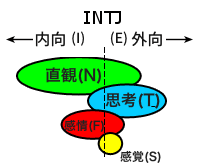
- Introverted Sensing/Ni
Very good at it /First functionThey are skilled at predicting their own future, and they can see the connections between things and events, and how an individual's destiny will unfold. - Extraverted Thinking/Te
I'm a little good at it /second functionObserve and understand current actions from a methodological and systemic perspective to determine whether they are efficient or not. - Introverted Feeling/Fi
I'm not very good at it.Third functionThey believe they possess the most correct ethical values. When challenged, they become stubborn, clinging to their own opinions. - Extroverted Sensing/Se
I'm really bad at it /Fourth functionThey fear and feel anxious about hurting others' feelings. They suffer because they don't know how to cope with or resolve pressure (or they run away without dealing with it).
<The cognitive axis of INTJ>
Ni – SeSeek a future where you can feel joy and peace, and grasp it intuitively.
Te – FiTo strive to be recognized.
By reading the following roadmap, you can learn about cognitive functions.INTJ (Strategist type)You can understand it in an orderly manner ↓
- Roadmap – INTJ (Strategist type) –
- Introduction – What is MBTI?
- Summary of my personality
- Cognition is
- Type-specific cognitive characteristics
- Four personality indicators (psychological tendency axes)
- Conflicts over personality indicators
- “The meaning of the four letters "INTJ"
- First character:Introvert (type I) or extrovert (type E)
- Second character:Intuitive type (N type) or Sensing type (S type)
- Third character:Feeling type (F type) or thinking type (T type)
- 4th character:Perceiving type (P type) or Judging type (J type)
- About psychological functions (cognitive functions)
- What are psychological functions (cognitive functions)?
- The eight psychological functions (cognitive functions)
- Decision-making (judgment) function
- Information gathering (perceptual) function
- Understanding your own psychological functions (cognitive functions)
- The developmental process of psychological functions (cognitive functions)
- INTJ's psychological functions (cognitive functions)
- First function:Introverted Intuition (Ni)
- Second function:Extraverted Thinking (Te)
- Third function:Introverted Feeling (Fi)
- Fourth function:Extroverted Sensing (Se)
- Making good use of psychological functions (cognitive functions)
- Strengths and weaknesses of the INTJ (Strategist type)
- Make the most of your strengths
- Reasons for focusing too much on the advantages
- How to improve your weaknesses
- If you are alone
- In a team setting: Have others compensate for your weaknesses (fourth function).
INTJ (Architect/Strategist Type) – A Comprehensive Guide to Links
- Explanation of INTJ
- INTJ Personality Trait 01
- INTJ Personality Traits 02
- INTJ Personality Traits 03
- INTJ's hobbies
- Strengths and weaknesses of INTJs
- Things that INTJs dislike
- Suitable occupations for INTJs
- INTJ leadership
- Compatibility between INTJs and other personality types
- INTJ Relationships and Romance
- How INTJs set goals and gather information
- INTJ's Decision-Making Methods
- INTJ parent-child relationships
- How INTJs can succeed
- INTJ psychological functions
- “The meaning of the four letters "INTJ"
- INTJ's psychological functions (cognitive functions)
- The difference between extroverted thinking (Te) and introverted feeling (Fi)
- The difference between extroverted thinking (Te) and introverted thinking (Ti)
- The difference between introverted thinking (Ti) and extroverted thinking (Te) [Part 2]
↑Click to open↑
youINTJ (Architect/Strategist type)Then
Share it on social media (tweet it) and let your followers know!
↓↓↓Share on social media (tweet)↓↓↓
↑↑↑Share on social media (tweet)↑↑↑

comment