
The following is a quote (with some modifications) from "Let's Look at the World from the Perspective of MBTI Personality Type Theory" (website no longer exists).
Extraverted Thinking (Te)とIntroverted Feeling (Fi)They work together, supporting each other. A unified understanding arises from their collaborative efforts.
Both extroverted thinking and introverted feeling share a common trait: frankness. Extroverted thinking judges the external world frankly based on rationality. They express their opinions without hesitation and value overall order. Introverted feeling judges their inner selves frankly based on ethical principles. They constantly observe and delve into their own deception and honesty through introspection. They value personal sensibilities and inner harmony.
Extroverted thinking seeks discipline and order in the external world. When things are pre-arranged in an orderly state, they can proceed efficiently and gain inner peace. Everything in the external world—appropriate planning, the allocation and flow of resources, the assignment of tasks and responsibilities—must be decided quickly and placed under discipline. This involves presenting efficient strategies based on objective and rational judgment. Those with strong extroverted thinking tend to sacrifice personal values and emotions for this purpose. They may see their own feelings and beliefs as mere selfishness from the perspective of overall rationality, and clinging to them seems foolish. Furthermore, when managing many people, decision-making that accommodates diverse values is too time-consuming, inefficient, and sometimes even impossible. Therefore, they may find themselves having to consolidate opinions and decide on a course of action by sacrificing some individuals. Moreover, a lack of order and a disregard for accountability will lead to various problems.
If a room is chaotic and cluttered, you can't expect to find what you need when you need it. Therefore, it's clear that not only will external chaos occur, but internal chaos will also result. This applies to order in organizations and society as a whole. Discipline, planning, and accountability must always be clearly defined; if everyone acts haphazardly, chaos is inevitable. This, in turn, threatens the inner well-being of those involved.
On the other hand, a functionally arranged state looks beautiful. However, for this to be the case, the strengths of each element must mesh together without conflicting with the role they play in the overall purpose. The good characteristics of each element should never be suppressed. This will have a negative effect in the long run. Firstly, this means wasting resources, which is counterproductive and inefficient. Individuals can naturally concentrate and achieve excellent results when they are engaged in work that matches their strengths. Secondly, sooner or later, the day will come when repressed individuals vent their pent-up feelings in completely irrational ways, and this is inevitable. This will not only lead to personal ruin, but also disrupt the overall order and bring about chaos. Seeking rationality at the expense of emotions, morals, and individuality produces completely irrational results. And unfortunately, we, with our dull intuition, cannot foresee who will bear the brunt of it. Introverted feeling types tend to be more attuned to such people and want to defend the victims. Many people may feel relieved and consider themselves lucky if they avoid becoming direct victims, but that never brings true inner peace. This is because, deep down, they know that individual elements and the whole are intimately interconnected.
End of quote from "Let's Look at the World from the Perspective of MBTI Personality Type Theory" (website no longer exists) (partially modified)


cognitive axis
Extraverted Thinking (Te)・Introverted Feeling (Fi) These are opposing psychological functions that complement each other. Furthermore, the characteristics of each function differ depending on which function is dominant.
In the following, the psychological functions mentioned earlier will be referred to and explained as the primary function (dominant function).
*In the following explanation, the first function (dominant function) and the fourth function (inferior function) are described as a pair, but the second function (auxiliary function) and the third function (alternative function) are also complementary pairs.
Te-Fi's Characteristics and Catchphrases
Extraverted Thinking (Te)A type in which this is well-developed (ENTJ、ESTJ) has a Te-Fi cognitive axis.
- Let's be recognized(Fi) and make an effort(Te)
- "What should I do?"(Te)"What should I do?"(Te)"It has to be like this"(Te)」
- "My own efforts"(Te)I want you to acknowledge this.(Fi)"I am very talented."(Te)Therefore, I would like you to acknowledge that.(Fi)」
Characteristics and catchphrases of Fi-Te
Introverted Feeling (Fi)A type in which this is well-developed (INFP、ISFP) has a cognitive axis of Fi-Te.
- My feelings are correct.(Fi)Therefore, others should follow you.(Te)
- "Important to me(Fi)"It would be good to have this."(Fi)"I think this is important."(Fi)"I feel that..."(Fi)"It feels like..."(Fi)"What I need(Fi)」
- "This is better"(Te)I think so, and I expect others to do the same.(Fi)"This is correct."(TeI think so, so I'll do that.(Fi)」
The synthesis of extroverted thinking (Te) and introverted feeling (Fi)
Extraverted Thinking (Te)とIntroverted Feeling (Fi)Mastering both requires considerable effort. Generally, people tend to favor one over the other.
So, how can we integrate (synthesize) extroverted thinking (Te) and introverted feeling (Fi)?
I've explained the method in the following article, so please take a look.
する方法.jpg)
For those who want to learn more about psychological functions
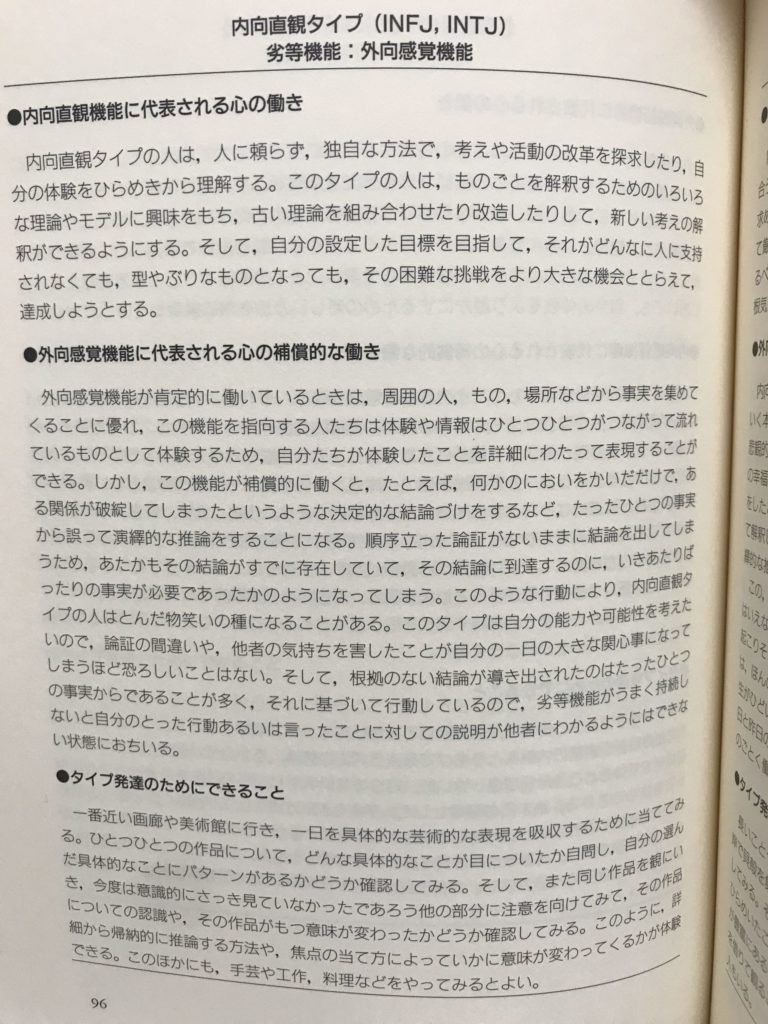
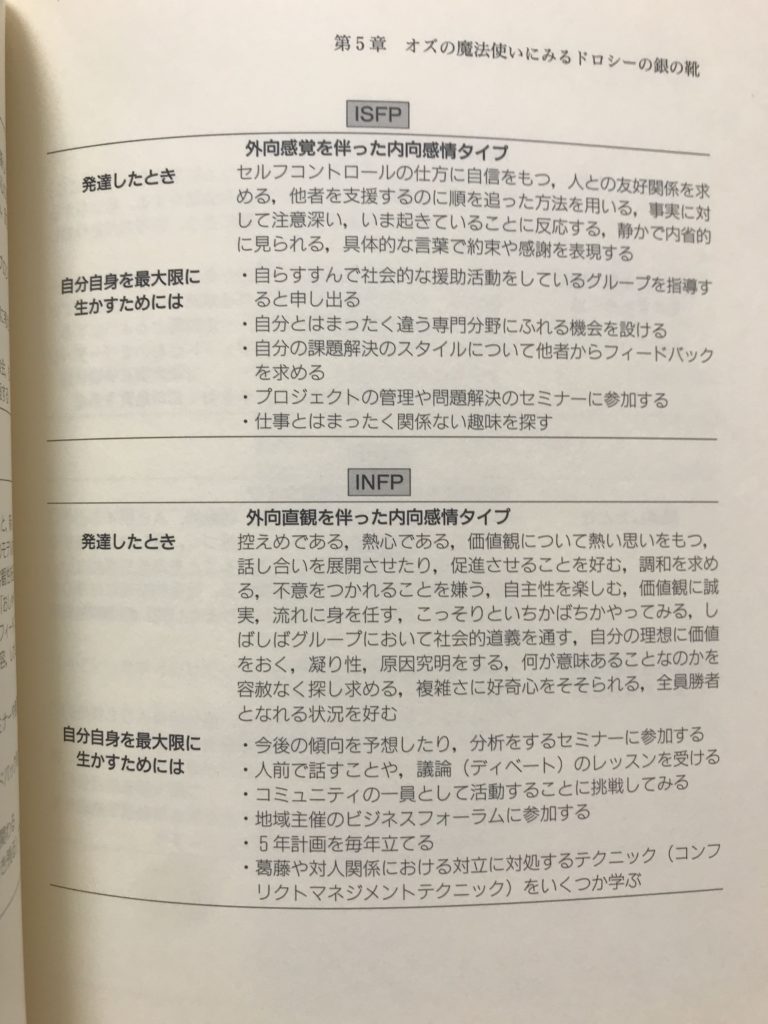
An Introduction to MBTI: Applying Jung's "Theory of Types" to Everyday Life』This book provides a detailed explanation of each psychological function.This book is so excellent that it's no exaggeration to say you'll understand everything about MBTI after reading it.There are many pages,Tables and documents that are not found on the internet or in other books.The data is abundant and very helpful.How to deal with aspects of your personality that you are not good at (=inferior functions)やClassification of ST/NT typesやHow to make the most of your individual typeetc.Tables and documents)

Related articles

.jpg)
comment