

A personality test that classifies people into 16 personality types.MBTIThere is such a thing, and it has a reputation for being very accurate.

This article will cover the following 16 types.INTJ (Strategist type)This explains the personality traits of [the character/person].
youINTJ (Architect/Strategist type)Then
Share it on social media (tweet it) and let your followers know!
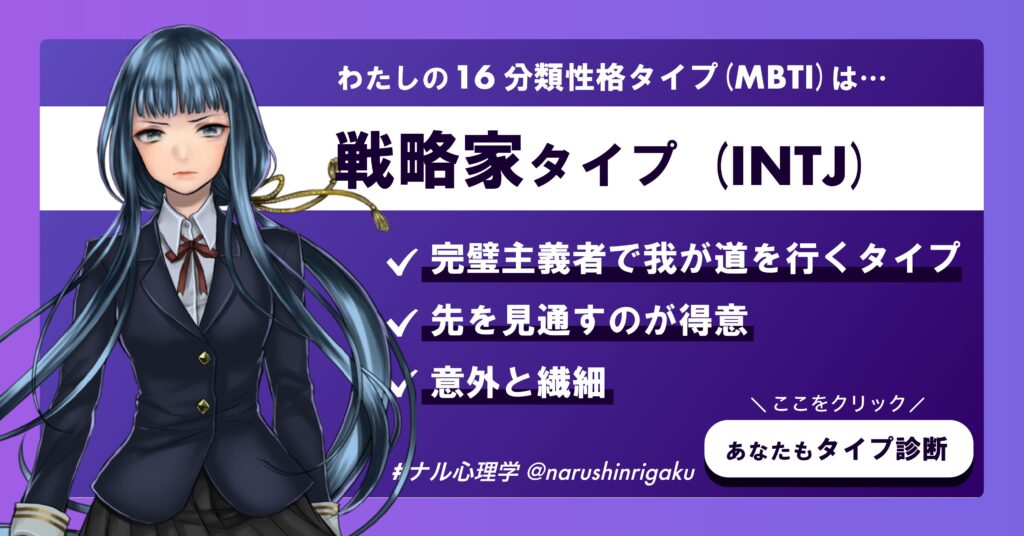
↓↓↓Share on social media (tweet)↓↓↓
↑↑↑Share on social media (tweet)↑↑↑


INTJ (Strategist type) personality
The following is a quote (with some modifications) from "Let's Look at the World from the Perspective of MBTI Personality Type Theory" (website no longer exists).
Clear, inner flashes of insight occur intermittently, deepening your understanding of your interests. You may suddenly notice connections and coherence in things, and be deeply moved by their precision and beauty.
I find it comforting and valuable to surrender my awareness to a continuous stream of insights. I strive to think independently, take responsibility for my own future, and work hard to achieve my goals.
They strive to become thoroughly knowledgeable about anything that interests them. From a young age, they develop a well-organized system of knowledge in their minds, sometimes reaching the level of an expert.
Once a certain level of understanding is reached, one focuses on related topics and delves deeper into them. Through this repetition, the scope of understanding and knowledge is steadily expanded little by little. This is based on a strong, often unspoken, motivation, belief, or quiet determination, and it demonstrates a certain mental toughness.
Intuition allows us to suddenly notice connections between things, often finding common ground and appearing consistent, making it trustworthy. It arises unconsciously, and rigorous proof through reasoning and analysis is considered later, if necessary. Confidence is further strengthened when it can be backed by a clear theory.
By examining the past and present, we can grasp trends and predict what will happen next. We also gain insight into societal values and shared criteria for judgment.
I don't think it's desirable to be so preoccupied with the current situation that you fail to grasp what's behind it, or to be unable to view things from a long-term perspective.
They always have a rational mindset, know what they need to do, make plans, and strive to execute them faithfully. This applies to both their daily actions and life choices.
Because you have a long-term vision, you are unlikely to encounter many serious problems in your education or career. If you make an effort to communicate your ideas and inspirations effectively, you will also benefit from this and be able to live a fulfilling life.
INTJs prefer rational and orderly thinking. Therefore, they are naturally drawn to scientific approaches. They are interested in the mechanisms and cause-and-effect relationships of things that can be understood systematically, such as natural phenomena, societies, organizations, institutions, machines, devices, and computers. They try to prove the validity of their insights and the effectiveness of their ideas by applying fundamental concepts and principles.
To avoid unnecessary actions, we try to estimate resource consumption by carefully considering and, if possible, calculating it beforehand.
INTJs' images, insights, and thought processes are abstract and difficult to express clearly to others. They strive to provide systematic explanations, but this is a much more challenging task than the moment of inspiration. Nevertheless, if they are convinced of the importance of their ideas, they cannot afford to neglect their efforts.
They possess foresight and believe in the power of will. They desire to execute sophisticated ideas and clear visions exactly as they envision them. They dislike compromise and tend to be perfectionists. However, what is clear to an INTJ is not clear to everyone. They unconsciously demand high standards from others and tend to blame those who do not understand. They become aware of this as they interact with others.
To others, they might appear confident in everything. However, in reality, they aren't confident in everything. They understand what they can and cannot solve based on their knowledge. When a solution is possible, they will show you how.
We are not satisfied with precedents or the status quo, and we strive to overcome them. We relentlessly pursue universality and practicality so that our ideas do not become obsolete and are buried as relics of the past. At all times, whether or not something "functions properly" is an important criterion for judgment.
It's not just about adapting to your environment, but about transforming it into a comfortable one. Similarly, you should come up with ways to improve systems and rules for your own benefit.
I don't mind if people think I'm a bit eccentric. I don't care whether I become popular or not. However, I do want fair evaluation.
They are confident in their independent attitude and originality. On the other hand, they are suspicious of the fact that the majority of people in this world live in groups without having their own opinions. They may even despise the idea that everyone is controlled by someone else and clinging to an average way of life.
Rather than being controlled by others, I tend to prefer controlling others. I understand and follow the rules of society and organizations. However, because I can find irrationalities and areas for improvement in the system, I may become disappointed in those in positions of power or express my opinions frankly and directly.
I am confident in my own opinions. I express calm and reasonable opinions and point out the flaws in others' ideas. I cannot tolerate people who cannot rationally explain their opposing viewpoints. In most cases, I am open to hearing others' opinions on alternatives.
I can no longer respect people who avoid responsibility or neglect their efforts, even if they are my superiors. Nevertheless, in order to achieve my goals and protect my personal life, I learn to control my ego and become adaptable.
Sometimes, antisocial ideas that disregard ethical considerations can arise. They are aware of and calmly observe the selfish nature of human beings.
Many become scientists, engineers, or businessmen and business managers. Some pursue academic paths, contemplating philosophy and social institutions. They possess a keen and objective understanding of human groups and the world. Occasionally, they propose reforms to social systems and institutions. While there are always numerous challenges to overcome before their realization, they begin by theoretically expressing and presenting their own observations.
I am interested in and sometimes explore the natural world, beautiful things, and mysterious phenomena.
End of quote from "Let's Look at the World from the Perspective of MBTI Personality Type Theory" (website no longer exists) (partially modified)
For those who want to learn more about INTJ (Strategist type) (compatibility, etc.)
For more information, please see below.Highly recommended (click to open) ↓
Compatibility: You can learn about compatibility and how to interact with other types.
RoadmapYou can learn about personality types and personality theories (MBTI) in a systematic way, from basic to specialized.
Related articlesLearn about the characteristics of each type (take a look at the parts that interest you)
INTJ (Strategist type)Compatibility with other types (click to show)
Ideal compatibility type pair
INTJs get along well with people who can structurally explain what the world will be like and how it should be, who have a systematic vision, and with whom they can discuss such prospects.
From an INTJ's perspective...
- INTP (Researcher Type):Ti – Ne, very logicalBecause they think about things in a certain way, it's easy to communicate with them.
Type pairs that are prone to conflict
Those who tend to clash with INTJs are often those who are articulate but don't think logically about things in everyday life.
From an INTJ's perspective...
- ESFJ (Sociable Type):Fe – SiOur communication styles and lifestyles don't match.
- ESTP (Adventurer type):Se – TiOur communication styles and lifestyles don't match.
- ESTJ (Responsible type):Te – SiI don't like the idea of not looking at what the future will be like or how it should be.
- ESFP (Optimist type):Se – Fi, their lifestyles are incompatible
Romantic compatibility type pair
INTJs are most compatible in romantic relationships with people who understand their perspectives and can reassure them about their vulnerabilities.
From an INTJ's perspective...
- ENFP (Reformer type):Ne – FiWe can discuss positive events that are likely to happen in the future in a positive way.
- INFP (Psychologist type):Fi – Ne, our lifestyles match, and we can discuss our ideas and interact with each other.
- ISFP (Artist type):Fi – SeIt creates a practical environment for you.
- ISFJ (Parental Type):Si – FeThey listen to you and offer advice, which gives you peace of mind and helps stabilize your emotions.
*The pairs that tend to clash and the pairs that have good romantic compatibility may overlap. This is because while people may dislike those who are the complete opposite of themselves due to disagreements, they may also be attracted to those who appear mysterious because they are different. However, it seems that these relationships often end up breaking down.
(Advice for those dating an INTJ)
Because INTJs have difficulty forming close relationships, their romantic relationships can sometimes become complicated. If your partner is an INTJ, it's important to know that loyalty and understanding are crucial.
Communication is also crucial. Instead of expecting an INTJ to notice your subtle signals, try being direct and even blunt about what you expect.
INTJ (Strategist type)Roadmap (Click to open)
INTJ (Strategist type)To truly understand this,Psychological functions (cognitive functions)This is important ↓
*Generally in cognitive science,Cognitive functions「The function by which living organisms actively collect external information, perceive and remember it, and then process it by adding reasoning and judgment in order to acquire knowledge about their subject.It is defined as "
- Introverted Sensing/Ni
Very good at it /First functionThey are skilled at predicting their own future, and they can see the connections between things and events, and how an individual's destiny will unfold. - Extraverted Thinking/Te
I'm a little good at it /second functionObserve and understand current actions from a methodological and systemic perspective to determine whether they are efficient or not. - Introverted Feeling/Fi
I'm not very good at it.Third functionThey believe they possess the most correct ethical values. When challenged, they become stubborn, clinging to their own opinions. - Extroverted Sensing/Se
I'm really bad at it /Fourth functionThey fear and feel anxious about hurting others' feelings. They suffer because they don't know how to cope with or resolve pressure (or they run away without dealing with it).
<The cognitive axis of INTJ>
Ni – SeSeek a future where you can feel joy and peace, and grasp it intuitively.
Te – FiTo strive to be recognized.
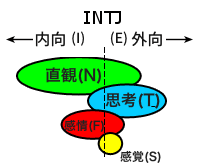
By reading the following roadmap, you can learn about cognitive functions.INTJ (Strategist type)You can understand it in an orderly manner ↓
- Roadmap – INTJ (Strategist type) –
- Introduction – What is MBTI?
- Summary of my personality
- Cognition is
- Type-specific cognitive characteristics
- Four personality indicators (psychological tendency axes)
- Conflicts over personality indicators
- “The meaning of the four letters "INTJ"
- First character:Introvert (type I) or extrovert (type E)
- Second character:Intuitive type (N type) or Sensing type (S type)
- Third character:Feeling type (F type) or thinking type (T type)
- 4th character:Perceiving type (P type) or Judging type (J type)
- About psychological functions (cognitive functions)
- What are psychological functions (cognitive functions)?
- The eight psychological functions (cognitive functions)
- Decision-making (judgment) function
- Information gathering (perceptual) function
- Understanding your own psychological functions (cognitive functions)
- The developmental process of psychological functions (cognitive functions)
- INTJ's psychological functions (cognitive functions)
- First function:Introverted Intuition (Ni)
- Second function:Extraverted Thinking (Te)
- Third function:Introverted Feeling (Fi)
- Fourth function:Extroverted Sensing (Se)
- Making good use of psychological functions (cognitive functions)
- Strengths and weaknesses of the INTJ (Strategist type)
- Make the most of your strengths
- Reasons for focusing too much on the advantages
- How to improve your weaknesses
- If you are alone
- In a team setting: Have others compensate for your weaknesses (fourth function).
INTJ (Architect/Strategist Type) – A Comprehensive Guide to Links
- Explanation of INTJ
- INTJ Personality Trait 01
- INTJ Personality Traits 02
- INTJ Personality Traits 03
- INTJ's hobbies
- Strengths and weaknesses of INTJs
- Things that INTJs dislike
- Suitable occupations for INTJs
- INTJ leadership
- Compatibility between INTJs and other personality types
- INTJ Relationships and Romance
- How INTJs set goals and gather information
- INTJ's Decision-Making Methods
- INTJ parent-child relationships
- How INTJs can succeed
- INTJ psychological functions
- “The meaning of the four letters "INTJ"
- INTJ's psychological functions (cognitive functions)
- The difference between extroverted thinking (Te) and introverted feeling (Fi)
- The difference between extroverted thinking (Te) and introverted thinking (Ti)
- The difference between introverted thinking (Ti) and extroverted thinking (Te) [Part 2]
↑Click to open↑
youINTJ (Architect/Strategist type)Then
Share it on social media (tweet it) and let your followers know!
↓↓↓Share on social media (tweet)↓↓↓
↑↑↑Share on social media (tweet)↑↑↑


comment