
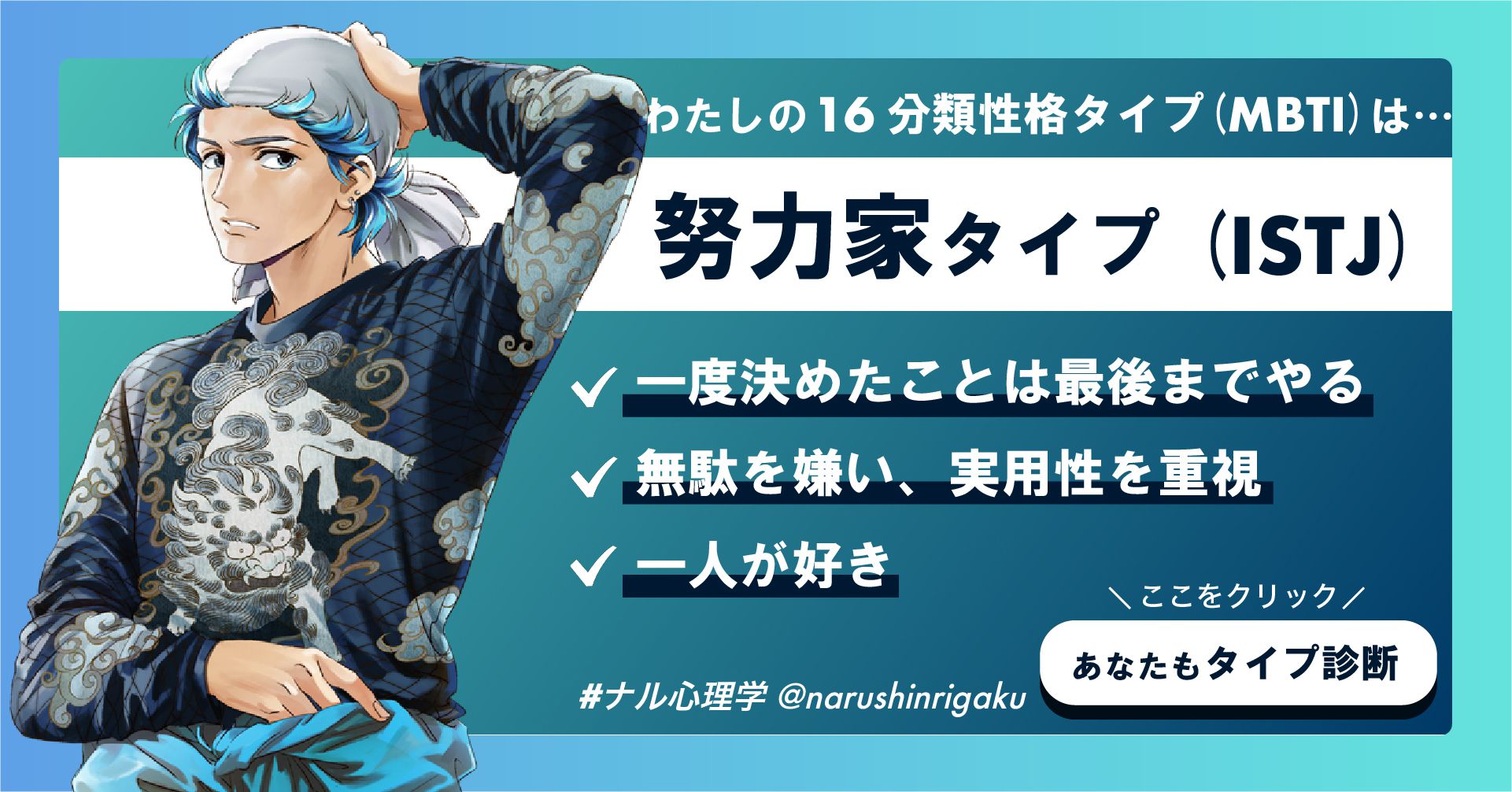
On this page, out of the 16 types,ISTJ (Logistician = Hard worker type)I will explain the personality traits of [this person/character].
youISTJ (Logistician = Hard worker type)Then
Share it on social media (tweet it) and let your followers know!
↓↓↓Share on social media (tweet)↓↓↓
↑↑↑Share on social media (tweet)↑↑↑
Classifying personalities into 16 types16-Type Personality TestCheck which type you are using the following↓↓

↑16-Type Personality Test↑
↑Diagnose↑


Description of the personality traits of the ISTJ (Logistician = Hard Worker type)
The following is a quote (with some modifications) from "Let's Look at the World from the Perspective of MBTI Personality Type Theory" (website no longer exists).
They approach things in an orderly manner, paying close attention to the details, focusing on what needs to be done, and dealing with it carefully and accurately.
I believe that having a strong sense of responsibility, taking obligations and promises seriously, and fulfilling them is important from the standpoint of morality and group discipline.
I will carefully examine the reality before me, think rationally without rushing, and consider the situation head-on.
When undertaking important tasks, I make sure to set aside time to think and prepare beforehand. I gather information thoroughly in advance, understand the methods and procedures, and strive to complete them efficiently. Once I start, I try my best to avoid getting sidetracked and persevere until the very end.
As they gain experience, they become wiser and produce higher-quality work. They also develop sound judgment criteria and understand the difference between right and wrong, good and bad.
They have firm opinions and can be strict, but they earn trust and are sometimes entrusted with positions of responsibility.
They tend to value their alone time, but they are sincere and loyal to close friends. They also have a unique and humorous personality.
They are generally calm and lead a balanced life. They value traditional values, cherish order and discipline, build stability through steady effort, and find affection in a simple family life. They don't have extravagant dreams, but they patiently accumulate small achievements and aim to achieve big goals in the long term.
I carefully read data, diagrams, tables, maps, graphs, and other information in books and documents, paying attention to even the smallest details. When I'm out, I pay close attention to shop signs and road signs, and I have a firm grasp of where I am. I skillfully utilize this objective information, along with knowledge based on my own experience, to deal with things appropriately.
They are comfortable with order and order. They always strive to be punctual, make thorough plans, and act with ample time to spare.
They understand and abide by societal values, organizational rules, and practical common sense.
As a member of the community and family, I strive to be a responsible person who doesn't cause trouble for others. Fulfilling my responsibilities is a source of pride and essential for my happiness. And I want others to be that way too.
For example, we should always follow traffic rules and drive safely. By doing so, we can usually ensure our own safety. Furthermore, if everyone drives with this attitude, we can create a safer driving society.
Actions that violate laws or community rules are frowned upon. I feel disgusted when I see people breaking the rules. However, I don't often express these feelings directly. If asked how I feel, I will answer frankly. If I am in a position of responsibility, I may take a firm stance against those who break the rules.
I prefer working alone, but I can always be mindful of teamwork and work smoothly when necessary.
By consistently performing their work carefully and steadily, and producing high-quality results, they gain trust.
They are loyal to the organization and respectful of their superiors, and after gaining experience, they may be entrusted with responsible positions such as supervisors.
I take my leadership role seriously and work in a normative manner, considering the impact on the group. To achieve goals, I plan, allocate funds and resources appropriately, and assign tasks to personnel. I then manage progress while providing appropriate guidance and support.
When they finish a task or take a short break, they'll chat amiably with close friends. While they generally project a serious demeanor, they possess the unique sense of humor characteristic of ISTJs and often say amusing things.
If you can complete your work in an orderly manner, checking your progress step by step, you can usually feel at ease. However, sometimes the standards you set for yourself become too high, and you become dissatisfied with your results. In such cases, you can find reassurance by being recognized by people you trust or who are close to you.
People around ISTJs tend to forget their meticulous consideration and diligent efforts, but these should not be taken for granted; rather, they should be appreciated.
ISTJs are reserved and often immerse themselves in such tasks, taking on the role of the unsung hero. As they gain trust and are entrusted with more work, the burden can become overwhelming. However, they will eventually realize that they should only take on work that they can handle in order to keep things on schedule.
While it may not always be easy to refuse, we ask that you refrain from excessive sympathy and instead expect each individual to fulfill their own responsibilities. If there are unavoidable circumstances, we will take them into consideration and offer assistance or find a way to manage the situation.
They strive to fulfill their roles in the home seriously. If they are children, they will help with chores and dedicate themselves to their studies. They will diligently repeat their daily routines without fail. If they are parents, they will keep the home clean and tidy and try to protect the safety of their family. They will arrange tasteful furniture neatly, organize their tools properly, and strive to maintain an efficient lifestyle. If their children are causing trouble for others or doing something dangerous, they will correct them properly. They are not very good at expressing their affection, but they feel a strong love. They expect their children to do what needs to be done and achieve their goals. Until then, they may not praise them.
You tend to take people's words at face value and have difficulty discerning their true intentions, so you need to be careful. You don't readily share your emotions with others or actively try to build a wide circle of friends. Before listening to what others have to say, you may become stubborn or try to impose your own judgment on them. Because of this, you may appear unfriendly. However, you experience a range of emotions internally, from joy and anger to sadness and happiness. Furthermore, a strong flame of conviction and passion quietly burns within you, supporting your choices and actions.
I believe that overflowing emotional expression is a waste of energy, but sometimes, unexpectedly, old memories resurface, and I feel a sense of nostalgia.
You might feel nostalgic when you encounter old things or old acquaintances. I cherish those memories.
When you're alone, unpleasant memories may linger in your mind.
You may feel the pain of heartbreak intensely and dwell on it for a long time. However, you can temporarily forget about such things in order to fulfill your public position and responsibilities at work. Dwelling on such things and letting time and energy be wasted on them would be irresponsible and selfish. Focus on fulfilling your responsibilities above all else. And if you succeed, you can feel proud. That process will also become a good memory.
Especially in their private lives, they have a side that wants to express their originality in their hobbies and preferences. They don't seem to mind being seen as a bit eccentric. They have their own unique perspective and show strong convictions.
You are interested in understanding, operating, and applying systems that function in an orderly manner. You may choose engineering, mechanical engineering, chemistry, computer science, or other fields as your area of specialization or career.
You may find it difficult to deal with abstract theories, but you can cultivate your knowledge by understanding and practicing concrete examples. Practical things can be enjoyable. Nowadays, many people choose careers such as system engineers and computer programmers.
I don't believe that new things or changes necessarily equate to progress. When new hypotheses or methods are proposed, I approach them with skepticism. I'm not inclined to take on challenges where the outcome is uncertain.
More than anything else, there is value in the establishment of functional practices, and I feel joy in being involved in them. The more I repeat them, the more familiar I become, and the harder it is to break those behavioral patterns. For example, I might develop picky eating habits. However, when my body starts to feel unwell, I try to find the cause and make improvements.
ISTJs don't always choose familiar and predictable options and avoid trying new things. When making important life decisions, they will consider various angles. In their leisure time, they may enjoy intellectual activities such as puzzles and games, or seek out places they've never been before. Relaxation is a good opportunity for ISTJs to have different experiences and acquire new knowledge.
While they pay close attention to detail, they tend to be less adept at understanding the connections between things, the hidden meanings behind them, and grasping the big picture. As a result, they sometimes get so caught up in the details that they miss the forest.
It's essential to have a clear understanding of your role within the overall framework. It's also a good idea to occasionally take time to reflect on the true value of the projects you're involved in.
By considering what value the project holds for you and what impact it will have on society, you can gain guidance and boost your motivation.
End of quote from "Let's Look at the World from the Perspective of MBTI Personality Type Theory" (website no longer exists) (partially modified)
Further characteristics of the ISTJ (Logistician = Hard Worker type) and compatibility with other types
- ISTJ Personality Trait 01
- ISTJ Personality Traits 02
- ISTJ's hobbies
- Things that ISTJs dislike
- Strengths and weaknesses of ISTJs
- Suitable occupations for ISTJs
- ISTJ leadership
- Compatibility between ISTJ and other types
- ISTJ Relationships and Romance
- How ISTJs set goals and gather information.
- ISTJ's Decision-Making Methods
- ISTJ parent-child relationships
- For ISTJs to succeed
↓Learn more below ↓
ISTJ (Logistician = Hard worker type)Compatibility chart and advice for other types
Ideal compatibility type pair
ISTJs are compatible with people who value ethics and diligence, and who are the type to work in an organizational environment.
From an ISTJ's perspective...
- ISFJ (Parental Type):Si – FeThey have a strong sense of ethics and can follow the organization's rules properly.
- ENTJ (Leader type):Te – NiThey have a clear vision and can lead the organization with strong leadership.
- INFJ (Empathy Type):Ni – FeHe has a strong sense of ethics and is respectable.
Type pairs that are prone to conflict
ISTJs tend to clash with people who challenge existing systems and established methods, and who do not value organizational cohesion or overall unity.
From an ISTJ's perspective...
- ENTP:Ne – TiTheir ideas and ways of thinking are fundamentally different and incompatible.
- ESFP (Optimist type):Se – FiThey disregard the organization's needs and schedules.
Romantic compatibility type pair
ISTJs are romantically compatible with people who are planners, stick strictly to schedules, and can provide reassurance even in difficult situations.
From an ISTJ's perspective...
- ENFJ (Collaborator Type):Fe – NiThey have a strong sense of ethics, can think about the big picture, and have excellent communication skills, so they can bring the whole group together effectively.
- ENFP (Reformer type):Ne – FiThey have a strong sense of morality and ethics, and are good at things they are not good at.
- ISFJ (Parental Type):Si – FeThey are more likely to adjust their lifestyles to each other, and they have a strong sense of morality and ethics.
*The pairs that tend to clash and the pairs that have good romantic compatibility may overlap. This is because while people may dislike those who are the complete opposite of themselves due to disagreements, they may also be attracted to those who appear mysterious because they are different. However, it seems that these relationships often end up breaking down.
(Advice for those dating an ISTJ)
ISTJs experience deep emotions, but often struggle to show this side of themselves in romantic relationships. Those in a relationship with an ISTJ can be understanding partners by not expecting the ISTJ to immediately reveal their feelings. Sometimes, an ISTJ may seem oblivious to your feelings, but you can help them understand your perspective by rationally presenting facts and logical explanations.
ISTJ (Logistician = Hard worker type)A collection of links explaining psychological functions (for those who want to understand how the mind works)
Reading the following roadmap from top to bottom will give you a step-by-step understanding of the ISTJ's mental structure ↓
- Roadmap – ISTJ (Hard Worker Type) –
- Introduction – What is MBTI?
- Summary of my personality
- Cognition is
- Type-specific cognitive characteristics
- Four personality indicators (psychological tendency axes)
- Conflicts over personality indicators
- “The meaning of the four letters "ISTJ"
- First character:Introvert (type I) or extrovert (type E)
- Second character:Intuitive type (N type) or Sensing type (S type)
- Third character:Feeling type (F type) or thinking type (T type)
- 4th character:Perceiving type (P type) or Judging type (J type)
- About psychological functions (cognitive functions)
- What are psychological functions (cognitive functions)?
- The eight psychological functions (cognitive functions)
- Decision-making (judgment) function
- Information gathering (perceptual) function
- Understanding your own psychological functions (cognitive functions)
- The developmental process of psychological functions (cognitive functions)
- Psychological functions (cognitive functions) of ISTJs
- First function:Introverted Sensing (Si)
- Second function:Extraverted Thinking (Te)
- Third function:Introverted Feeling (Fi)
- Fourth function:Extroverted Intuition (Ne)
- Making good use of psychological functions (cognitive functions)
- Strengths and weaknesses of the ISTJ (hard worker type)
- Make the most of your strengths
- Reasons for focusing too much on the advantages
- How to improve your weaknesses
- If you are alone
- In a team setting: Have others compensate for your weaknesses (fourth function).
ISTJ (Logistician = Hard worker type)To truly understand this,Psychological functions (cognitive functions)* is important ↓
*Generally in cognitive science,Cognitive functions「The function by which living organisms actively collect external information, perceive and remember it, and then process it by adding reasoning and judgment in order to acquire knowledge about their subject.It is defined as "
- Introverted Sensing/Si
Very good at it /First functionThey are adept at matters of loyalty to others and themselves, and have a precise understanding of their position and civic duties. - Extraverted Thinking/Te
I'm a little good at it /second function: You are responsible for understanding and observing methodologies and systems, and for knowing whether what is currently being done is efficient in completing the action. - Introverted Feeling/Fi
I'm not very good at it.Third functionThey believe they possess the most correct ethical values. When challenged, they become rigid, arrogant, and stubborn. - Extroverted Intuition/Ne
I'm really bad at it /Fourth functionThey feel fear or anxiety towards novelty and unpredictability. They don't know how to take new measures that involve a certain degree of risk (or don't like taking them).
<ISTJ Cognitive Aspects>
Si – Ne: Accumulate sensory information to survive in a chaotic world.
Te – Fi: To show an effort to gain recognition.

List of articles related to ISTJ (Logistician = Hard worker type)
- Psychological functions of ISTJ
- “The meaning of the four letters "ISTJ"
- Psychological functions (cognitive functions) of ISTJs
- Integration of the ISTJ's second and third functions
- The difference between extroverted thinking (Te) and introverted feeling (Fi)
- The difference between extroverted thinking (Te) and introverted thinking (Ti)
- The difference between introverted thinking (Ti) and extroverted thinking (Te) [Part 2]
- SJ type: Parental temperament
↑Learn more↑
List of 16 types (≒MBTI types)
A Collection of Information on the 16 Personality Types – The Little-Known Truths of Each Type (Summary, Illustrations, and Analysis)
- Summary of 16 Personality Type Test Websites
- List of articles categorized by personality type (16 types)
- Compatibility chart for 16 personality types
- Suitable occupations, ideal jobs, and dream jobs for each of the 16 personality types
- Nicknames (names) for each of the 16 personality types
- What if there were a country with 16 personality types...?
- The relationship between national characteristics around the world and the 16 personality types
- List of 16 Personality Types Based on Famous Characters
- Detective Conan: A Summary of 16 Personality Types for Each Character
- Percentage of 16 personality types
- Reactions of 16 Personality Types – Heaven and Hell
- To describe the 16 personality types in one word:
- 16 Simple Explanations of Personality Types
- 16 Personality Types: Strengths, Weaknesses, and Ways to Improve Weaknesses
- 16 Personality Types: Preferences and Strengths/Weaknesses in Majors and Subjects
- 16 Personality Types: How to Enjoy Life to the Fullest…?
- 16 Personality Types: Inspiring Quotes from Great Figures
- What if each of the 16 personality types were a murderer?
- How to become an attractive husband or wife based on your personality type (16 types)
- What 16 personality types do after a breakup
- Reasons for fighting according to 16 personality types
- Income by 16 Personality Types - Misconceptions and Truths -
- Characteristics of employees based on 16 personality types
- Potential pathological tendencies of 16 personality types
- Psychological Functions of 16 Personality Types Based on Statistics
- Viewing percentage of the detailed personality pages for each of the 16 personality types
- Summary of the characteristics of the 16 personality types
- 8 psychological functions: "What if I did...?"
- Approaches to tasks based on psychological function: Intuitive (N-type) & Sensing (S-type)
- Social interaction explained by psychological functions
- Understanding Your Financial Habits Through Psychological Functions – Are You a Saver or a Spender?
- Humor (sense of humor) as revealed by psychological functions
- How extroverts (Type E) and introverts (Type I) can get along well
- How Sensing types (S type) and Intuitive types (N type) can get along well
- How Thinking (T-type) and Feeling (F-type) People Can Get Along Well
- How to get along well with Judging (J-type) and Perceiving (P-type) types
- Characteristics of parents with 16 personality types
- Parent-child relationships between extroverts (Type E) and introverts (Type I)
- Parent-child relationships between sensing types (S-type) and intuitive types (N-type)
- Parent-child relationships between thinking types (T-type) and feeling types (F-type)
- Parent-child relationships between judging (J-type) and percepting (P-type) types
- How to identify your partner's personality type: [16 Personality Types]

comment