
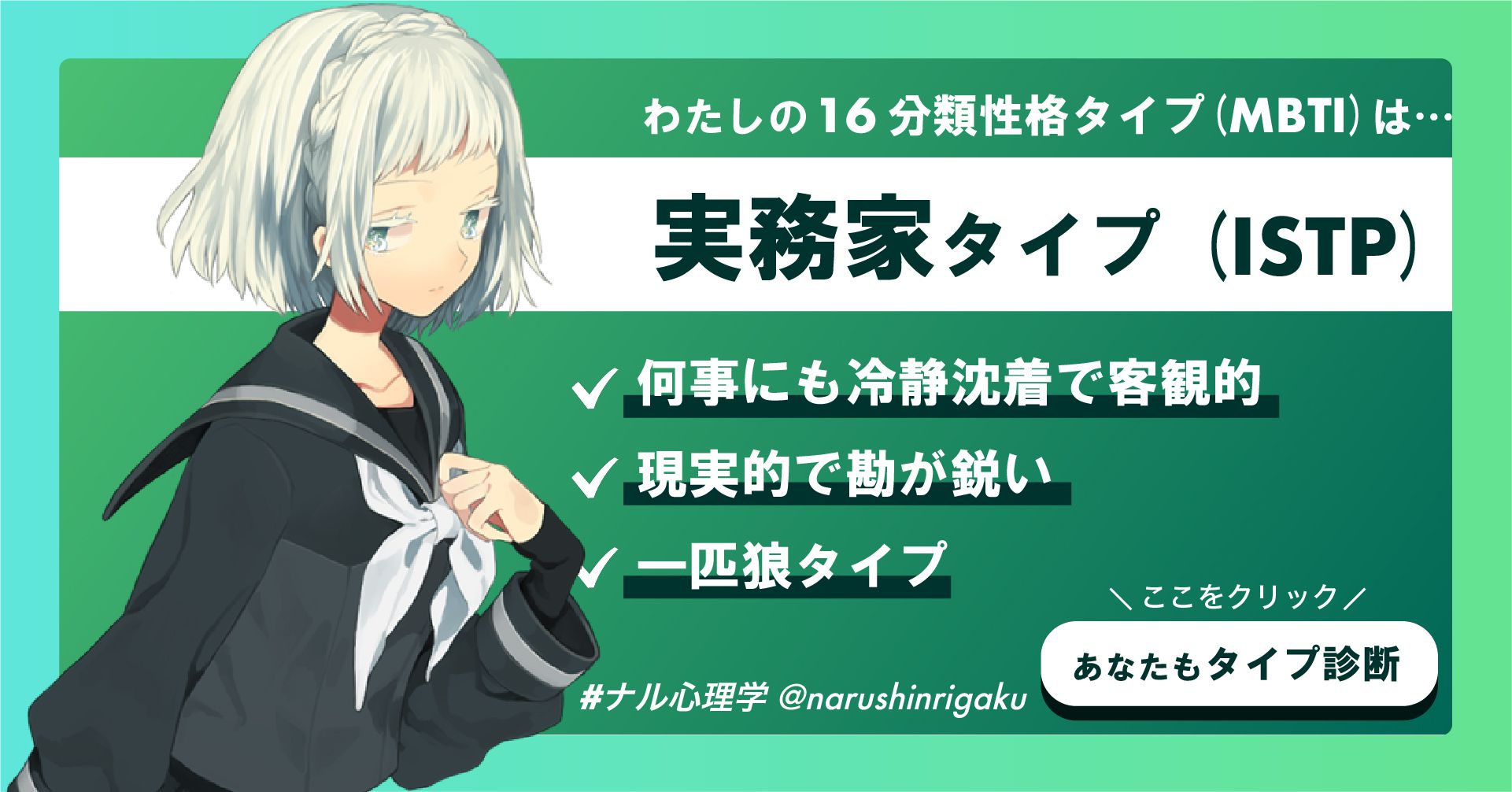
On this page, out of the 16 types,ISTP (Master/Practitioner Type)This article explains their personality, characteristics, values, and views on love.
youISTP (Master/Practitioner Type)Then
Share it on social media (tweet it) and let your followers know!

↓↓↓Share on social media (tweet)↓↓↓
↑↑↑Share on social media (tweet)↑↑↑
Classifying personalities into 16 types16-Type Personality TestCheck which type you are using the following↓↓
↑16-Type Personality Test↑
↑Diagnose↑
Your 16-type personality test result is...
"ISTP type (Practitioner type)"
Detailed diagnosis results ↓
Let's get straight to your diagnosis results.
Share it on social media (tweet it) and let your followers know!
↓↓↓Share on social media (tweet)↓↓↓
↑↑↑Share on social media (tweet)↑↑↑
Your type,ISTP (Practitioner type)This explains their personality, characteristics, values, and views on love.


- Famous people, historical figures, and anime characters who are ISTP (Master/Practical Type)
- Characteristics of the ISTP (Master/Practitioner Type) personality
- Hobbies and interests of the ISTP (Master/Practitioner type)
- Interesting facts about ISTP (Master/Practitioner type)
- Further characteristics of the ISTP (Master/Practitioner type) and compatibility with other types
- ISTP (Master/Practitioner type) as a child
- The values and motivations of the ISTP (Master/Practitioner type)
- What is the opposite type of personality to the ISTP (Master/Practitioner type), the ENFJ (Protagonist/Collaborator type)?
- Similar to ISTP (Master/Practitioner type)
- Instructions for ISTP (Master/Practitioner Type)
Famous people, historical figures, and anime characters who are ISTP (Master/Practical Type)
ISTP is the third most common personality type among men and the fourth least common among women. The proportion of ISTPs is as follows:
- population1 in 20 people(5%)
- men1 in 11 people(9%)
- women1 in 50 people(2%)
ISTPTo give you a sense of what kind of type it is,ISTP (Master/Practitioner Type)Let me introduce the characters.
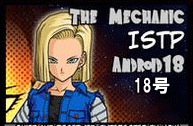
Famous anime characters from Dragon Ball, Studio Ghibli, and more are categorized into 16 personality types!
Let's get a feel for the unique atmosphere of each type ↓
youISTP (Master/Practitioner Type)Then
Share it on social media (tweet it) and let your followers know!
↓↓↓Share on social media (tweet)↓↓↓
↑↑↑Share on social media (tweet)↑↑↑
Here you can find famous people, psychologists, philosophers, and quotes for all 16 personality types.
↓
Other famous people, great figures, and characters who are ISTPs (Masters/Practitioners).↓
- Roronoa Zoro (One Piece)
- Miyamoto Musashi (swordsman)
- Ichiro (baseball player)
- The 14th Dalai Lama (Priest of Tibet)
- Tom Cruise (actor)
- Bruce Lee (actor)
- Kim Yuna (figure skater)
- Sunggyu (INFINITE)
- Clint Eastwood (actor)
- Zachary Taylor (President of the United States)
- Alan Shepard (astronaut)
(Estimated by the author)
Characteristics of the ISTP (Master/Practitioner Type) personality
ISTPs are skilled craftsmen who are adept at mechanics and interested in repairing malfunctions. They think flexibly and approach tasks on-site while seeking practical solutions. Independent and adaptable, they usually try to engage with those around them in their own way. They are highly independent and adaptable, and proactively seek to interact with others.
ISTPs are attentive to detail and capable of meeting the expectations of those around them. They have a good grasp of their surroundings, allowing them to act quickly and excel at spontaneous responses and emergency situations. While reserved, they are not shy. They cherish the physical and sensory experiences that surround them and enjoy taking initiative.
ISTPs are highly likely to excel when given the opportunity to understand how things work. They enjoy taking things apart, putting them back together, and getting their hands dirty. This type loves jobs that allow them to delve deeper into complex matters.
Their success stems from their ability to pursue new opportunities when they want to, without being bound by a strict schedule. They have impulsive personalities and dislike being tied down by formal routines or schedules.
I love going on adventures and experiencing new things. However, I prefer to act alone or with one or two close friends rather than in large groups. Whether it's a new restaurant, a concert, or a new job, ISTPs never miss an opportunity.
ISTPs enjoy finding practical solutions to troublesome problems. This type prefers to tackle the problem at hand rather than spending time thinking about what should be done. They tend to find the best solution by actually trying out many options.
reference
・ISTP personality trait: "Try everything at least once." ~ How do gender differences affect the lives of ENTPs? ~
・A personality guide for the ISTP (Master/Practitioner type)
First impression of an ISTP (Master/Practitioner type)
"He may seem cool on the outside, but he has a passionate side that some people might notice. He seems to have a lot of interests, but he comes across as steady and grounded. He's also diligently trying to improve his life little by little. He might seem a little shy or unfriendly at times, but when he asks questions, he can ask them accurately. He's very talkative and easy to get along with, even on the first meeting."
Strengths and weaknesses of the ISTP (Master/Practitioner type)
Strong Points
- The ability to think and act logically
- We can learn from experience.
- Emphasis on taking action
- Being able to approach things in a realistic and practical way
- Enjoying new things you're doing for the first time
- They are confident and generous.
Disadvantages
- They can be difficult for others to approach.
- They can be insensitive and lack consideration for others.
- I get bored easily
- Sometimes we take too many risks.
- They are (excessively) averse to making promises or taking on responsibility.
Continue →Strengths and weaknesses of the ISTP (Master/Practitioner type)
Hobbies and interests of the ISTP (Master/Practitioner type)
My interests include magic, comedy, archery, weapons, hunting, scuba diving, rappelling, airplanes, skydiving, motorcycles, and other extreme sports. I am drawn to dangerous and thrilling activities, as well as operating machinery.
Continue →Hobbies of ISTP (Master/Practitioner type)
Interesting facts about ISTP (Master/Practitioner type)
- In personality assessments, they are described as critical, detached, cautious, independent, and resourceful.
- This is often seen in male college scholarship athletes.
- Compared to other types, they are more likely to have heart problems (due to stress).
- Of the 16 personality types, this type has the lowest ability to cope with social stress.
- This is one of the four types of people who are least satisfied with their marriage or romantic relationships.
- Of the 16 types, this one has the lowest probability of graduating from university.
- My personal values are "autonomy and self-reliance," while in my work, I prioritize "stability," "safety," "independence," and "achievement."
- In terms of occupation, it is common in skilled trades, technical fields, agriculture, law enforcement, and military-related fields.
Further characteristics of the ISTP (Master/Practitioner type) and compatibility with other types
- The ISTP (Master/Practitioner type) personality trait: "Try everything at least once." ~ How do gender differences affect the lives of ENTPs? ~
- A guide to the ISTP personality type
- ISTP's hobbies
- Things that ISTPs dislike
- Strengths and weaknesses of the ISTP personality type
- Suitable occupations for ISTPs
- ISTP leadership
- Compatibility between ISTP and other types
- ISTP and Relationships
- ISTP and love
- How ISTPs set goals and gather information.
- ISTP's Decision-Making Methods
- ISTP parent-child relationships
- For ISTPs to succeed
↓Learn more↓
ISTP (Master/Practitioner Type)Compatibility chart and advice for other types
Ideal compatibility type pair
ISTPs are compatible with people who possess common sense, value logic, and can think realistically and practically.
From an ISTP's perspective...
- ISTJ (Hardworking Type):Si – Te, to think about things in a practical and realistic way
- ENTP (Inventor Type):Ne – Ti, the ability to make logical and coherent reasoning to realize an idea.
- ISFP (Artist type):Fi – SeThey think about things realistically, but also respect freedom.
Type pairs that are prone to conflict
ISTPs tend to clash with idealistic, conceptual people who don't have a realistic or common-sense perspective.
From an ISTP's perspective...
- ENFJ (Collaborator Type):Fe – NiThey act based on their own sense of ethics and ideals, but reality doesn't operate on ideals alone, so in reality they accomplish nothing.
Romantic compatibility type pair
ISTPs tend to be romantically compatible with people who are good at navigating social situations (those with a realistic perspective on the world) or those who can provide a sense of security even in difficult circumstances.
From an ISTP's perspective...
- ESTP (Adventurer type):Se – TiHe is a realist who thinks about things from a practical perspective.
- ENTP (Inventor Type):Ne – TiIt's a way of thinking that can actually be used and applied in various ways.
- ENFJ (Collaborator Type):Fe – NiEven in difficult situations, it somehow provides a sense of reassurance.
*The pairs that tend to clash and the pairs that have good romantic compatibility may overlap. This is because while people may dislike those who are the complete opposite of themselves due to disagreements, they may also be attracted to those who appear mysterious because they are different. However, it seems that these relationships often end up breaking down.
(Advice for those dating an ISTP)
reference ISTP (Master/Practical Type) and Romance
Because ISTPs live in the present moment, maintaining long-term relationships can be challenging. To deepen your relationship with an ISTP partner, it's important to cherish each day and respect their strong desire for independence.
ISTP (Master/Practitioner Type)A collection of links explaining psychological functions (for those who want to understand how the mind works)
Reading the following roadmap from top to bottom will help you understand the ISTP mindset in a logical order ↓
- Roadmap – ISTP (Practitioner Type) –
- Introduction – What is MBTI?
- Summary of my personality
- Cognition is
- Type-specific cognitive characteristics
- Four personality indicators (psychological tendency axes)
- Conflicts over personality indicators
- “The meaning of the four letters "ISTP"
- First character:Introvert (type I) or extrovert (type E)
- Second character:Intuitive type (N type) or Sensing type (S type)
- Third character:Feeling type (F type) or thinking type (T type)
- 4th character:Perceiving type (P type) or Judging type (J type)
- About psychological functions (cognitive functions)
- What are psychological functions (cognitive functions)?
- The eight psychological functions (cognitive functions)
- Decision-making (judgment) function
- Information gathering (perceptual) function
- Understanding your own psychological functions (cognitive functions)
- The developmental process of psychological functions (cognitive functions)
- Psychological functions (cognitive functions) of ISTPs
- First function:Introverted Thinking (Ti)
- Second function:Extroverted Sensing (Se)
- Third function:Introverted Intuition (Ni)
- Fourth function:Extraverted Feeling (Fe)
- Making good use of psychological functions (cognitive functions)
- Strengths and weaknesses of the ISTP personality type
- Make the most of your strengths
- Reasons for focusing too much on the advantages
- How to improve your weaknesses
- If you are alone
- In a team setting: Have others compensate for your weaknesses (fourth function).
ISTP (Practitioner type)To truly understand this,Psychological functions (cognitive functions)* is important ↓
*Generally in cognitive science,Cognitive functions「The function by which living organisms actively collect external information, perceive and remember it, and then process it by adding reasoning and judgment in order to acquire knowledge about their subject.It is defined as "
List of articles related to ISTP (Master/Practitioner type)
- Psychological functions of ISTP
- “The meaning of the four letters "ISTP"
- Psychological functions (cognitive functions) of ISTPs
- Integration of the ISTP's second and third functions
- The difference between extroverted thinking (Te) and introverted thinking (Ti)
- The difference between introverted thinking (Ti) and extroverted thinking (Te) [Part 2]
↑Learn more↑
ISTP (Master/Practitioner type) as a child
ISTP children are often seen by people of other personality types as constantly causing trouble because they want to understand how machines and other things work and end up taking them apart, or they try to do something they want to do without getting permission.
As for hobbies, I tend to be interested in motorcycles, and I enjoy both riding and repairing them. This often causes concern for my family.
Continue →What if an ISTP (Practical Type) was a parent or child...?
The values and motivations of the ISTP (Master/Practitioner type)
ISTPs are interested in how the world around them works and have an excellent ability to skillfully use tools and equipment. They tend to study how things work and are often proficient in using and operating machinery, instruments, and devices.
This type seeks practical expertise that can be used immediately and quickly loses interest in abstract theories and theoretical concepts. They tend to be calm and composed, and prefer machines to complex human emotions.
ISTPs are independent and reserved, valuing their private space and wanting to do things freely and at their own pace. They are selective about the relationships they have and cherish people who allow them the freedom to do what they want.
reference Things that ISTPs (masters/practitioners) dislike
youISTP (Master/Practitioner Type)Then
Share it on social media (tweet it) and let your followers know!
↓↓↓Share on social media (tweet)↓↓↓
↑↑↑Share on social media (tweet)↑↑↑
What is the opposite type of personality to the ISTP (Master/Practitioner type), the ENFJ (Protagonist/Collaborator type)?
ISTP (Master/Practitioner Type)The opposite type is,ENFJ (Protagonist/Collaborator type)is.ISTP (Practitioner type)He is calm, composed, and logical,ENFJ (Collaborator Type)He is very kind-hearted and emotional.
For example, Master Roshi from Dragon Ball or Tanjiro from Demon SlayerENFJ (Collaborator Type)This is my type (estimated by the author).

You can read previews of each manga at the Amazon links below, so please take a look if you're interested ↓
Similar to ISTP (Master/Practitioner type)
- ESTP: E (extrovert) and I (introvert) But they are different.
- INTP: N (Intuitive type) and S (Sensing type) But they are different.
- ISFP: T (thinking type) and F (feeling type) But they are different.
- ISTJ: J (Judgment type) and P (Perception type) But they are different.
If you're not confident that you're an ISTP, you might be one of the four types mentioned above. Read the article or take some time to think about it again.diagnosisLet's try it.
Instructions for ISTP (Master/Practitioner Type)
If your friends, colleagues, or family members are ISTPs, there are things you can do to communicate with them more effectively and deepen your relationships.
*If you are an ISTP, showing this guide to your friends and family may help improve your relationships.
To build good friendships
ISTPs tend to be curious and adventurous, but sometimes they also have a strong desire to be alone. It's good to encourage them to go out and try new things, but if they don't feel like going out, respect their desire to spend time quietly.
Learn more ↓
- Relationships and romance for ISTP (Practical Type)
- How extroverts (Type E) and introverts (Type I) can get along well
- How Sensing types (S type) and Intuitive types (N type) can get along well
- How Thinking (T-type) and Feeling (F-type) People Can Get Along Well
- How to get along well with Judging type (J type) and Perceiving type (P type)
To build a good parent-child relationship
Parents of ISTP children are well aware of their child's independent and adventurous nature. Providing safe and healthy opportunities is crucial for fostering their self-confidence. Rules and guidance are necessary, but be careful not to be overprotective. Create plenty of opportunities for experiential learning, outdoor adventures, and learning about and experimenting with how things work.
Learn more ↓
- Parent-child relationships of ISTP (Practitioner type)
- Parent-child relationships between extroverts (Type E) and introverts (Type I)
- Parent-child relationships between sensing types (S-type) and intuitive types (N-type)
- Parent-child relationships between thinking types (T-type) and feeling types (F-type)
- Parent-child relationships between judging types (J type) and perceiving types (P type)
List of 16 Personality Types
A Collection of Information on the 16 Personality Types – The Little-Known Truths of Each Type (Summary, Illustrations, and Analysis)
- Summary of 16 Personality Type Test Websites
- List of articles categorized by personality type (16 types)
- Compatibility chart for 16 personality types
- Suitable occupations, ideal jobs, and dream jobs for each of the 16 personality types
- Nicknames (names) for each of the 16 personality types
- What if there were a country with 16 personality types...?
- The relationship between national characteristics around the world and the 16 personality types
- List of 16 Personality Types Based on Famous Characters
- Detective Conan: A Summary of 16 Personality Types for Each Character
- Percentage of 16 personality types
- Reactions of 16 Personality Types – Heaven and Hell
- To describe the 16 personality types in one word:
- 16 Simple Explanations of Personality Types
- 16 Personality Types: Strengths, Weaknesses, and Ways to Improve Weaknesses
- 16 Personality Types: Preferences and Strengths/Weaknesses in Majors and Subjects
- 16 Personality Types: How to Enjoy Life to the Fullest…?
- 16 Personality Types: Inspiring Quotes from Great Figures
- What if each of the 16 personality types were a murderer?
- How to become an attractive husband or wife based on your personality type (16 types)
- What 16 personality types do after a breakup
- Reasons for fighting according to 16 personality types
- Income by 16 Personality Types - Misconceptions and Truths -
- Characteristics of employees based on 16 personality types
- Potential pathological tendencies of 16 personality types
- Psychological Functions of 16 Personality Types Based on Statistics
- Viewing percentage of the detailed personality pages for each of the 16 personality types
- Summary of the characteristics of the 16 personality types
- 8 psychological functions: "What if I did...?"
- Approaches to tasks based on psychological function: Intuitive (N-type) & Sensing (S-type)
- Social interaction explained by psychological functions
- Understanding Your Financial Habits Through Psychological Functions – Are You a Saver or a Spender?
- Humor (sense of humor) as revealed by psychological functions
- How extroverts (Type E) and introverts (Type I) can get along well
- How Sensing types (S type) and Intuitive types (N type) can get along well
- How Thinking (T-type) and Feeling (F-type) People Can Get Along Well
- How to get along well with Judging (J-type) and Perceiving (P-type) types
- Characteristics of parents with 16 personality types
- Parent-child relationships between extroverts (Type E) and introverts (Type I)
- Parent-child relationships between sensing types (S-type) and intuitive types (N-type)
- Parent-child relationships between thinking types (T-type) and feeling types (F-type)
- Parent-child relationships between judging (J-type) and percepting (P-type) types
- How to identify your partner's personality type: [16 Personality Types]

comment
I found it very interesting to read. It was written in detail and was extremely fascinating.
By the way, isn't the description of ISTP personality traits actually describing ISTJ? The cognitive function diagram also appears to be for INTP.
I apologize if I've misread something, but I would appreciate it if you could double-check just to be sure. Thank you.
I'm the administrator.
Thank you for pointing that out.
As you pointed out, both articles in this article contained incorrect information.
We sincerely apologize for publishing incorrect information due to our carelessness.
We have now replaced the information with the correct ISTP content, so please check it.
We look forward to your continued support of Nar Psychology.
Thank you so much for the quick corrections. There were so many points that applied that it was almost funny (though there might be some wishful thinking mixed in there too?).
I'll try to read through the parts that aren't directly relevant to me, little by little. Thank you very much!
I'm glad it was helpful!
Taki, the protagonist of the movie "Your Name,"
They're also said to be the same ISTP type (though I'm not certain...).
If you found this article helpful, please share it using the social media sharing buttons below the title (Twitter, etc.).
Your support is very encouraging, so thank you very much! ✨